
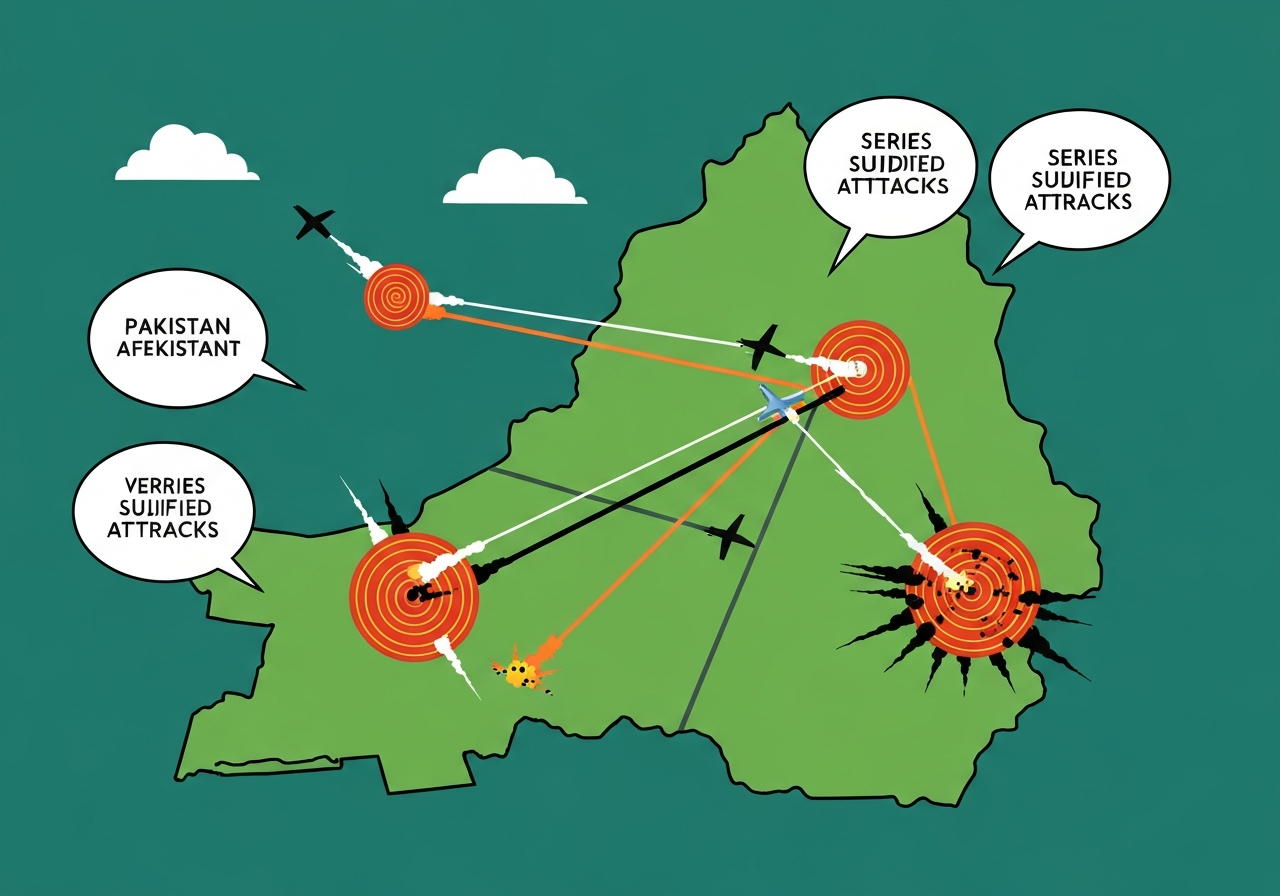
— Pakistan’s military launched air strikes into eastern Afghanistan on Sunday, saying it targeted camps and hideouts linked to groups behind recent suicide attacks, including the 6 February bombing at a Shia mosque in Islamabad. Afghanistan’s Ministry of Defense said the strikes struck a religious school and residential homes in Nangahar and Paktika provinces, causing dozens of deaths and injuries, including among women and children. Afghan sources reported at least 17 people killed in Nangahar. The moves have put a fragile, Qatar-mediated ceasefire and recent diplomacy between the neighbours under renewed strain.
Key takeaways
- Pakistan reported intelligence-based air operations striking seven camps and hideouts in Nangahar and Paktika on 22 February 2026, naming Tehrik-e-Taliban Pakistan (TTP) and an Islamic State affiliate as targets.
- Afghan officials say the strikes hit a religious school and residential homes, producing “dozens” of casualties; local sources put at least 17 dead in Nangahar.
- The strikes followed a string of lethal attacks: a 6 February Islamabad mosque bombing that killed at least 31 and wounded about 170, a vehicle-borne attack in Bajaur that killed 11 soldiers and one child, and a Bannu convoy bombing that killed two soldiers.
- Pakistan’s Information Ministry said it has “conclusive evidence” linking recent attacks in Islamabad, Bajaur and Bannu to Afghanistan-based handlers; the Taliban-led Afghan government rejects those charges.
- Officials warn the strikes risk undoing a ceasefire mediated on 19 October 2025 after deadly border clashes; talks in Istanbul since then did not produce a binding settlement.
- Both capitals framed their actions as security necessities: Pakistan prioritised citizen safety; Afghanistan condemned the strikes as breaches of international law and vowed a measured response.
Background
Cross-border violence between Pakistan and Afghanistan has risen since the fall of the previous Afghan government and the reshaping of armed groups across the border. Pakistan has long accused TTP elements of using Afghan territory as sanctuary to plan and execute attacks inside Pakistan; the TTP denies centralized control from across the border. Separately, Islamic State-Khorasan Province (ISKP) has claimed responsibility for high-profile urban bombings, including the 6 February attack on a Shia mosque in Islamabad that left at least 31 dead and roughly 170 wounded.
In October 2025, fierce clashes along the border killed dozens of soldiers, civilians and suspected fighters on both sides and prompted Qatari mediation. A ceasefire declared on 19 October has largely held, but follow-up talks in Istanbul failed to resolve core issues, including mutual accusations of cross-border militancy and responsibilities under the 2020 Doha-era assurances the Taliban signed to prevent cross-border attacks. Those unresolved frictions set the stage for Sunday’s escalation.
Main event
On 22 February 2026 Pakistan’s Ministry of Information and Broadcasting said its military conducted “intelligence-based, selective operations” against seven camps and hideouts it attributed to TTP and affiliates, and against an IS affiliate in the border region. The statement framed the strikes as responses to recent suicide bombings and attacks in Islamabad, Bajaur and Bannu. Pakistan reiterated that it had repeatedly urged the Afghan authorities to act against armed groups using Afghan soil.
The Afghan Ministry of Defense, however, described the strikes as unlawful strikes on civilian structures, saying they hit a religious school and residential homes in Nangahar and Paktika provinces and caused dozens of deaths and injuries, including women and children. Afghan local sources told reporters at least 17 people died in Nangahar alone. Kabul’s statement labelled the attacks a breach of international law and warned of a measured response.
The strikes followed a week of bloody incidents inside Pakistan: in the Bannu district, a suicide bomber killed two soldiers including a lieutenant colonel; in Bajaur a vehicle-borne suicide attack with gunmen killed 11 soldiers and a child, with authorities later saying the attacker was an Afghan national. Pakistani authorities had linked those attacks and the 6 February Islamabad mosque bombing — attributed by Islamic State to ISKP — to handlers based in Afghanistan.
Officials in Islamabad stressed the operations were selective and aimed at militant infrastructure, while Kabul emphasised civilian harm and the targeting of religious and residential sites. The sequence of events has prompted concern among neighbouring states and mediators who helped negotiate the October ceasefire.
Analysis & implications
The strikes deepen a cycle in which cross-border attacks and retaliatory strikes feed mutual distrust. Pakistan frames its actions as self-defence and an operational necessity to disrupt planning networks; Kabul frames them as violations that erode sovereignty and endanger civilians. That dichotomy complicates diplomatic avenues for de-escalation and coordination on counterterrorism that were already strained after October’s clashes.
Internationally, the strikes risk galvanising criticism if civilian casualties mount — especially given reports of religious schools and homes being hit. For Pakistan, the political imperative to show decisive action after high-profile domestic attacks competes with the strategic cost of further isolating its neighbour or provoking tit-for-tat responses that could destabilise border provinces.
Operationally, Pakistan’s claim of “conclusive evidence” will matter only if evidence is shared and verified by neutral parties; without transparent corroboration, Kabul is unlikely to accept Islamabad’s narrative. That impasse reduces the chance of coordinated intelligence-sharing or joint operations to dismantle transnational networks, allowing groups like TTP and ISKP to exploit the diplomatic gap.
Looking ahead, the most immediate risks are renewed border skirmishes, reprisals by Afghan-based militants, and humanitarian impact in Nangahar and Paktika. The durability of the October ceasefire depends on renewed diplomacy—potentially mediated by Qatar, Turkey or other regional actors—and on tangible steps by Kabul to restrain armed groups and by Islamabad to limit civilian harm in its countermeasures.
Comparison & data
| Event | Date | Reported fatalities | Reported injuries |
|---|---|---|---|
| Islamabad mosque bombing (Khadija Tul Kubra) | 6 Feb 2026 | 31 | ~170 |
| Bajaur security post attack | Early Feb 2026 | 11 soldiers + 1 child | Not specified |
| Bannu convoy bombing | Prior to 22 Feb 2026 | 2 soldiers | Not specified |
| Pakistan air strikes (Nangahar, Paktika) | 22 Feb 2026 | Dozens (at least 17 in Nangahar) | Dozens |
The table aggregates reported counts from Afghan officials, local sources and Pakistani statements. Variations between official tallies and local reporting are common in fast-moving cross-border incidents; independent verification by neutral observers is limited in the immediate aftermath.
Reactions & quotes
We conducted intelligence-based, selective operations against seven camps and hideouts linked to groups responsible for recent attacks, taking steps to protect Pakistani citizens.
Pakistan Ministry of Information and Broadcasting (official statement)
These strikes targeted civilians and religious sites. We hold the Pakistani military responsible and will respond in due course with a measured and appropriate response.
Afghan Ministry of Defense (official statement)
Unconfirmed
- The precise civilian-versus-combatant casualty breakdown from the 22 February strikes has not been independently verified.
- Pakistan’s claim of “conclusive evidence” linking the 6 February Islamabad bombing and other attacks to Afghanistan-based handlers has not been publicly substantiated with material shared for independent review.
- The extent to which Afghanistan’s de facto authorities directed or sheltered the specific cells accused by Islamabad remains unresolved and under investigation.
Bottom line
The 22 February strikes mark a significant escalation that risks unraveling an already fragile ceasefire and complicates regional diplomacy. Pakistan frames the action as necessary to prevent further high-casualty attacks; Afghanistan frames it as a breach of sovereignty with civilian costs. Without transparent information-sharing and credible third-party verification, mutual distrust will likely deepen, increasing the risk of further violence along the porous border.
International mediators and neighbouring states will be critical in pressing both sides toward de-escalation, verification mechanisms and humanitarian safeguards. Observers should watch for independent casualty assessments, any reciprocal military measures from Kabul, and whether Pakistan publishes the evidence it cites to support its claims.
Sources
- Al Jazeera — international news report summarising statements from both governments and local sources