
Lead
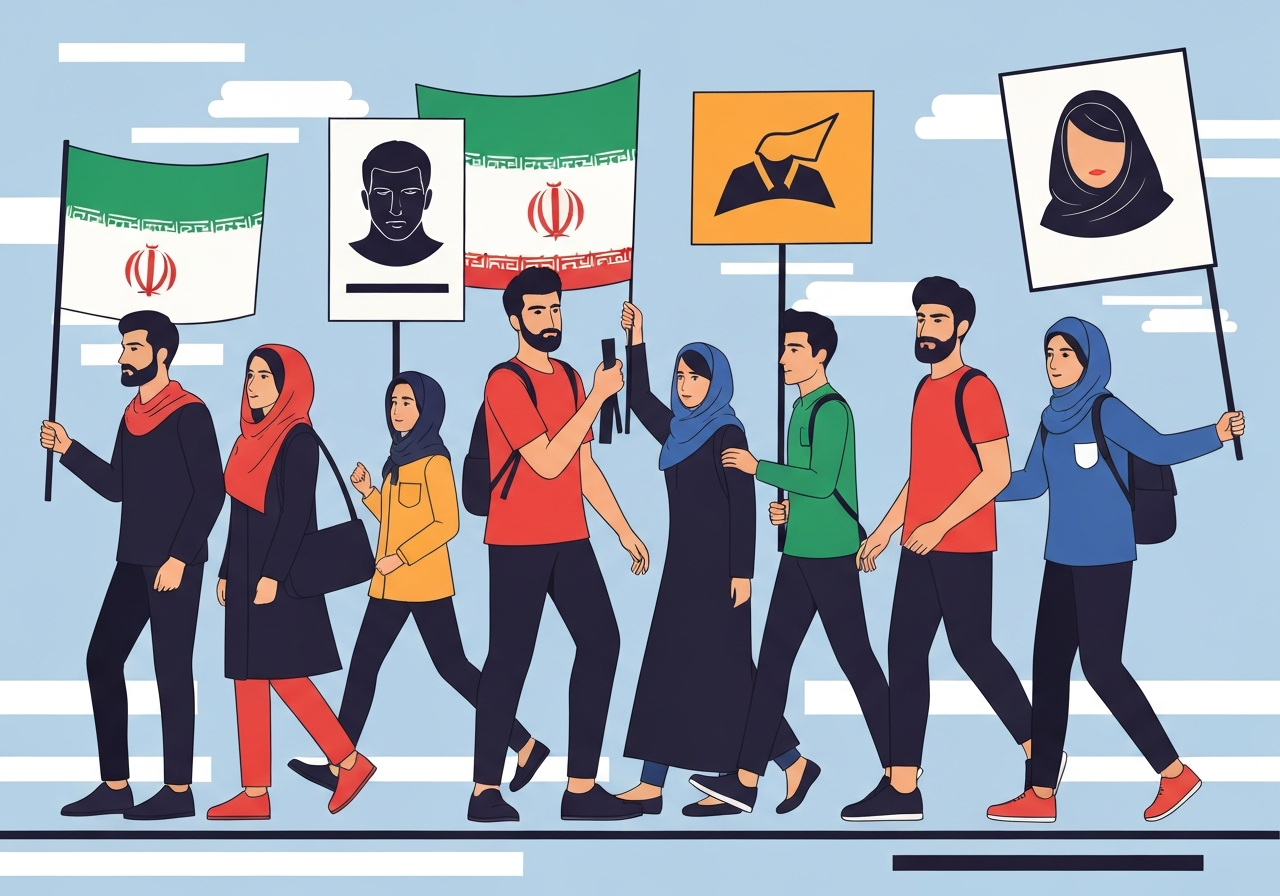
On Feb. 21, 2026, students at multiple Iranian universities — including Sharif and Amirkabir in Tehran and campuses in Mashhad — held demonstrations on the first day of the new semester. Marches and sit-ins, many participants wearing black to mourn those killed in earlier unrest, revived public agitation a month after a lethal government crackdown. Videos verified by independent analysts and reporting by several outlets showed chants and clashes on campuses as authorities and state media described tensions. The protests signaled that student activism, long central to Iran’s political mobilization, remains a focal point even after a heavy security response.
Key Takeaways
- On Feb. 21, 2026, students staged rallies at Sharif University and Amirkabir University in Tehran and at other campuses, marking the semester’s first day.
- Demonstrators at Sharif were filmed chanting “Death to the dictator,” a reference to Supreme Leader Ayatollah Ali Khamenei, while some groups at Amirkabir called to target “the entire system.”
- The Iranian government has said more than 3,000 people were killed in the January crackdown; rights groups report at least 7,000 deaths, a discrepancy that remains unresolved.
- State broadcasters described campus gatherings as tense and said some events began as sit-ins that escalated; student groups reported arrests at Amirkabir, which state-linked agencies disputed.
- Students and bazaari merchants helped expand earlier protests into a nationwide movement before the January suppression, and campuses have been repeatedly targeted by security operations historically.
- Open-source video verification and reporting on Feb. 21 confirmed on-the-ground demonstrations but showed varying accounts of scale and clashes between opposing groups.
Background
University students have been central actors in Iranian political movements for decades, dating to the 1979 revolution and recurrent waves of campus dissent since. Campuses are seen both as incubators of political activism and as sensitive sites for the state, which has repeatedly used policing, arrests, and academic bans to limit student organizing. The unrest that erupted last season spread from initial protests into broader civic and economic sectors, including Tehran’s bazaars, amplifying pressure on the clerical establishment.
The government’s January response was one of the most severe in Iran’s modern history: official statements cite more than 3,000 fatalities, while several rights organizations and monitoring groups place the toll far higher. That scale of violence — concentrated over a few nights in early January, according to multiple reports — has left a deep imprint on public sentiment and raised international human rights concerns. As the new academic term opened, authorities faced the delicate task of reasserting control on campuses without provoking fresh nationwide mobilization.
Main Event
On the morning of Feb. 21, footage verified by independent analysts and shared by student groups showed large gatherings at Sharif University and Amirkabir University in Tehran. Many participants wore black, a visible sign of mourning for those killed during the January crackdown, and groups moved through campus grounds chanting slogans critical of the leadership. At Sharif, videos show chants of “Death to the dictator,” while at Amirkabir a Telegram post from a student group quoted protesters saying “our target is the entire system.”
State-affiliated broadcasters characterized events differently, saying a sit-in at Sharif escalated into chanting and that tensions were short-lived and contained. At Amirkabir, student organizers reported that police had blocked the university entrance and that several students were detained; the semiofficial Tasnim agency and other state outlets denied mass arrests. Independent verification of arrests on Feb. 21 remains incomplete, with conflicting on-the-ground accounts and limited access for outside observers.
Demonstrations were also reported at Shahid Beheshti University in Tehran and at a university in Mashhad in the northeast, according to campus groups. Some video clips showed moments of disorder — apparent push-and-shove between pro- and anti-protest groups — suggesting contested spaces on campus rather than uniformly peaceful marches. Security forces and university administrators restricted movement at several campuses, and social-media traffic related to the protests was intermittently visible amid broader platform disruptions reported during the period.
Analysis & Implications
Student protests are strategically significant in Iran because universities concentrate young, politically engaged citizens and produce narratives that ripple outward through families, workplaces and online networks. The re-emergence of campus demonstrations signals that the grievances fueling earlier unrest — over political freedoms, economic strain and state violence — remain unresolved. Even if campus actions are smaller than the nationwide waves earlier in the year, they can act as catalysts for wider mobilization if met with heavy-handed suppression.
The divergence between official death figures and counts from rights groups undermines the government’s narrative of proportional response and complicates international engagement. If the higher rights-group figures are substantiated as verification continues, diplomatic pressures and human rights scrutiny are likely to intensify, potentially affecting Iran’s regional posture and economic relations. Conversely, Tehran’s framing of incidents as isolated or short-lived could be intended to limit domestic panic and international censure.
For security planners inside Iran, campuses pose a persistent dilemma: tight control risks provoking renewed unrest; leniency may permit organizing to rebuild. The pattern of arrests, prosecutions and academic sanctions the state has used historically creates chilling effects but can also deepen grievances that motivate clandestine organizing. International observers will watch both subsequent campus schedules and university disciplinary measures for signs of whether the movement is reconstituting or being contained.
Comparison & Data
| Source | Claimed Death Toll |
|---|---|
| Iranian government (official statements) | More than 3,000 |
| Human Rights Activists News Agency and other rights groups | At least 7,000 (and rising as verifications proceed) |
The table highlights a substantial gap between state and rights-group tallies from the January crackdown. Independent verification is ongoing; the discrepancy affects both domestic legitimacy and international responses. Accurate, transparent accounting remains central to any reconciliation process and to assessing the proportionality of the authorities’ actions. Researchers caution that casualty verification in such contexts is slow and may shift as investigations, witness interviews and forensic reviews proceed.
Reactions & Quotes
Officials and different observers framed the campus events in competing ways, reflecting the polarized information environment.
“A silent sit-in turned into a gathering and chanting of subversive slogans; tensions were limited and short-term,”
Islamic Republic of Iran Broadcasting (state media)
This statement reflects the official line that campus incidents were contained and brief. State media sought to emphasize order and to downplay the scale of student action, while portraying demonstrators’ slogans as subversive.
“Our target is the entire system,”
Student group post (Amirkabir University)
The slogan circulated on student channels underscores the political breadth of demands voiced by some campus groups. Organizers used encrypted and semi-public messaging platforms to coordinate and to report arrests, shaping outside perceptions of the events.
Unconfirmed
- Precise number and identities of students detained at Amirkabir on Feb. 21 remain unverified by independent monitors.
- The full scale of clashes between opposing groups on campus and the extent to which those were organized are not independently confirmed.
- Final, independently corroborated casualty figures from the January crackdown are still pending and may change as verification continues.
Bottom Line
The reopening of Iran’s universities on Feb. 21, 2026, brought students back into visible opposition, reminding observers that campuses remain a central arena for political contestation. While state media described events as contained, student organizers and independent video verification show rallies, chants and localized clashes that kept political grievances in public view. The unresolved disparity in casualty figures from January and the unsettled question of arrests mean that the situation can evolve quickly.
Policymakers, human rights monitors and university communities will be watching subsequent academic schedules, administrative disciplinary actions and any travel or communications restrictions as indicators of whether the movement recedes or regenerates. For readers, the key things to watch are credible casualty verification, transparent reporting on detentions, and whether campus activism spreads beyond symbolic actions to broader civic disruption or sustained organizing.
Sources
- The New York Times — (international news reporting; visual verification referenced)
- Islamic Republic of Iran Broadcasting (IRIB) — (state media)
- Tasnim News Agency — (semi-official news agency)
- Human Rights Activists News Agency (HRANA) — (rights monitoring group)