
Lead
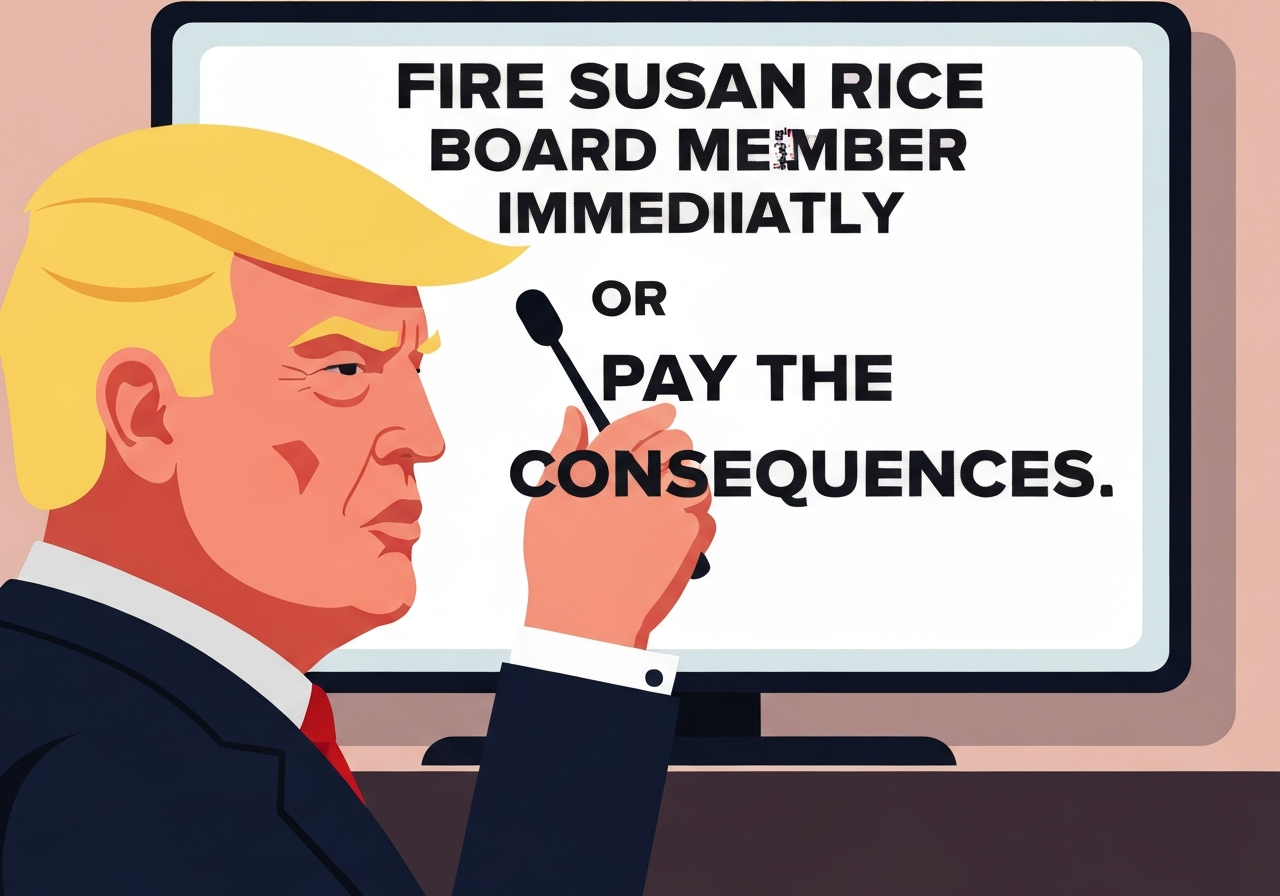
President Donald Trump on Saturday urged Netflix to remove board member Susan Rice, posting that the company should act “immediately, or pay the consequences.” The comment accompanied a screenshot of a social post that criticized Rice’s remarks on accountability for corporations in a November 2024-era podcast interview. Rice, a former U.S. National Security Advisor (2013–2017) and Domestic Policy Advisor (2021–2023), had discussed potential legal and political scrutiny of companies following elections. The episode has now become the focal point of a heated public exchange involving the president, a right-wing activist, and media coverage of a possible industry merger.
Key Takeaways
- On Saturday, President Trump posted on Truth Social calling for Netflix to fire board member Susan Rice or face unspecified “consequences,” repeating charged language and questioning her qualifications.
- Trump’s post included a screenshot of an X post by activist Laura Loomer that reacted to Rice’s appearance on the Stay Tuned with Preet podcast.
- Susan Rice told host Preet Bharara she expects an “accountability agenda” that could include subpoenas and document preservation for companies if Democrats win certain future elections.
- Laura Loomer framed Rice’s comments as a threat and tied them to concerns about a potential Netflix–Warner Bros. deal and the influence of Higher Ground Productions.
- In early February, Trump said he had not intervened in the competition to acquire Warner Bros. Discovery and that the Justice Department would handle antitrust issues.
- Rice’s public roles are factually recorded: National Security Advisor (2013–2017) and Domestic Policy Advisor (2021–2023); she currently serves on Netflix’s board.
Background
The exchange began after Susan Rice appeared on the Stay Tuned with Preet podcast, where she discussed how companies that took short-term corporate positions in the wake of Donald Trump’s presidency might face scrutiny if political control shifts. Rice warned companies to preserve records and be prepared for subpoenas if wrongdoing is alleged. That interview was quickly amplified by right-wing commentators and activists who characterized her remarks as partisan pressure on corporations.
Laura Loomer, a far-right activist and social media figure, reposted a clip and commentary linking Rice’s interview to fears about content and messaging if large media transactions — including a potential Netflix–Warner Bros. consolidation — move forward. Loomer framed the issue around alleged ideological influence and potential market concentration, themes common in post-election corporate-politics debates.
Main Event
On Saturday, President Trump shared Loomer’s social post on Truth Social, writing that Netflix “should fire racist, Trump Deranged Susan Rice, IMMEDIATELY, or pay the consequences,” and questioned her compensation and qualifications. The post echoed Loomer’s portrayal of Rice’s podcast comments and amplified pressure on Netflix’s board.
Rice’s original comments on the podcast—summarized by the activist—noted that companies which acted in their perceived short-term self-interest by distancing themselves from Trump may find themselves subject to legal or political accountability if opponents prevail at the ballot box. Rice said officials and litigators could pursue document preservation and subpoenas where appropriate.
Laura Loomer expanded the narrative in her repost, linking Rice’s remarks to the broader debate over media consolidation and accusing Democratic figures and production companies of planning widespread messaging campaigns across streaming platforms should mergers concentrate content ownership. She also named specific political figures and regulatory actors in her post.
Analysis & Implications
The public clash spotlights how corporate governance and board composition have become politicized flashpoints. A board member’s public comments about governance, accountability, or the political environment can be reframed as operational or reputational risk by political actors and activists. Netflix now faces amplified scrutiny not because of an internal governance action but because the board member’s public profile intersects with partisan narratives.
For Netflix, the reputational calculus is complex. Boards routinely include high-profile public servants whose experience with government and public policy is valuable for navigating regulation and international markets. Demands for removal based on political disagreement risk chilling board diversity of experience and could provoke shareholder or governance debates over independence and speech.
On the regulatory front, references to subpoenas and document preservation are procedural, not predictive of guilt. Rice’s language described potential legal steps that follow allegations, not guarantees of enforcement. Still, activists and political actors can turn procedural language into politically charged claims, increasing pressure on companies and complicating merger reviews or antitrust considerations.
Comparison & Data
| Role | Years |
|---|---|
| U.S. National Security Advisor | 2013–2017 |
| Domestic Policy Advisor | 2021–2023 |
| Netflix Board Member | Current (service date not specified) |
The table summarizes Susan Rice’s recent public-service roles and her current board membership. Her government experience is often cited by supporters as expertise in national security and policy; critics interpret that same experience as evidence of political partiality. The specific start date of her Netflix board term is not detailed in public reporting cited in this article.
Reactions & Quotes
President Trump’s post framed the dispute as a demand for personnel action from a private company, elevating the matter beyond commentary into a call for corporate consequence. This approach can mobilize supporters and investors to pressure companies directly or through regulatory channels.
“Netflix should fire racist, Trump Deranged Susan Rice, IMMEDIATELY, or pay the consequences,”
Donald J. Trump (Truth Social)
Rice’s podcast remarks were procedural in tone, describing possible legal mechanisms that might follow if wrongdoing is alleged rather than promising punishment. Observers emphasize that discussing accountability is different from advocating retribution.
“There will be an accountability agenda. Companies already are starting to hear they better preserve their documents. They better be ready for subpoenas,”
Susan Rice (Stay Tuned with Preet)
Laura Loomer’s repost framed Rice’s comments within a broader conspiracy-style narrative about content, mergers, and political messaging, which escalated the story into cultural and market concerns that the president then amplified.
“If the Netflix–Warner Bros. merger is approved… positive messaging of the Democrats’ upcoming witch hunts… would likely be blasted across all streaming services,”
Laura Loomer (X)
Unconfirmed
- Claims that Netflix will imminently remove Rice from the board are unconfirmed; Netflix has not issued a public statement about personnel action at the time of reporting.
- Assertions that the Obamas or Higher Ground Productions would direct a coordinated messaging campaign across streaming platforms via a merger are speculative and lack direct evidence linking content strategy to the alleged coordination.
- Allegations about the specific amount Netflix pays Rice or the details of her compensation were raised in public posts but have not been corroborated by Netflix disclosures in the cited reporting.
Bottom Line
The episode underscores how corporate governance, public service backgrounds, and politics now collide in high-profile ways. A board member’s commentary about legal and political accountability can be reframed as an existential threat by opponents, prompting calls for corporate action that may be more political than managerial.
For Netflix and other large companies, the immediate choice is procedural: respond, stay silent, or issue a clarifying statement. Each option carries risks for reputation, shareholder relations, and regulatory scrutiny. Observers should watch for formal company statements, shareholder inquiries, or regulatory filings that would provide clearer, verifiable developments.
Sources
- The Hollywood Reporter (news media coverage of the exchange)
- Donald J. Trump (Truth Social) (social post cited by the president; social media source)
- Stay Tuned with Preet (Preet Bharara podcast) (podcast interview with Susan Rice)
- Laura Loomer (X) (social post amplifying Rice’s interview; social media source)