
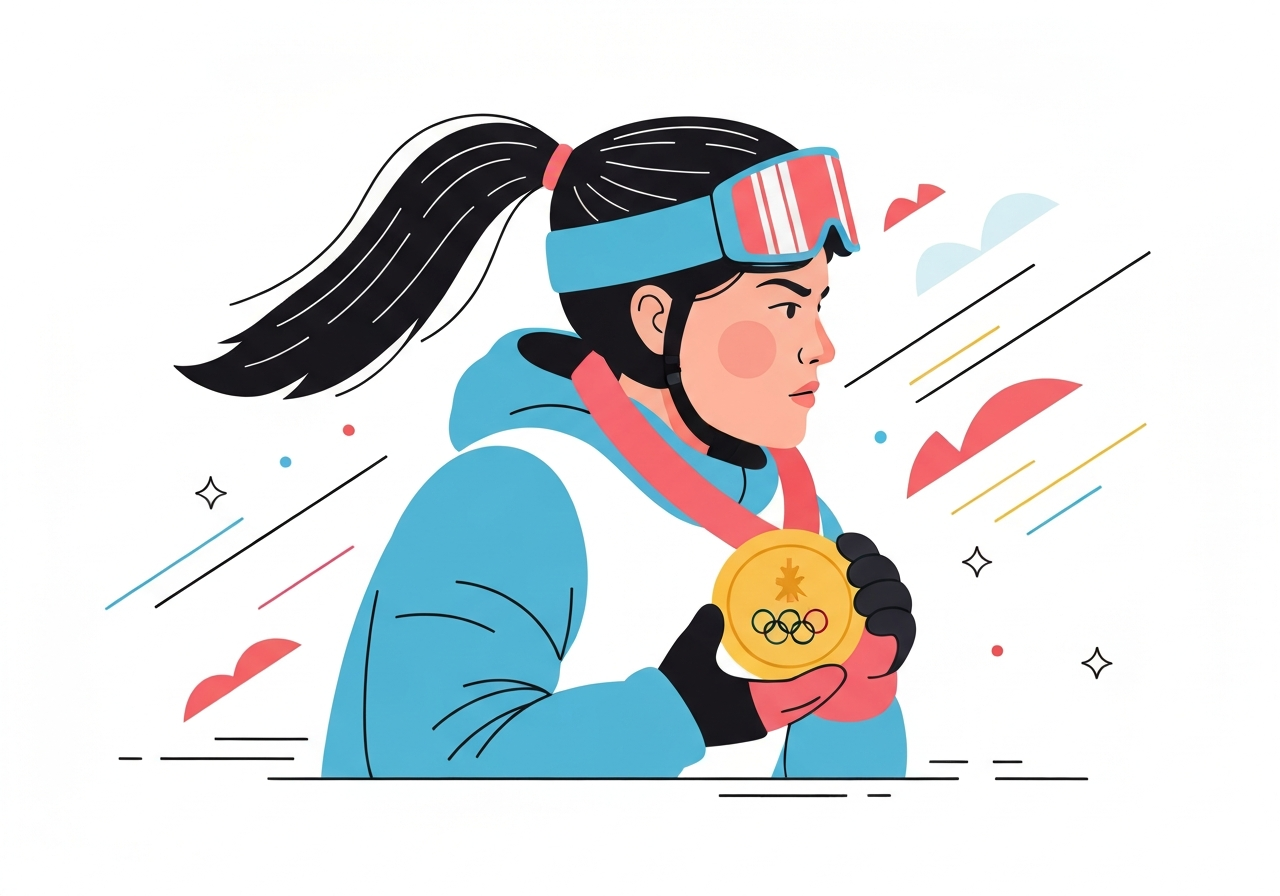
On Feb. 22, 2026 in Livigno, Italy, Eileen Gu successfully defended her Olympic ski halfpipe title, delivering a 94.75 on her final run to capture gold. The 22-year-old, American-born but competing for China, extended a streak that now totals six medals across her Winter Games career. The victory came on a bright, rescheduled Sunday at Livigno Snow Park after heavy snow the night before. Teammate Li Fanghui took silver and Britain’s Zoe Atkin earned bronze.
Key takeaways
- Gu scored 94.75 on her decisive final run to win the halfpipe gold at Livigno on Feb. 22, 2026.
- She is 22 years old and now has six Olympic medals across six events in her Winter Games career.
- Gu’s Olympic tally combines two golds and one silver from Beijing 2022 with two silvers at Milan Cortina 2026 and this Livigno halfpipe gold.
- Li Fanghui of China finished second; Zoe Atkin of Great Britain was third and reached 5.4 meters (18 feet) above the pipe during the contest.
- The event had been postponed to Sunday after a heavy snowstorm; weather cleared and the final ran under bright sun.
- Notable absences or issues included Cassie Sharpe withdrawing from the final after a qualifying crash and Svea Irving recording a DNS in run two before returning and finishing 11th.
Background
Freeski halfpipe is a relatively young Olympic discipline with a fast-rising international profile; top athletes compete across halfpipe, slopestyle and big air events that reward amplitude, technical difficulty and execution. Eileen Gu emerged as a dominant figure after Beijing 2022, where she won multiple medals and helped elevate the sport’s visibility in both China and global markets. At Milan Cortina 2026 she had already collected two silver medals in other events, positioning her as one of the most decorated freestylers at this Games.
Gu’s choice to compete for China while being U.S.-born has been a prominent storyline since 2020, drawing attention from media, sponsors and national federations. The athlete’s results have translated into sponsorship interest and a high media profile, but they have also placed her squarely in conversations about national representation and the fast professionalization of freeskiing. Rivals such as Zoe Atkin and Canada’s Cassie Sharpe remain competitive forces, ensuring a deep field at major events and World Cup stops.
Main event
The final began with an early scare: Gu lost her balance on the first trick of her opening run and cut that attempt short. She recovered in run two with a clean, technically sound pass that placed her back in contention. In the final run she improved further—landing her sequence and pumping her ski poles after the last trick—drawing a 94.75 that topped the leaderboard.
Atkin led after the first run with a smooth performance and produced one of the day’s most eye-catching moments, soaring roughly 5.4 meters (18 feet) above the lip of the pipe on a single hit. She ultimately settled for bronze as Gu and Li put together higher-scoring clean finales. Li Fanghui’s silver reinforced China’s depth in freeski disciplines at these Games.
Conditions played a role: organizers postponed the event to Sunday following a heavy overnight snowstorm, but athletes competed in bright sun once the final was staged. The crowd at the base of the halfpipe included visible Gu supporters waving flags and holding photos; several competitors also experienced individual dramas during the final, including Svea Irving’s DNS in run two and Canada’s Cassie Sharpe—2018 gold medalist—sitting out the final after a hard qualifying crash.
Analysis & implications
Gu’s sixth Olympic medal cements her status as the most decorated freeskier in the sport’s short Olympic history, male or female, a distinction she highlighted in post-event remarks about competitive and mental strength. That record is consequential for how national teams allocate resources and for sponsors seeking athletes with global reach and consistent podium visibility. For China, Gu’s success supports a broader strategy of investing in winter-sport development and international competitiveness.
Sporting depth is also visible: Atkin’s consistent World Cup performances and dramatic amplitude in Livigno illustrate that Gu faces technically capable challengers who can push trick innovation and execution. The competitive environment suggests margins will remain narrow at future championships, increasing the importance of consistency and injury avoidance. Cassie Sharpe’s absence from the final underscores how quickly podium prospects can shift due to crashes or health.
Looking beyond medals, Gu’s continued prominence will shape media narratives around nationality and athlete branding, while also drawing attention to how federations cultivate dual-national athletes and manage international representation. On the sport side, rising technical standards—higher airs, more complex rotations and cleaner landings—will likely drive rule and judging debates as organizers and federations attempt to balance innovation with safety.
Comparison & data
| Games | Year | Gu: G-S-B |
|---|---|---|
| Beijing | 2022 | 2 G, 1 S |
| Milan Cortina | 2026 | 1 G, 2 S (includes Livigno halfpipe gold) |
The table above breaks down Gu’s Olympic medal haul by Games and shows how the Livigno halfpipe victory completed a six-medal total across two Winter Games. That total is notable given freeskiing’s short Olympic lifespan and rapid technical progression; few athletes in any winter discipline reach six medals within two editions of the Games.
Reactions & quotes
Several competitors and observers framed Gu’s win as both exceptional and indicative of the sport’s rising standard.
“She is ‘Wonder Woman.'”
Mischa Thomas, New Zealand competitor
Thomas’s comment reflected a common refrain among rivals admiring Gu’s combination of amplitude, trick difficulty and competitive poise. Teammates and opponents alike noted how Gu’s presence raises the level for the field while acknowledging that others remain within striking distance.
“I’m the most decorated freeskier of all time, male or female. That’s a testament to competitive strength.”
Eileen Gu
Gu used her podium moment to emphasize performance and mental resilience rather than gendered comparisons. Her phrasing highlighted the athlete’s focus on preparation and pressure management as key contributors to repeat success.
“We have an amazing group of skiers… the level is truly unmatched.”
Zoe Atkin, Great Britain, defending world champion
Atkin framed the result as part of a broader rise in competitive depth, pointing to consistent World Cup performances and a generation of athletes pushing technical limits across events.
Unconfirmed
- There is no official announcement yet on whether Gu will target the 2028 Winter Games; future plans remain unconfirmed by the athlete or her team.
- Reports about commercial deals or endorsements tied specifically to the Livigno victory have not been confirmed by sponsors or athlete representatives.
- Claims that Gu is unequivocally the single most successful freeskier across every international metric require cross-checks with FIS and Olympic archives for complete verification.
Bottom line
Eileen Gu’s halfpipe title in Livigno is a landmark within freeskiing’s young Olympic era: a final-run 94.75 produced her sixth career Winter Games medal and reinforced her role as a defining athlete of the discipline. The result matters not only for personal records but also for China’s standing in freestyle skiing and for how sponsors and media allocate attention in a rapidly professionalizing sport.
Competition depth suggests that while Gu remains the benchmark, challengers such as Zoe Atkin and others will continue to narrow margins, making future events highly contested. For fans and stakeholders, the evolving technical bar and the interplay of national programs and athlete branding will be the central storylines to watch heading into World Cups and the next Olympic cycle.