
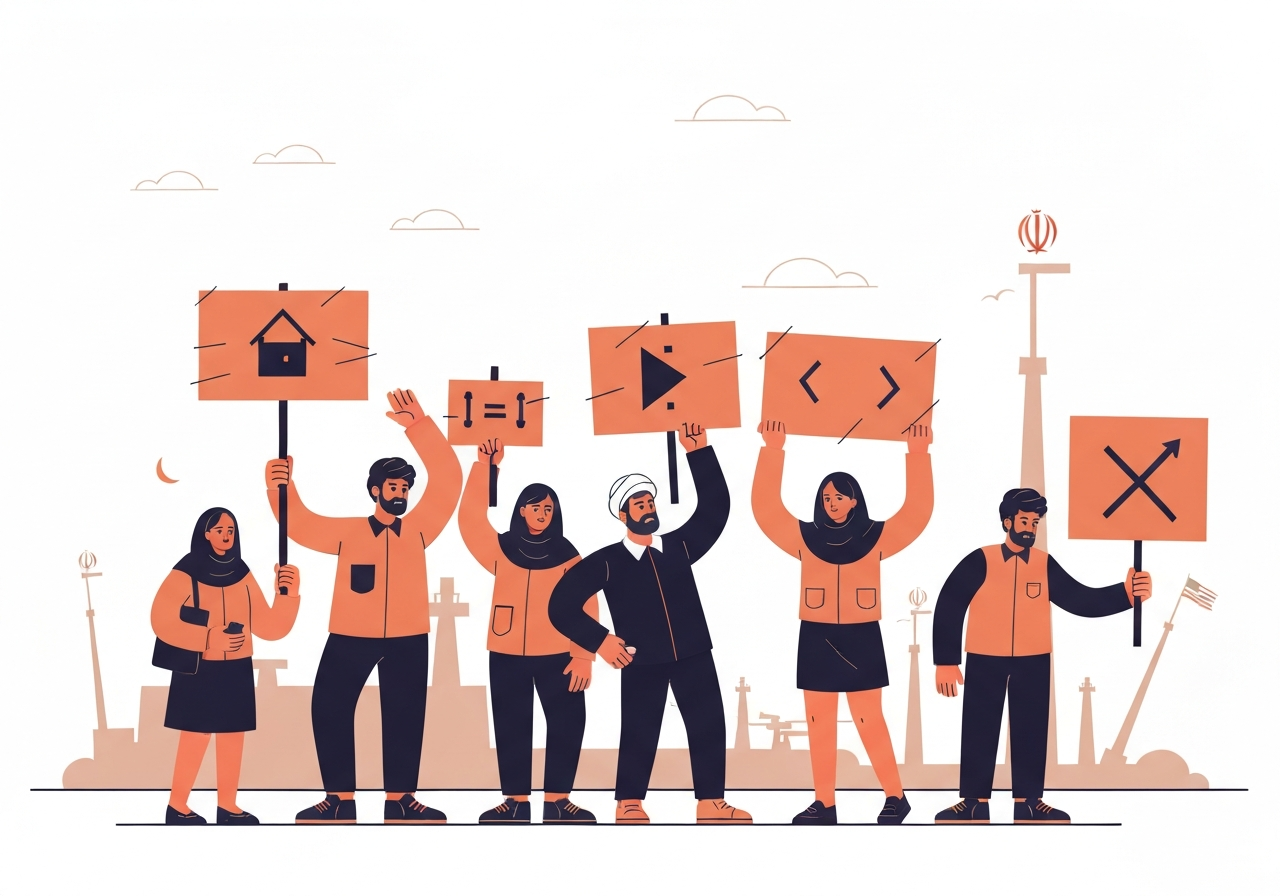
Lead: Students at multiple Tehran universities staged renewed demonstrations over the weekend as Washington increases its military presence in the wider Middle East. The rallies — occurring on Saturday and Sunday at campuses including Amirkabir and Sharif University of Technology — followed a 40-day mourning period tied to January unrest. U.S. special envoy Steve Witkoff said President Donald Trump is “curious” why Iran has not accepted stricter nuclear limits, while Iranian officials signalled ongoing indirect talks on a possible interim nuclear text. Tensions rose against a backdrop of U.S. carrier strike groups and additional combat aircraft being sent toward the region.
Key Takeaways
- Protests took place at Amirkabir University, Sharif University of Technology and Iran University of Science and Technology in Tehran on Saturday and Sunday, with verified video showing clashes between pro- and anti-regime groups.
- Iranian state agencies reported counter-revolutionary chants at the campuses; some student crowds reportedly called for the return of the monarchy and denounced Supreme Leader Ayatollah Ali Khamenei.
- U.S. special envoy Steve Witkoff told Fox News an administration official raised the question of why Iran has not “capitulated” under pressure; the interview was recorded on Thursday.
- The USS Gerald R. Ford carrier strike group is en route to join another carrier group near the region, and dozens of U.S. combat aircraft have been repositioned amid heightened tensions.
- Iranian Foreign Minister Abbas Araghchi said negotiators are preparing a draft counterproposal and hoped for further talks in early March, with indirect sessions involving Witkoff already held this month.
- IAEA estimated Iran’s highly enriched uranium (HEU) stockpile at more than 440 kilograms last year; Tehran has proposed options such as partial export, dilution, or a regional enrichment consortium as bargaining chips.
- On Friday, President Trump publicly asserted a much higher death toll — 32,000 — from last month’s unrest than previously reported by independent counts; that figure remains disputed.
Background
Widespread anti-government demonstrations in Iran last month prompted a forceful security response and an extended national atmosphere of mourning that culminated in 40-day commemorations this weekend. Universities have historically been centers of political expression in Iran; recent campus rallies echo earlier cycles of student activism that have influenced national debates. Tehran’s state-run outlets and independent social media channels have presented competing narratives of those gatherings, with state agencies focusing on alleged “counter-revolutionary” elements and nascent social media verification showing street-level clashes.
Diplomatic avenues have continued in parallel. Iranian and U.S.-aligned negotiators have pursued indirect exchanges this month aimed at narrowing differences over sanctions relief and nuclear constraints. Tehran insists on its right to peaceful enrichment; Washington has pushed for relinquishment or significant reduction of Iran’s most enriched uranium. The IAEA’s last public estimate of Iran’s HEU stockpile — more than 440 kilograms — remains a central data point in those talks.
Main Event
At the start of the new semester, students assembled at several Tehran campuses to mark mourning rituals and to protest. Verified video circulated showing scuffles at Amirkabir University on Sunday between groups supporting and opposing the government, and some chants referenced the monarchy and opposition figures. State news agencies including Fars reported similar disruptions at Sharif and Science and Industry University, framing the incidents as “counter-revolutionary” actions.
University officials offered cautious responses. Hossein Goldansaz, a Tehran professor quoted by Mehr, said authorities permitted demonstrations on campus within narrowly defined limits and warned students against provoking violence. He described the gatherings as tied to the recent mourning for those killed in January unrest and emphasized that permission would be conditional on respecting red lines.
On the diplomatic front, Iran’s Abbas Araghchi said negotiators were drafting a response text and expected further indirect talks as soon as late February or early March, with potential meetings in Geneva. U.S. special envoy Steve Witkoff — speaking to Fox News in an interview recorded on Thursday — questioned why Iran has not been compelled by pressure to accept sharper nuclear limits, framing U.S. military presence as part of that leverage.
Analysis & Implications
The overlap of campus protests and a visible U.S. military repositioning raises the risk of miscalculation. Student-led unrest can become a focal point for broader political grievances, and if clashes escalate they could be used by hardliners in Tehran to justify crackdowns or to rally nationalist sentiment against external pressure. Conversely, Iranian moderates may see an opening to press for diplomatic solutions that preserve some enrichment rights while easing tensions.
U.S. military moves — including the Gerald R. Ford carrier strike group’s transit — are intended to signal deterrence but also complicate regional risk dynamics. Carrier presence increases maritime patrols and strike readiness, which can deter direct action but also raises the stakes if an incident occurs. For Washington, the challenge is converting military pressure into diplomatic leverage without triggering uncontrolled escalation.
On the nuclear file, the arithmetic hinges on Iran’s HEU stockpile, enrichment capacity and time needed to rebuild a weapons pathway if restrictions lapse. Proposals mentioned by Iranian officials — exporting some HEU, diluting purity, or forming a regional enrichment consortium — are designed to protect a domestic enrichment capability while offering tangible reductions in proliferation-sensitive materials. Each option would demand rigorous verification mechanisms to satisfy international inspectors and U.S. concerns.
Comparison & Data
| Item | Latest figure | Context |
|---|---|---|
| Iran HEU stockpile | >440 kg | IAEA estimate (last reported year) |
| U.S. claimed protest deaths | 32,000 | Statement by President Trump (disputed) |
| Carrier groups in transit | USS Gerald R. Ford + another group | U.S. naval repositioning to region |
The table highlights core numbers shaping both the diplomatic and security environment: Iran’s reported HEU amount guides technical constraints; the very large death toll figure cited by President Trump is far above independent tallies and remains unverified; and the arrival of U.S. carrier assets changes operational posture in regional waters. These figures provide a factual anchor for policy options and public debate.
Reactions & Quotes
U.S. administration perspective was vocal in broadcast interviews, framing military deployments as part of a toolbox to compel Iranian concessions.
“I don’t want to use the word ‘capitulated’ — but why they haven’t capitulated?”
Steve Witkoff, U.S. special envoy (Fox News interview)
Tehran’s negotiators struck a more diplomatic tone, stressing ongoing work to produce a text acceptable to both sides.
“We continue negotiations; we are working on the elements of a deal and the draft of a text.”
Abbas Araghchi, Iranian deputy foreign minister (CBS/Face the Nation remarks)
University officials emphasized limits on campus action and the priority of preventing violence while allowing mourning rituals.
“We will allow them to hold their demonstrations on the university … provided they respect the red lines.”
Hossein Goldansaz, Tehran university professor (Mehr)
Unconfirmed
- President Trump’s claim that 32,000 people were killed during last month’s protests is far higher than independent estimates and remains unverified.
- Reports that specific student groups were directly organized by foreign actors have circulated on social media; these claims lack independent confirmation.
- Precise dates and locations for upcoming indirect talks between U.S. and Iranian envoys have been described as possible rather than confirmed; schedules remain tentative.
Bottom Line
Renewed student demonstrations in Tehran this weekend intersect with a sharper U.S. military posture in the region and ongoing, tentative diplomacy on Iran’s nuclear program. The coexistence of on-the-ground unrest and strategic signaling raises the risk of escalation driven by misperception or isolated incidents. Diplomacy — including possible interim arrangements addressing Iran’s HEU and enrichment rights — remains the most realistic route to reduce pressure on both domestic stability in Iran and regional security risks.
Observers should watch three near-term variables: the tone and content of any draft text from Iranian negotiators, movement or incidents involving U.S. naval and air assets, and the trajectory of campus unrest as both a barometer of domestic sentiment and a potential flashpoint. Transparent verification and careful crisis management will be essential if negotiators hope to translate pressure into a durable, verifiable agreement.
Sources
- Yahoo News Singapore (news outlet) — primary report provided to author
- Reuters (international news agency) — coverage of campus protests and diplomatic developments
- Fox News (broadcast/interview) — interview with U.S. special envoy Steve Witkoff
- Mehr News (Iranian state-affiliated news agency) — quoted university official statements
- Fars News Agency (Iranian state-affiliated news agency) — reports on campus slogans and reactions
- International Atomic Energy Agency (IAEA) (international organization) — estimates of Iran’s HEU stockpile and nuclear monitoring data
- CBS News / Face the Nation (broadcast) — remarks by Abbas Araghchi