
Lead
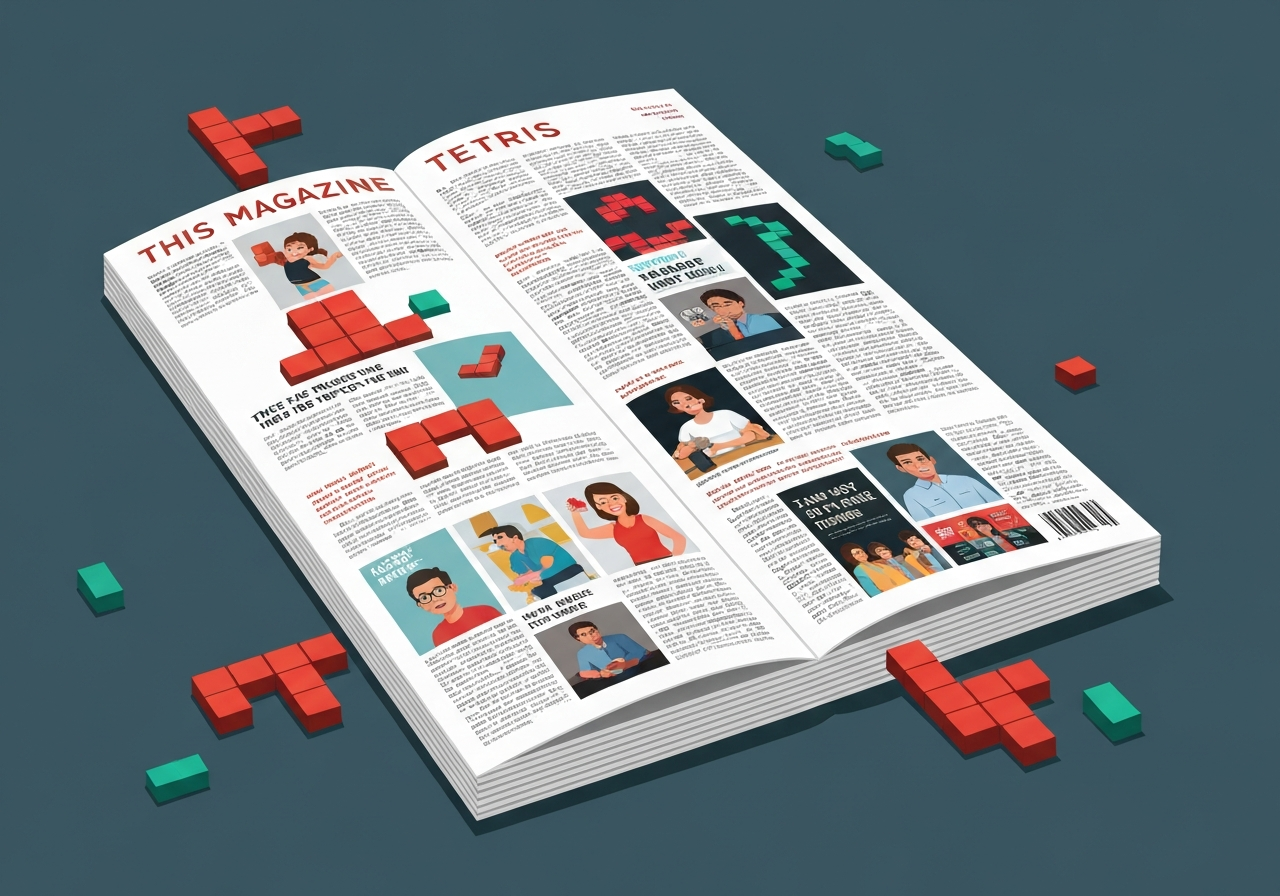
Last year Red Bull Media House produced a limited-edition 180-page gaming issue of The Red Bulletin whose cover hides a working Tetris game built from flexible electronics. The project, engineered with Kevin Bates, turns 180 tiny RGB LEDs and capacitive touch sensors into a playable sleeve that wraps a book-sized magazine. The stunt followed Red Bull’s drone-powered, 150-meter Dubai Frame Tetris installation that used more than 2,000 drones as pixels. Only about 1,000 copies of the magazine were printed and just 150 covers with the playable electronics were produced for event participants, contributors and select media.
Key Takeaways
- The playable cover contains a 180-LED RGB matrix mounted on a flexible circuit board only 0.1 mm thick; individual LEDs are about 2 mm across.
- Kevin Bates — known for the 2014 Tetris business card and the 2015 $39 Arduboy — led hardware design and development across most of the prior year.
- To balance thinness and durability the sleeve uses flexible circuits bonded between paper sheets; the full cover reaches almost 5 mm at its thickest point where components cluster.
- Controls are seven printed capacitive touch sensors integrated into the copper layer; responsiveness was tuned for paper stock and adhesives used in production.
- An ARM-based 32-bit microprocessor and four rechargeable LIR2016 3V coin-cell batteries live on a thin, rigid PCB along the spine; charging is via a concealed USB-C connector in a paper pocket.
- Feature trade-offs were deliberate: the GamePop GP-1 omits modern Tetris conveniences like hold and next-piece previews to save power and complexity.
- Red Bull produced roughly 1,000 copies of the issue; 150 playable covers were reserved for competitors, contributors, influencers and select press — none were sold to the general public.
Background
Tetris has a long history of being reimagined on unconventional hardware — from wristwatches to plastic toys and novelty packaging. Kevin Bates built his reputation producing ultra-compact devices (a Tetris-playing business card in 2014 and the Arduboy handheld in 2015) that enabled a small-maker ecosystem to experiment with games on tiny platforms. The Red Bulletin collaboration taps that maker tradition, combining accessible components and bespoke flexible circuitry to embed a game directly into printed media.
Flexible printed circuits have existed for decades in consumer electronics, used to connect tight internal layouts in phones and laptops. In the last five to six years these manufacturing capabilities became more attainable for small teams and niche runs, letting designers like Bates explore bendable displays outside of factory-scale OLED supply chains. Red Bull’s interest in experiential marketing and high-visibility gaming tie-ins — including a drone-based Tetris on Dubai Frame using over 2,000 drones — set the stage for a low-volume, technically ambitious magazine sleeve.
Main Event
The playable sleeve — officially called the GamePop GP-1 Playable Magazine System — centers on a custom flexible circuit bearing 180 RGB LEDs that function as a low-resolution Tetris display. Bates and his collaborators mounted the LEDs on a 0.1 mm-thick flex board and sandwiched the circuitry between paper sheets to form a thin wraparound cover. Where components cluster (LED drivers, batteries, processor), the thickness approaches 5 mm, but the overall object still reads as a paper sleeve when handled.
To keep the cover thin and seamless, the team replaced mechanical buttons with seven capacitive touch sensors printed into the copper layer of the board. Those sensors provide no mechanical click, but the paper’s flex and carefully tuned sensitivity give convincing tactile feedback for casual play. Bates said he adjusted responsiveness specifically to account for the chosen paper stock and glue, which affect touch behavior.
Not all parts are flexible. A slender rigid PCB housed along the interior spine carries an ARM-based 32-bit microprocessor and four rechargeable LIR2016 3V coin cells used for power. Charging is provided through a hidden USB-C interface: rather than a metal shell, the port is a small paper pocket exposing a pin-covered connector. The approach reduces weight and cost but is less robust than a conventional metal-mounted port.
The software is purposely simple. The GamePop GP-1 saves high scores and plays a brief Tetris-theme snippet at startup, but it omits modern features like next-piece previews or a hold function to conserve energy and limit complexity. The device includes a piezo speaker, and Bates noted that sound consumes roughly as much energy as the rest of the system; with sound you can play for an hour or two, and idle battery life can extend for months when not used.
Analysis & Implications
The playable magazine is not a step toward rollable smartphone displays; rather it is a demonstration of how existing, low-cost technologies can be recombined to achieve new experiences. By choosing discrete LEDs and flexible circuits over fragile, expensive foldable OLEDs, the team prioritized durability and affordability for a limited-run novelty. The trade-offs — low resolution, minimal features, and a delicate charging port — were conscious decisions to keep the object printed-media friendly.
From a production standpoint, the project highlights how small-batch manufacturing now enables mixed-material objects that bridge print and electronics. While traditional publishers have long experimented with augmented covers or sample gadgets, embedding a functional game into a paper sleeve at any scale requires cross-disciplinary design work across electronics, materials, and print finishing. For niche brands or promotional runs the approach is viable, but scaling to mass-market magazine runs would raise cost, assembly and recyclability challenges.
There are also sustainability and repairability questions. Flexible circuits bonded inside paper complicate recycling, and the concealed USB-C pocket is unlikely to endure heavy daily use. For collectors or marketing giveaways, the novelty and shareability may justify these compromises. For long-term consumer electronics, manufacturers still need more robust connectors, modular repair pathways, and supply chains for flexible displays.
Comparison & Data
| Attribute | GamePop GP-1 Sleeve | Typical Foldable OLED Phone |
|---|---|---|
| Display tech | 180 RGB LEDs on 0.1 mm flexible PCB | High-density OLED panel |
| Typical thickness (max) | ~5 mm at component cluster | 6–7 mm folded |
| Durability | Designed to withstand flex — tested by designer | Fragile; prone to crease damage |
| Features | Basic Tetris, high-score save, piezo sound | Full OS, multimedia, multitasking |
| Production volume | ~150 playable covers (special), ~1,000 total issues | Millions globally |
The table frames the sleeve as a narrow-purpose object compared with multifunctional foldable phones. The sleeve’s simplicity and low component count reduce some failure modes but introduce others (connector wear, glued assemblies). Its value is experiential rather than utilitarian.
Reactions & Quotes
Design and engineering context: before each quote we summarize the speaker and why their perspective matters.
On maker experience and development time — Bates described long-term experimentation with flex circuits and his role in translating that experience into this project.
“I’ve been messing around with flexible circuits for about as much time,”
Kevin Bates, hardware designer (quoted to The Verge)
On durability testing — Bates emphasized that the design was stress-tested beyond normal handling to check survivability.
“I hit it with a hammer a few times”
Kevin Bates (developer remarks reported to The Verge)
On user experience — a reviewer noted that despite the simple hardware, the sleeve delivers a surprisingly paper-like handheld feel.
“You genuinely feel like you’re playing a handheld made of paper,”
Reviewer (The Verge)
Unconfirmed
- The precise per-unit manufacturing cost for the playable covers and total project spend have not been disclosed by Red Bull or Bates.
- The long-term plans for broader production or a commercial retail release of the playable cover have not been announced publicly.
- Details about the exact supply chain partners and the recyclability process for the bonded electronics-in-paper construction remain unspecified.
Bottom Line
The Red Bulletin’s playable Tetris sleeve is a carefully limited experiment that showcases how mature, low-cost components and flexible PCB techniques can create compelling tactile experiences inside printed media. It prioritizes durability and novelty over full-featured gameplay, deliberately trimming software and hardware complexity to fit within a magazine form factor and power budget. As a marketing and design statement it succeeds: the object is playable, shareable and technically interesting without pretending to be a mass-market device.
For publishers and designers considering similar integrations, the project is instructive: use existing, accessible technologies; accept feature trade-offs; plan for constrained production runs; and address end-of-life recycling. For collectors and gaming fans, the magazine is a scarce artifact — approximately 1,000 issues printed, with 150 covers reserved for collaborators and select recipients — that connects maker ingenuity with mainstream promotional reach.
Sources
- The Verge — coverage of the playable Tetris magazine (media report)
- Red Bull / The Red Bulletin (publisher/official)
- Arduboy (developer platform and Kevin Bates’ earlier project)