
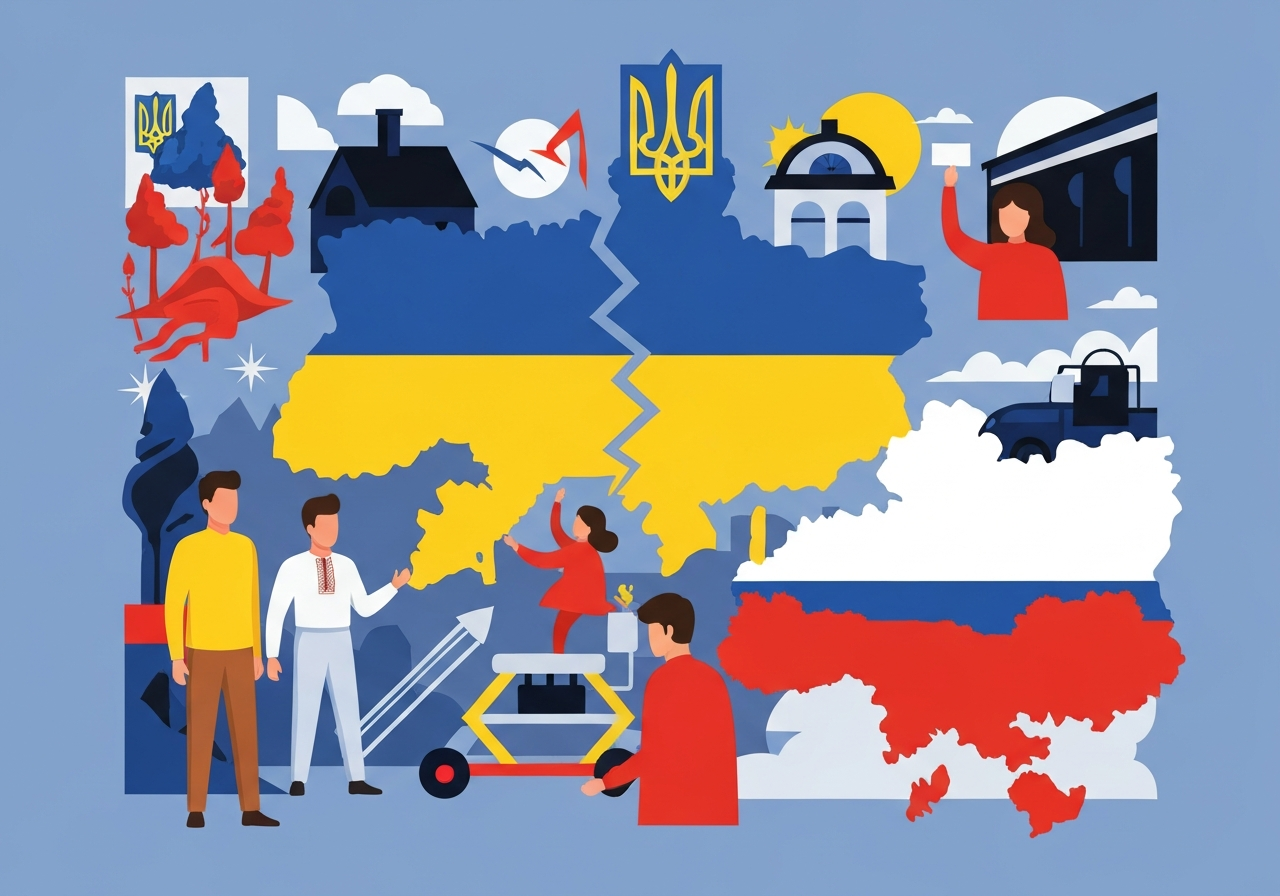
On 24 February 2026 Ukraine observed the fourth anniversary of Russia’s full-scale invasion with nationwide commemorations and international expressions of support. Ukrainian President Volodymyr Zelensky said Russian President Vladimir Putin “has not achieved his goals” and pledged to pursue peace and justice. European leaders, G7 representatives and a loose ‘coalition of the willing’ used the date to reaffirm military and financial backing, even as diplomatic efforts show little sign of a decisive breakthrough. Moscow, for its part, told state media the invasion’s aims remain incomplete and cited a mix of security and political objectives.
Key takeaways
- Anniversary: Russia launched its full-scale invasion on 24 February 2022; the date was marked across Ukraine and by allied leaders on 24 February 2026.
- Political message: President Zelensky said Vladimir Putin “has not achieved his goals” and vowed to press for peace and justice.
- International backing: The EU pledged a €90bn loan to meet urgent defence needs and G7 leaders issued a joint statement reaffirming support.
- Diplomacy stalled: US-led trilateral talks (Russia, Ukraine, US) continue without resolution on territorial and sovereignty issues; a fourth round was expected within days.
- UN vote: The UN General Assembly passed a ceasefire resolution with 107 votes in favour, 12 against and 51 abstentions.
- Military balance: Western officials report Russia recruited 30,000–35,000 soldiers monthly but has recently suffered higher casualties than new recruits over a three-month period.
- Air-defence needs: Zelensky asked for PAC-2 and PAC-3 interceptors to strengthen Patriot batteries against ballistic threats, citing depleted stocks.
- Civilian impact: Frequent aerial attacks and infrastructure damage have left large numbers without heat, water or electricity and sustained civilian casualties.
Background
The invasion that began on 24 February 2022 transformed a long-running political dispute into a large-scale war involving conventional forces, drones and extended artillery campaigns. Russia framed its intervention in terms of “demilitarisation” and “denazification,” claims widely rejected by Western governments and scholars; Moscow has also expressed a goal of preventing Ukraine from joining NATO. Kyiv and its partners view the conflict as an unlawful use of force against a sovereign state and a fight to preserve territorial integrity.
Since 2022 the battlefield has shifted primarily to eastern and southern Ukraine, where fortified lines, attritional fighting and periodic offensives have defined the front. Western military aid, sanctions on Moscow and diplomatic pressure have aimed both to bolster Ukraine’s defence and to raise the economic and political costs for Russia. At the same time, peace initiatives — including US-led trilateral talks and various back-channel efforts — have produced limited technical progress on ceasefire mechanisms but no agreement on core territorial issues.
Main event
Commemorative events on the fourth anniversary ranged from intimate moments of remembrance to public ceremonies in Kyiv and other cities. President Zelensky used the occasion to reiterate that Russia had failed to meet its strategic aims and to call for sustained allied support, including additional air-defence interceptors. European leaders present in Kyiv emphasised continued assistance: European Commission and Council officials announced a significant loan package intended to prioritise defence and critical infrastructure.
On the diplomatic front, representatives from Ukraine, Russia and the United States have been engaged in rounds of talks this year; Kyiv described earlier discussions as yielding progress on monitoring arrangements for a ceasefire but not on political or territorial settlements. Ukrainian officials said a further trilateral meeting could take place in Geneva on 26–27 February, while uncertainty remained about whether Moscow would shift its negotiating stance on core demands for territorial concessions.
In Moscow, state outlets downplayed the anniversary and focused on messaging that the campaign’s objectives remain outstanding. Kremlin statements at the FSB board meeting stressed security concerns and accused Kyiv of sponsoring attacks inside Russia, assertions that Russian officials presented without publicly released corroborating evidence. Meanwhile small acts of symbolic dissent — such as flowers left at monuments to Ukrainian cultural figures in Moscow and St Petersburg — were reported and closely monitored by police.
Analysis & implications
Strategically, the conflict has become an attritional contest in which incremental territorial gains cost both sides heavily. Western assessments cited by officials suggest Russia’s manpower model is under strain: recruitment drives producing tens of thousands of new soldiers monthly appear, in recent months, to have been offset by even greater numbers of wounded and killed. If sustained, such losses will constrain Moscow’s capacity for large-scale offensives and could force adjustments in operational tempo or strategy.
Politically, the anniversary highlights a tension in allied policy: sustained military and financial backing aims to deny Russia a decisive victory, but diplomatic engagement that treats some of Moscow’s demands as negotiable risks normalising territorial concessions. The balance chosen by Western capitals will shape Kyiv’s bargaining power at future talks and influence domestic political debates in donor countries about the scale and duration of assistance.
Economically, the EU’s €90bn loan signals long-term commitment but also reflects recognition that Ukraine’s defence and reconstruction needs go beyond short-term aid. Prioritising funds for air defences and critical services seeks to reduce civilian suffering and preserve state functionality, but delivery, training and logistical integration will be complex and time-consuming. The loan is intended to shore up Ukraine’s resilience ahead of a potentially prolonged conflict.
Comparison & data
| Item | Figure |
|---|---|
| UN General Assembly ceasefire vote | 107 for / 12 against / 51 abstentions |
| EU loan pledged for Ukraine | €90 billion (announced) |
| Russian monthly recruitment (reported) | 30,000–35,000 per month |
| Russian estimated casualties (UK MoD) | ~1.25 million (reported estimate) |
The table summarises principal figures referenced during anniversary coverage. The UN vote demonstrates broad, but not universal, international support for a ceasefire call. The EU loan is intended for urgent defence and resilience needs; disbursement timing and conditionality will determine near-term impact. Recruitment and casualty figures come from Western official estimates and indicate a potential manpower squeeze on Russian forces, while precise totals remain contested.
Reactions & quotes
Allied leaders and officials used the anniversary to underscore support and to push for concrete aid commitments and political backing.
“We must defeat the falsehood that Russia is winning,”
UK Prime Minister Keir Starmer (statement at ‘coalition of the willing’ meeting)
Starmer framed allied messaging as both strategic and political, urging partners to counter narratives of Russian progress and to maintain momentum on military support.
“The EU will deliver a €90bn loan one way or another,”
European Commission President Ursula von der Leyen (news conference in Kyiv)
Von der Leyen described the loan as prioritising Ukraine’s urgent defence needs and framed it as a deterrent to further aggression, while stopping short of a timeline for EU accession.
“Only by coming to Ukraine… can one understand what this war is really about,”
President Volodymyr Zelensky (inviting US President to visit)
Zelensky used the anniversary to press for visits and direct engagement from foreign leaders, arguing that first-hand exposure would deepen understanding and political will.
Unconfirmed
- Claims by Russia’s Foreign Intelligence Service that the UK and France plotted to arm Ukraine with a nuclear or “dirty” bomb have not been substantiated with publicly available evidence.
- Kremlin assertions that Kyiv directed a recent attack in Moscow and that imminent sabotage of Black Sea pipelines is planned were presented without verifiable public proof.
- Russian state assertions that “denazification” equates to “de-Ukrainisation” reflect official rhetoric; independent historical and cultural evidence shows a distinct Ukrainian national identity predating Soviet-era ties.
Bottom line
The fourth anniversary underscored two durable dynamics: robust international support for Ukraine’s defence and a diplomatic impasse on territorial and sovereignty questions. Financial and military pledges — including the EU’s €90bn loan and requests for additional air-defence interceptors — aim to sustain Kyiv through continued fighting but are not a short-term route to truce.
Operationally, reported recruitment pressures and escalating casualty tallies suggest Moscow may face difficulties sustaining major offensives without replenished manpower and materiel. Politically, the outcomes of upcoming trilateral talks and the credibility of allied support will determine whether diplomacy can move from technical arrangements toward any substantive negotiation over borders or security guarantees.