
Lead
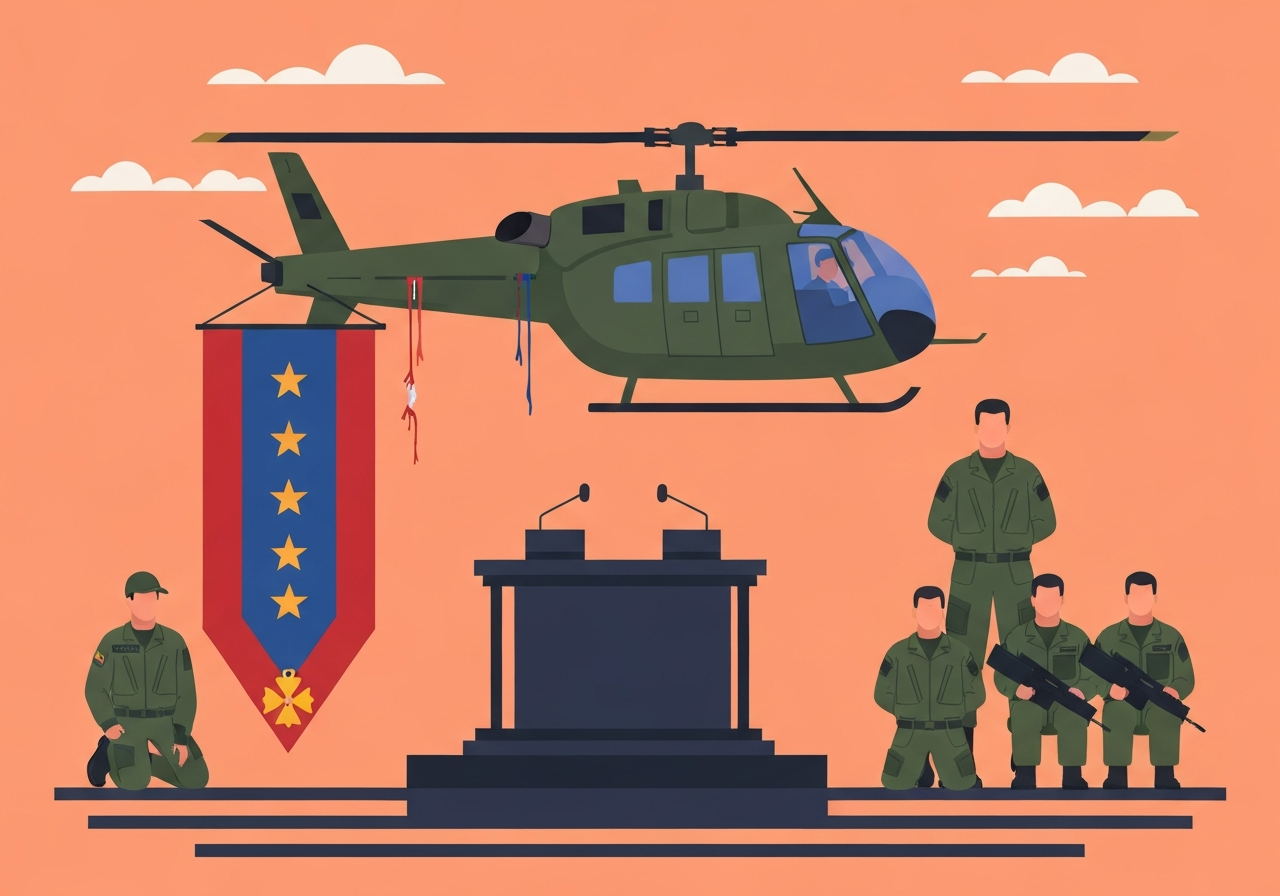
On Feb. 24, 2026, at the U.S. Capitol in Washington, President Donald Trump presented Chief Warrant Officer 5 Eric Slover with the Medal of Honor during his State of the Union address. Slover, a U.S. Army helicopter pilot wounded while leading the flight into the Caracas compound that held Venezuelan President Nicolás Maduro, was honored on the chamber floor and received a standing ovation. The award recognized Slover’s role in Operation Absolute Resolve and his actions after sustaining multiple gunshot wounds. The presentation marked the first time a Medal of Honor has been given during the annual presidential address.
Key Takeaways
- Chief Warrant Officer 5 Eric Slover was presented the Medal of Honor by President Trump on Feb. 24, 2026, during the State of the Union at the U.S. Capitol.
- The administration credited Slover as flight lead aboard the first CH-47 Chinook to approach the Caracas compound during Operation Absolute Resolve.
- According to the president’s remarks, Slover was struck repeatedly in the leg and hip, absorbing four bullets while preparing to land.
- The White House described the target site as heavily defended and said it was protected by thousands of soldiers and foreign technology.
- This ceremony was paired with a separate Medal of Honor presentation that evening to retired Navy Capt. Royce Williams for Korean War actions.
- Slover received prolonged applause and chants of “USA, USA, USA” as he and his wife entered the chamber.
- Officials said Slover is continuing medical recovery following the wounds he sustained in the raid.
Background
The award comes after a high-profile U.S. operation—identified by the administration as Operation Absolute Resolve—that resulted in the capture of Venezuelan President Nicolás Maduro. The mission, according to officials, targeted a fortified compound in Caracas late at night and relied on rotary-wing lift and close planning by special operations and aviation elements. The United States had long accused Maduro’s government of corruption and human-rights abuses; Washington labeled the capture a major foreign-policy success for the Trump administration.
Presentation of the Medal of Honor—the nation’s highest military award for valor—typically occurs in formal ceremonies at the White House or other military venues. Officials and veterans noted that awarding the medal during the televised State of the Union was unprecedented and intended to highlight the mission publicly. Domestic reaction to the raid and to the public honoring of participants has been intense, with supporters praising operational success and critics questioning the diplomatic and legal ramifications.
Main Event
According to remarks delivered from the podium, Slover served as the flight lead on the first Chinook to approach Maduro’s compound, which the president described as heavily defended and assisted by foreign technology. The administration characterized the approach as “very dangerous” because, they said, enemy forces had prior knowledge of the incoming force. As the helicopter descended to land, the president recounted, hostile fire struck Slover multiple times, including four shots that wounded his leg and hip.
Despite his injuries, officials said Slover maintained control of the aircraft and ensured the crew and passengers were brought back to safety. The president described Slover as focused on the mission throughout the engagement, quoting him as having pinned his awareness on securing the target even while bleeding. Slover and his wife were invited into the House chamber near the close of the address, drawing a standing ovation and audible chants of support.
Later the same evening, retired Navy Capt. Royce Williams received a separate Medal of Honor for his actions as a fighter pilot during the Korean War. The two presentations made the evening notable within military-honors history and underscored the administration’s intent to connect contemporary operations with historical acts of valor.
Analysis & Implications
A public Medal of Honor presentation during a State of the Union is symbolically significant: it converts a private military recognition into a focal point of national politics and foreign policy messaging. By honoring Slover on live television, the administration amplified the tactical success of the raid and framed it as a decisive ink in its broader strategy toward Venezuela. Politically, the presentation serves both to bolster public support for the administration’s actions and to elevate the narrative of U.S. operational competence.
Operationally, details the White House released—such as the role of a Chinook flight lead and the claim that the compound was defended by thousands and shielded with foreign systems—if accurate, suggest a complex, high-risk insertion that required interservice coordination and precise aviation leadership. If those accounts are corroborated by after-action reviews, the mission will likely be studied for its planning and execution, including tactics for penetrating layered defenses at night.
Internationally, the raid and the public honor create immediate diplomatic challenges. Allies and adversaries alike will weigh the legal and geopolitical precedents: capture of a sitting head of state on foreign soil raises questions about sovereignty, international law, and possible escalation. The administration’s framing of the operation as a successful precision mission contrasts with concerns from some quarters about unintended consequences in Latin America and relations with nations cited as having supported Maduro’s security apparatus.
Comparison & Data
| Recipient | Branch | Conflict/Action | Date of Presentation |
|---|---|---|---|
| Chief Warrant Officer 5 Eric Slover | U.S. Army | Operation Absolute Resolve (Maduro seizure) | Feb. 24, 2026 (State of the Union) |
| Retired Capt. Royce Williams | U.S. Navy | Korean War (fighter pilot actions) | Feb. 24, 2026 (evening ceremony) |
The table shows that two Medal of Honor presentations were associated with the same date but different conflicts and service branches. Presenting a modern operational medal in a high-profile political address is unusual and will likely become a reference point in future discussions about the intersection of military recognition and national messaging.
Reactions & Quotes
Audience reaction in the chamber was immediate and vocal as Slover and his wife entered; the moment underscored the political theater and public attention surrounding the award.
“USA, USA, USA.”
Chamber audience
The president framed the mission in stark terms, emphasizing both the peril and the outcome. His remarks repeatedly cited Slover’s pain and determination as central to the mission narrative, and he used the occasion to underscore the broader success of the operation.
“Maduro was the only thing Eric was thinking about.”
President Donald Trump
The president also highlighted the claimed scale of defenses and foreign support at the compound, using a rhetorical question to dismiss opposing capabilities and emphasize the operation’s effectiveness.
“How did that work out? Not too good.”
President Donald Trump
Unconfirmed
- The administration’s claims that the compound was defended by “thousands of soldiers” and by specific Russian and Chinese technologies are reported by officials but not independently verified in open-source reporting at the time of publication.
- Detailed after-action timelines, full casualty counts, and the precise sequence of events inside the compound have not been publicly released and remain under review.
Bottom Line
Chief Warrant Officer 5 Eric Slover’s public Medal of Honor presentation during the Feb. 24, 2026 State of the Union elevated a tactical operation into a national narrative about U.S. military capability and resolve. The award highlights individual bravery and serves the administration’s broader messaging about decisive action against the Maduro regime.
At the same time, key operational assertions made from the podium—about the scale of defenses, foreign assistance to Venezuela, and specific tactical details—remain to be independently confirmed. How allies, adversaries, and domestic institutions respond in the coming days will shape whether the event is viewed primarily as a celebrated rescue or a contentious geopolitical flashpoint.
Sources
- Military Times — news outlet reporting on the State of the Union presentation and official remarks
- Associated Press (photo credit: Alex Brandon/AP) — photo and agency reporting