
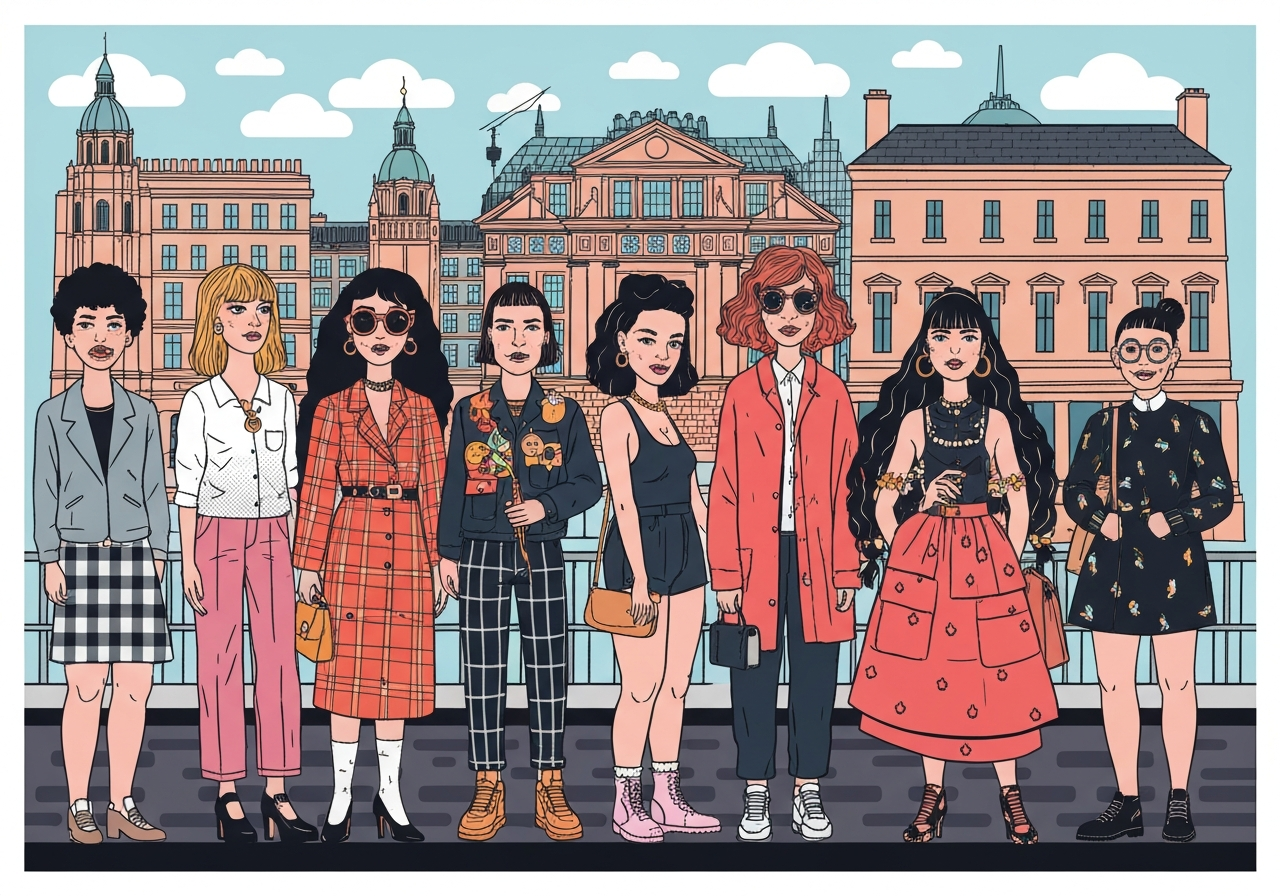
Photographs taken during London Fashion Week on 25 February 2026 capture a playful, experimental street-style scene where thrifted finds, high fashion and low-cost collaborations sit side by side. Attendees — from designers and stylists to journalists and photographers — mixed pieces from Saint Laurent, Bora Aksu and Maison Margiela with preloved items from Vinted, Beyond Retro and even a Lidl trolley-bag collaboration. The images and brief interviews collected outside shows on Wednesday, 25 February 2026 illustrate a mood of camaraderie, humour and risk-taking rather than strict brand couture. The result is a snapshot of a fashion moment in which accessibility and eccentricity are as visible as luxury labels.
- At least 15 individuals were profiled on 25 February 2026, with ages ranging from 23 (Alex Chambers) to 47 (Makiko Takizawa).
- Multiple attendees cited thrifted or preloved pieces — Vinted, Beyond Retro and vintage finds appear repeatedly across the sample.
- Designer and luxury labels such as Saint Laurent, Bora Aksu, Maison Margiela and Louis Vuitton were referenced by several subjects alongside high-street names like Nike, Asos and Uniqlo.
- Lara Grayson appeared with a Lidl trolley-bag collaboration; one subject carried a vintage Louis Vuitton bag, highlighting the juxtapositions present on the street.
- Interviewees repeatedly praised London’s focus on independent talent and a collegial atmosphere, contrasting it with more corporate or hurried international fashion weeks.
Background
London Fashion Week has long positioned itself as an incubator for independent designers and risk-takers, a role that continues to shape what attendees choose to wear outside the catwalks. The capital’s street-style culture is often described as more democratic than the spectacle in Paris or New York: many people travel by tube, mix price points freely and use fashion week as an occasion for playful self-expression. That tradition intersects with growing consumer interest in sustainability and secondhand clothing, which has helped preloved markets and platforms such as Vinted and Beyond Retro gain cultural currency among buyers and tastemakers.
Historically, London’s street-style moments have served two purposes: they amplify emerging designers and they act as a living catalogue of how trends are adopted and adapted by diverse communities. Photographers and content creators who document looks outside shows often spotlight combinations that major runway coverage might overlook — from affordable-brand collaborations to upcycled and thrifted styling. This environment supports a cycle where young designers and high-street retailers both respond to, and are inspired by, what people actually wear on the streets during fashion week.
Main Event
Between shows on 25 February, a cross-section of fashion professionals and fans gathered on the streets, offering concise descriptions of their outfits and reasons for attending. Mahoro Seward, 30, a fashion and style editor, chose an Our Legacy shearling jacket and a Saint Laurent skirt for a look she described as chic but comfortable ahead of an evening event. Others, like Alice Satterthwaite, 32, combined accessible brands — Arket trousers and an Amazon bag — with statement pieces such as Toteme heels and Ray-Ban sunglasses, underscoring the mix-and-match ethos of the day.
Thrift and preloved pieces were prominent: Kadija Omer, 29, and Angela Baidoo referenced Vinted and Beyond Retro finds; Jojo Kanda paired thrifted accessories with streetwear staples. Rachael Broussard carried a vintage Louis Vuitton bag alongside a Nike windbreaker, and Lara Grayson combined a Year Zero sparkly bag with a Lidl trolley-bag collaboration made with designer Nik Bentel, illustrating how collaboration and vintage lookbooks coexist in London’s street style.
Several attendees explicitly contrasted London’s atmosphere with other fashion capitals. Yomi Adegoke and others celebrated the city’s risk-taking and humour, saying Londoners are comfortable being slightly eccentric. Photographers at the scene noted an inclusive energy; Martin O’Neill highlighted friendliness and a lack of standoffishness, while Pearl Mackie framed the day as a personal milestone tied to her Brixton roots.
Analysis & Implications
London’s street-style mix of high-end, high-street and preloved items reflects broader shifts in consumer behaviour: value-consciousness, sustainability and a preference for individuality over brand signaling. For independent designers, this dynamic is double-edged: their work benefits from visible adoption on the street, yet the proliferation of affordable alternatives can compress margins and complicate positioning. Still, the prominence of young talent and the willingness of attendees to wear non-mainstream pieces reinforce London’s reputation as a creative testing ground.
The visibility of preloved and collaborative items — from Beyond Retro trousers to a supermarket-bag designer partnership — signals how nontraditional channels are entering mainstream fashion narratives. Retailers and brands that embrace circularity and partnerships may find commercial upside, while established luxury houses can benefit from street-level reinterpretations of their pieces that keep their names culturally salient. Social-media amplification of these looks accelerates trend cycles but also democratizes who can set them.
Economically, the juxtaposition of thrift and luxury suggests a bifurcated market where consumers oscillate between investment pieces and low-cost experimentation. If this pattern persists, it could stabilize a hybrid retail landscape in which resale markets and collaborations coexist with traditional luxury demand. Internationally, London’s approach may encourage other markets to foreground community-oriented, less formal fashion weeks that privilege originality and accessibility.
Comparison & Data
| Sample measure | Count (of 15 profiled) |
|---|---|
| Individuals quoted | 15 |
| Mentioned designer/luxury labels | 6 |
| Mentioned thrift/preloved sources | 5 |
| Referenced high-street/affordable brands | 4 |
The table above summarises a small, non-random sample of people photographed and interviewed outside shows on 25 February 2026. It is intended to illustrate the co-existence of designer, high-street and preloved items in this snapshot rather than to represent comprehensive market shares. Observers should treat these counts as indicative: a larger, systematic audit across multiple days would be needed to quantify trends precisely.
Reactions & Quotes
“We don’t take ourselves too seriously — there’s a lot of risk-taking and humour here.”
Yomi Adegoke, journalist and author
Yomi’s comment summarises a common theme among those photographed: London values personality and playfulness. Several interviewees echoed the point, linking the city’s creative culture to its willingness to mix price points and styles.
“Everyone experiments more than at other fashion weeks — it feels friendlier and less corporate.”
Mahoro Seward, fashion and style editor
Mahoro’s remark highlights how industry professionals perceive London as a nurturing space for independent talent. That sentiment was repeated by content creators and stylists who said the city’s scale and transport accessibility encourage attendance and spontaneity.
“I love preloved fashion and the designers are fearless — that’s why London breeds talent.”
Angela Baidoo, freelance senior fashion editor
Angela’s observation links the flourishing secondhand scene with the pipeline for emerging designers, suggesting a feedback loop between reuse culture and original creativity.
Unconfirmed
- Whether the prevalence of thrifted items at this single-day sample corresponds to a measurable rise in resale sales across the UK fashion market remains unverified.
- Any causal link between supermarket-brand collaborations and broader shifts in consumer spending patterns has not been demonstrated from this observational snapshot.
- The table’s counts are based on a limited set of photographed attendees and should not be extrapolated to the entire fashion-week population without further study.
Bottom Line
London Fashion Week’s street style on 25 February 2026 portrayed a city that prizes experimentation, humour and mix-and-match dressing. The scene showed both established labels and secondhand finds coexisting in ways that reflect broader shifts toward sustainability, affordability and individual expression. For designers and retailers, this environment offers opportunities to engage with new audiences through collaborations, circular initiatives and visibility on the street.
Looking ahead, if London continues to foreground independent talent and accessible creativity, the city will likely remain a cultural bellwether for how fashion adapts to economic and environmental pressures. For readers and industry watchers, the key takeaway is that style signals are increasingly plural: value and vintage are as meaningful as logo power when it comes to what people wear during fashion week.
Sources
- The Guardian — street-style gallery, 25 Feb 2026 (press/UK national newspaper and original photo interviews)