
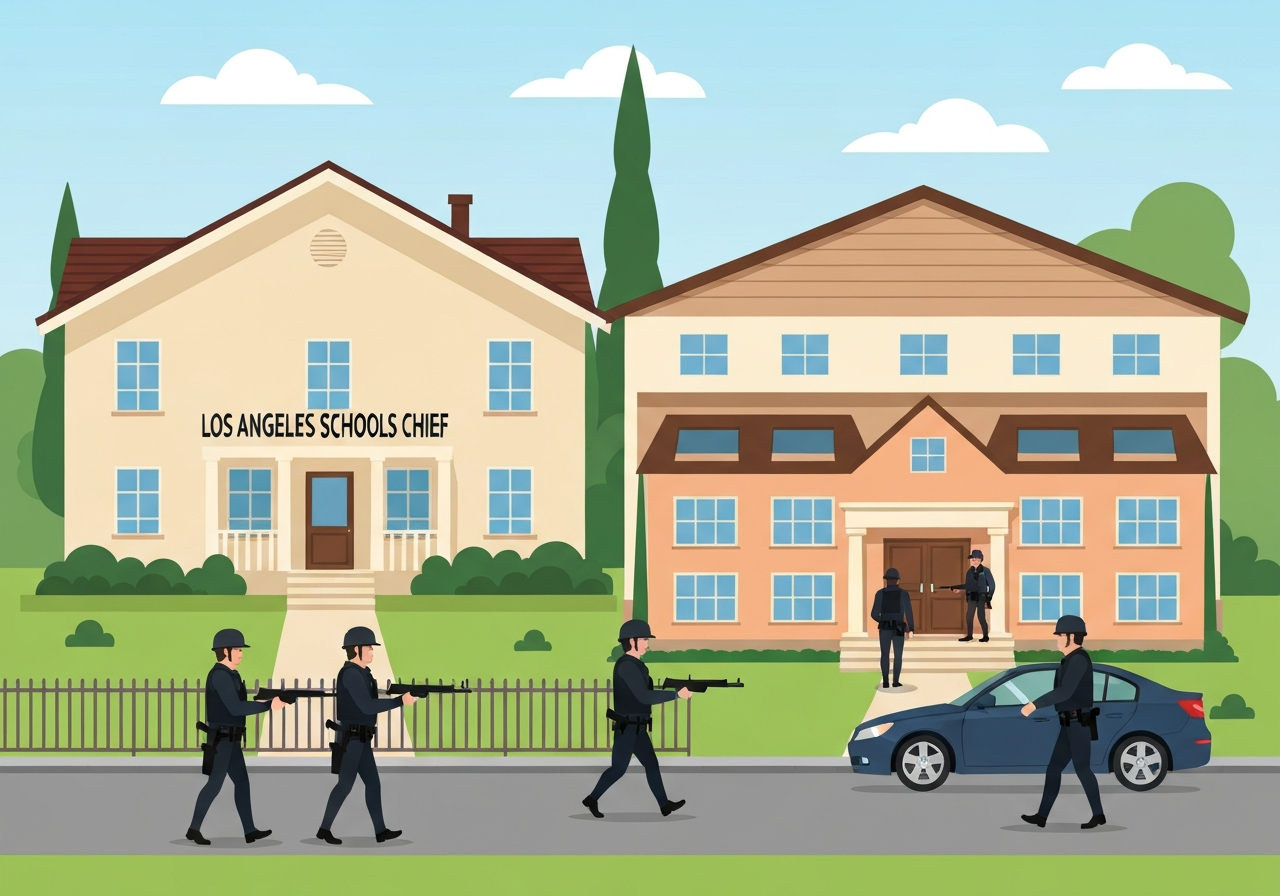
On Feb. 25, 2026, FBI agents executed sealed search warrants at the home of Los Angeles Unified School District Superintendent Alberto M. Carvalho and at the district’s downtown headquarters. Federal officials confirmed the warrants were being carried out but said the supporting affidavits were under seal and did not identify the investigation’s specific target. The district — serving about 400,000 students — said it was aware of the activity and is cooperating with authorities. No arrests or charges were announced publicly the day of the raids.
Key Takeaways
- The FBI executed search warrants at Alberto Carvalho’s residence and LAUSD headquarters on Feb. 25, 2026; court affidavits were sealed.
- Los Angeles Unified serves roughly 400,000 students, making it the nation’s second-largest K–12 district; Carvalho’s reported salary is $440,000 annually.
- Federal filings did not name a target; officials declined to disclose the scope or subject of the probe.
- The raids follow previous federal scrutiny of AllHere, a tech vendor that won a $6 million LAUSD contract and entered bankruptcy in 2024.
- District officials said they were cooperating with investigators; Carvalho did not immediately respond to requests for comment.
Background
Los Angeles Unified School District (LAUSD) is one of the country’s largest public-education systems, administering K–12 services to an estimated 400,000 students across the city and surrounding communities. As superintendent, Alberto M. Carvalho occupies one of the highest-profile roles in American K–12 education; public records show his annual salary at about $440,000. In recent years the district has contracted with private technology vendors for student-facing tools, including an A.I. chatbot product supplied by a firm called AllHere.
AllHere secured a roughly $6 million contract with LAUSD but later filed for bankruptcy protection in 2024. That vendor relationship and the procurement process have been cited in reporting as areas of interest for federal prosecutors, though the precise connections — if any — to the Feb. 25 searches have not been made public. Federal search-warrant practice often includes sealed affidavits early in an inquiry to protect ongoing investigative steps; sealing does not itself indicate wrongdoing.
Main Event
Federal agents appeared at Carvalho’s residence and at LAUSD’s central office on the morning of Feb. 25. The FBI confirmed that agents were executing search warrants at both locations and that the supporting affidavits had been sealed by a court. Law-enforcement officials provided no further details about items sought or whether the searches were targeted at documents, electronic devices or other materials.
LAUSD issued a brief statement acknowledging the activity and saying the district was cooperating with federal authorities. Carvalho did not immediately respond to requests for comment through district channels. Media on the scene described a focused law-enforcement presence at the headquarters building; district operations continued with limited public disruption, according to the district’s statement.
Outside observers noted the sealed-affidavit designation meant investigators were still in an information-gathering phase. Prosecutors commonly proceed this way when they are assembling evidence or when revealing details could alert subjects under investigation. No search-warrant returns, indictments, or charging documents were released publicly as of the evening of Feb. 25.
Analysis & Implications
The immediate implications for LAUSD operations are primarily reputational and administrative: the district must maintain continuity of education services for roughly 400,000 students while also responding to federal inquiries. Short-term disruption to internal workflows is possible if investigators removed records or devices, and the district will likely prioritize data-security reviews and counsel coordination to protect student privacy and contractual obligations.
Politically, the raids place a spotlight on procurement oversight and vendor relationships in large urban school systems. The AllHere contract — valued at about $6 million and later followed by the company’s 2024 bankruptcy — has been a public flashpoint; if investigators are tracing procurement decisions, the inquiry could prompt broader reviews of contracting policies across similar districts. For elected officials and school boards, the case underscores governance risks when public institutions work with private technology vendors.
Legally, sealed affidavits typically signal an active investigation rather than a completed case. The presence of search warrants does not equate to charges. If the probe results in indictments, the legal process could be protracted; if not, the sealed phase may end with minimal public consequence. Meanwhile, media coverage and political reaction could shape public perception regardless of the ultimate legal outcome.
Comparison & Data
| District | Approx. Enrollment | U.S. Rank |
|---|---|---|
| New York City Department of Education | ~1,000,000 | 1 |
| Los Angeles Unified (LAUSD) | ~400,000 | 2 |
| Chicago Public Schools | ~320,000 | 3 |
LAUSD’s scale — roughly 400,000 students — explains why federal attention to its contracting or governance practices has broader resonance. Large districts encounter complex procurement needs and multiple outside vendors, increasing the administrative burden of due diligence and contract oversight. Any changes in LAUSD procurement policy that result from this investigation could set practices that other large districts watch closely.
Reactions & Quotes
“We are aware of the activity at the superintendent’s home and district headquarters and are cooperating with federal authorities.”
LAUSD (official statement)
The district framed its response around cooperation and continuity for students while avoiding details about materials or personnel involved.
“The FBI confirms it executed search warrants at the locations referenced; the affidavits are under seal.”
FBI (agency statement)
Federal officials provided a narrow operational confirmation and said court filings were sealed, leaving the investigatory focus undisclosed.
“Sealed affidavits are often used to prevent premature disclosure that could compromise an ongoing inquiry.”
Independent former federal prosecutor (legal analyst)
Legal observers emphasized that sealing is procedural and not itself proof of misconduct; they noted subsequent filings or unsealing can change the public picture.
Unconfirmed
- Whether the search warrants were focused primarily on Carvalho personally, on district procurement files, or on specific vendor records has not been publicly confirmed.
- Any direct connection between the Feb. 25 searches and the 2024 AllHere bankruptcy has not been publicly established by authorities.
- No public charging documents or indictments had been filed or announced by Feb. 25, 2026; future filings could reveal additional details.
Bottom Line
The FBI’s execution of sealed search warrants at the superintendent’s home and at LAUSD headquarters on Feb. 25, 2026, marks a significant development for one of the nation’s largest school systems. At this stage, the actions signal an active federal inquiry but do not provide enough public information to determine targets, allegations, or likely outcomes.
Stakeholders — including district administrators, school-board members, parents and local officials — should expect a period of uncertainty. The district’s short-term priorities will include maintaining uninterrupted student services, cooperating with investigators, and reviewing procurement and record-keeping practices that could be implicated. Observers should watch for unsealing of affidavits or subsequent filings, which will be the clearest indicators of the investigation’s direction.