
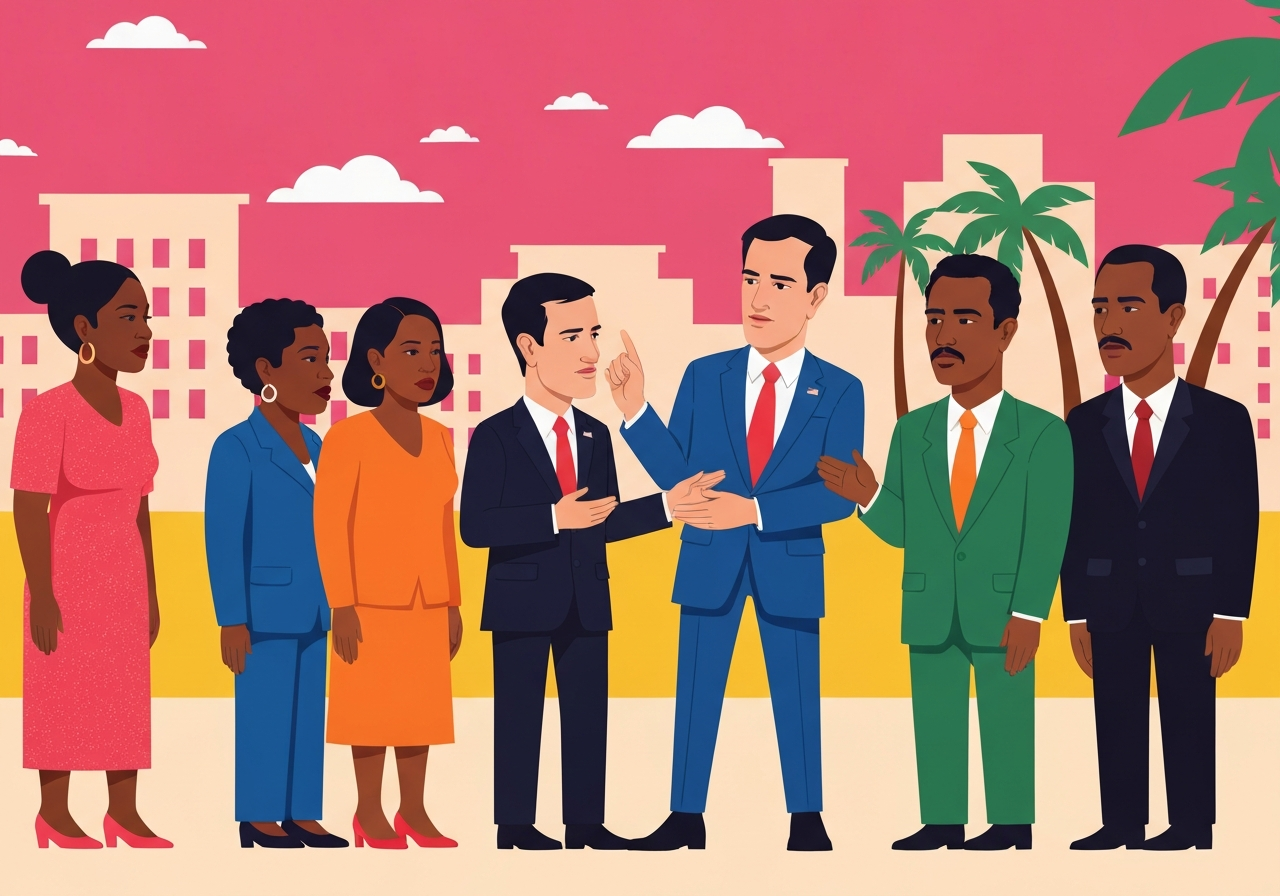
Lead: U.S. Secretary of State Marco Rubio met Caribbean leaders on Wednesday in Basseterre, St. Kitts and Nevis, to discuss regional anxieties tied to recent U.S. policies and actions. The closed-door session with 15 CARICOM members preceded separate bilateral meetings with prime ministers from St. Kitts, Trinidad and Tobago and other nations. Leaders said they sought clarity on U.S. approaches ranging from migration and deportation demands to heightened military activity and pressure on Cuba. The talks come amid continuing fallout from a U.S. operation last month that seized Venezuela’s then-leader, Nicolás Maduro, and a broader U.S. security emphasis in the hemisphere.
Key Takeaways
- Rubio addressed a 15-nation CARICOM bloc on Wednesday in Basseterre, St. Kitts and Nevis, before holding one-on-one meetings with several prime ministers.
- Caribbean leaders cited concern over a perceived U.S. push for a 21st-century Monroe Doctrine and demands to accept third-country deportees.
- The U.S. conducted a raid last month that captured Nicolás Maduro and transported him to face drug charges in the United States; Maduro has pleaded not guilty.
- Since early September, U.S. strikes tied to anti-narcotics operations have killed at least 151 people; a recent Monday attack in the Caribbean Sea killed three.
- The Treasury Department modestly eased limits on Venezuelan oil sales to Cuba the same week, reflecting granular shifts in U.S. policy.
- Regional leaders emphasized risks from prolonged instability in Cuba, warning of impacts on migration, security and economic stability across the Caribbean basin.
- Prime ministers including Terrance Drew and Andrew Holness framed the region as facing shifting geopolitics, supply chain uncertainty and growing climate shocks.
Background
The meeting took place against a backdrop of strained U.S.-Caribbean relations after a series of assertive U.S. measures. The Trump administration has articulated a renewed focus on American dominance in the Western Hemisphere, language officials and leaders described as a 21st-century version of the Monroe Doctrine aimed at limiting outside influence. That posture has coincided with tougher anti-narcotics operations at sea and stepped-up pressure on Cuba to alter its diplomatic and economic ties.
Caribbean governments, many reliant on tourism, remittances and regional trade, said they are navigating competing pressures: security demands from Washington, offers of economic engagement from other global powers, and the need to manage climate-related shocks. Several prime ministers described operations and policy shifts—such as requests to accept third-country deportees and calls to cool ties with China—as creating diplomatic strains and domestic political risk. The recent U.S. military activity in the region and the high-profile capture of Venezuela’s leader have intensified those concerns.
Main Event
Rubio convened CARICOM leaders behind closed doors for a plenary that CARICOM chair and St. Kitts and Nevis Prime Minister Terrance Drew opened by warning the region “stands at a decisive hour.” After the group session, Rubio planned separate bilateral talks with leaders including the prime ministers of St. Kitts and Trinidad and Tobago to discuss security, trade and economic growth. U.S. officials framed the visit as focused on promoting regional stability and cooperation.
Caribbean ministers raised several concrete grievances: requests from the U.S. to accept deportees routed through third countries, pressure to limit engagement with China, and concern over maritime operations that have killed dozens. Trinidad and Tobago’s Prime Minister Kamla Persad-Bissessar publicly thanked U.S. forces for actions against alleged narcotrafficking, saying her country valued cooperation on security. Other leaders, however, urged more multilateral consultation and stressed that unilateral measures can have spillover effects.
President Trump highlighted the administration’s hemisphere policy during the State of the Union, stating the U.S. is “restoring American security and dominance in the Western Hemisphere.” That rhetoric has heightened regional anxieties about balance-of-power moves and how U.S. security priorities may affect migration flows and economic ties. U.S. officials noted recent tactical adjustments—such as a partial easing by the Treasury on Venezuelan oil sales to Cuba—while emphasizing enforcement against drug trafficking.
Analysis & Implications
The Caribbean’s response to Rubio’s outreach reflects a region trying to reconcile security cooperation with sovereign concerns about outside pressure. For many governments, pragmatic security ties with the U.S. are valuable, but leaders warned that aggressive enforcement and politicized measures risk destabilizing migration patterns and local economies. If tensions persist, smaller island states could face increased public backlash and diplomatic realignments toward other partners.
Economically, policy shifts and geopolitical friction can hurt tourism, remittances and investment flows at a time when supply chains and energy markets are volatile. Leaders highlighted climate-related vulnerabilities that require long-term financing and predictable partnerships; abrupt policy swings from major partners complicate planning for infrastructure and resilience. The modest Treasury easing on Venezuelan oil sales to Cuba signals that Washington may calibrate measures in response to regional impacts, but such adjustments may be incremental.
On security, the reported U.S. strikes that killed at least 151 people since September have heightened scrutiny of intelligence and rules of engagement. Caribbean governments seek both results against trafficking and clear evidence when lethal force is used in their maritime approaches. Lack of transparent evidence linking targeted boats to drug shipments erodes trust and could spur calls for stronger multilateral oversight of maritime operations.
Comparison & Data
| Metric | Recent U.S. Action | Regional Impact |
|---|---|---|
| High-profile operation | Capture of Nicolás Maduro (last month) | Diplomatic shock, legal proceedings in U.S., regional debate |
| Maritime strikes | At least 151 people killed since early September | Concerns over legality and evidence, 3 killed in latest Caribbean strike |
| Policy adjustments | Treasury eased some limits on Venezuelan oil to Cuba (this week) | Partial relief for fuel shortages in Cuba, political signaling |
The table summarizes recent concrete actions and their immediate regional effects. While Washington emphasizes enforcement and strategic posture, Caribbean leaders are focused on practical outcomes: migration, energy access and the rule-of-law implications of kinetic operations. The numbers on maritime fatalities underscore why transparency and evidence-sharing are central to regional trust.
Reactions & Quotes
“The Caribbean is challenged from inside and out,”
Godwin Friday, Prime Minister of St. Vincent and the Grenadines
Prime Minister Friday framed the situation as both internal and external strains, urging adherence to international norms. His comment echoes broader regional unease about shifting global practices and the cumulative effects of security operations and diplomatic pressure.
“The global order is shifting… the region stands at a decisive hour,”
Terrance Drew, Prime Minister of St. Kitts and Nevis and CARICOM chair
Drew used the CARICOM opening to stress strategic uncertainty and to call attention to climate, supply chain and political risks that demand coordinated responses from partners and multilateral institutions.
“A prolonged crisis in Cuba will not remain confined to Cuba,”
Andrew Holness, Prime Minister of Jamaica
Holness warned that humanitarian and economic deterioration in Cuba could produce broader migration and security consequences across the Caribbean basin, and he urged de-escalation through dialogue.
Unconfirmed
- The U.S. government has not publicly released conclusive evidence that the small boats struck since September were carrying drugs; that linkage remains contested.
- Reports about the precise scale of U.S. military asset deployments compared with prior Caribbean surges are based on official statements and open-source tracking; independent confirmation of exact asset counts was not provided in the briefings.
Bottom Line
Rubio’s visit sought to soothe and clarify amid rising Caribbean unease over U.S. policy and operations that regional leaders say affect migration, security and economic stability. While Washington is signaling a tougher posture on narcotics and influence in the hemisphere, Caribbean governments want more consultation, evidence and predictable policy that account for downstream humanitarian and economic effects.
Going forward, the relationship will likely balance continued security cooperation with calls for transparency and multilateral engagement. Small states will press both the U.S. and alternative partners for concrete support on climate resilience, economic stability and migration management, making follow-up diplomacy and shared fact-finding crucial to defusing tensions.
Sources
- Associated Press — News report on Rubio’s Caribbean meetings (news)
- U.S. Department of State — Official statements and travel briefings (official)
- U.S. Treasury Department — Policy notices and sanctions guidance (official)
- The White House — State of the Union transcript and presidential remarks (official)