
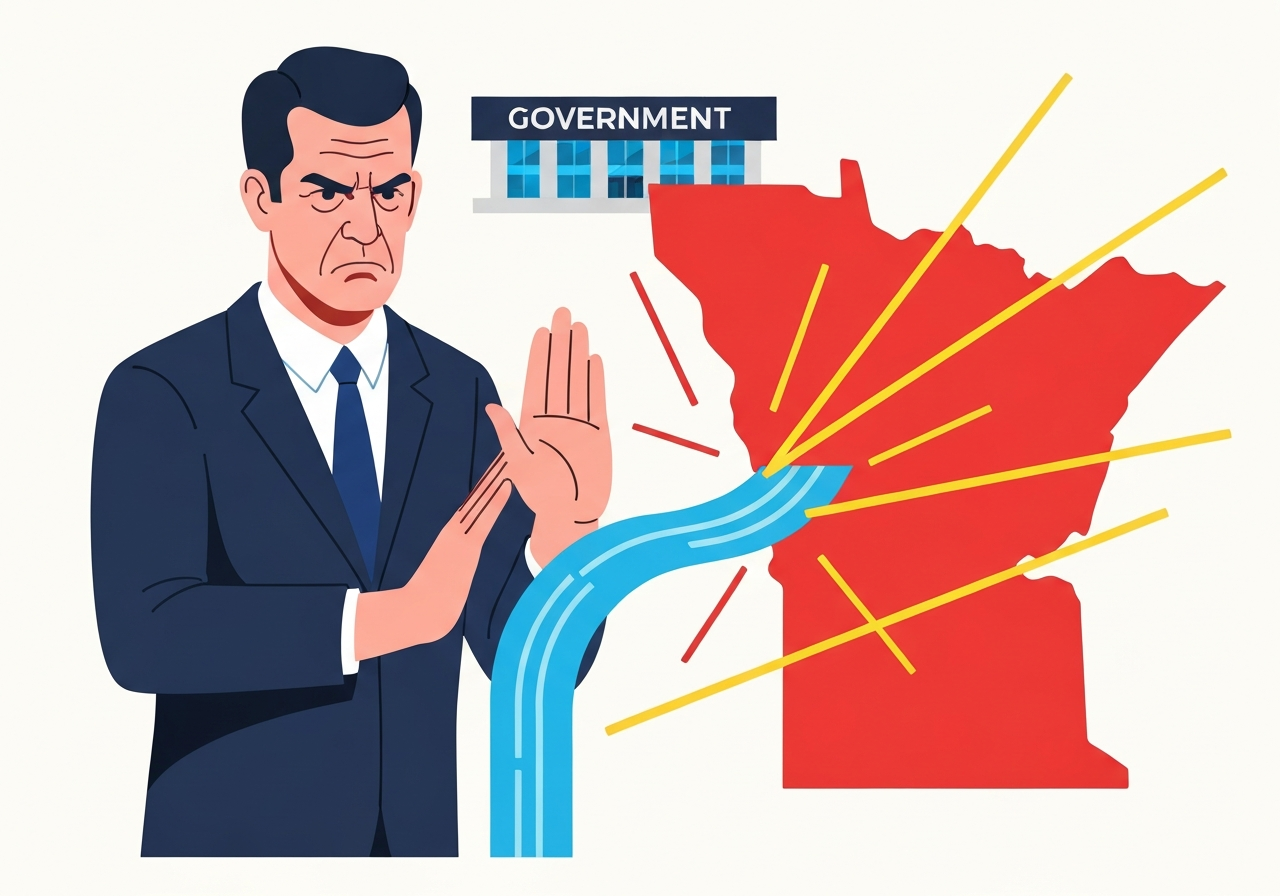
Vice-President JD Vance announced on Wednesday that the Trump administration will temporarily halt more than a quarter-billion dollars in federal Medicaid reimbursements to Minnesota as part of a newly declared “war on fraud.” The move, announced at a Washington press briefing with Centers for Medicare & Medicaid administrator Mehmet Oz, follows a sprawling fraud probe tied to schemes linked to members of the Somali community in Minneapolis. The federal action comes after the administration deployed immigration agents to Minneapolis in connection with the investigation, an operation that preceded the deaths of two US citizens and sparked wide protests. Minnesota officials have disputed the rationale and warned of impacts on low-income residents who rely on Medicaid coverage.
Key takeaways
- The administration announced a temporary pause on more than $250 million in federal Medicaid reimbursements to Minnesota; the pause is intended to press the state to address alleged fraud.
- CMS administrator Mehmet Oz said this is the first time federal Medicaid payments have been stopped for a state and announced a six-month national moratorium on new enrollments for durable medical equipment funding.
- Medicaid covers roughly 70 million Americans nationally; Minnesota’s Medicaid and MinnesotaCare together cover nearly 1.3 million people, about one in four state residents.
- Federal prosecutors previously estimated up to $9 billion was lost in schemes tied to Minnesota social services and individuals from the Somali community; dozens were charged in 2022.
- Minnesota Governor Tim Walz disputed the administration’s framing, saying the enforcement actions had produced deadly encounters and harmed children and protesters.
- Senior federal prosecutors Joseph Thompson and Harry Jacobs, who led earlier fraud prosecutions, resigned in January amid internal DOJ pressure over a separate investigation connected to the shooting of Renee Good.
- Officials framed the measure as protecting taxpayer dollars; state leaders warned it risks interrupting services for vulnerable residents.
Background
The administration has escalated federal scrutiny of Minnesota after long-running investigations into fraud within certain social service and healthcare programs. Federal prosecutors have linked a set of large-scale schemes to actors associated with parts of the state’s Somali population and estimated cumulative losses as high as $9 billion. Dozens of defendants were charged in 2022 by a Minnesota prosecution team that at the time was pursuing complex multi-jurisdictional cases.
Those prosecutions, and subsequent enforcement actions, intersected with broader tensions in Minneapolis: federal immigration agents were deployed to assist investigations, and separate law-enforcement uses of force, including the killing of Renee Good, have inflamed local protests. In January, two senior federal prosecutors who had led the earlier fraud work resigned after alleged pressure from Justice Department officials to pursue a separate line of inquiry connected to that killing. The environment has combined criminal prosecution, immigration enforcement, and political rhetoric, complicating cooperation between federal and state officials.
Main event
At a Washington press event on Wednesday, Vance said the administration would “temporarily halt” more than a quarter-billion dollars in Medicaid reimbursements to Minnesota until state authorities demonstrate stronger anti-fraud measures. He framed the step as ensuring Minnesota acts as “a good steward of the American people’s tax money” and urged state cooperation to protect services for eligible residents. Mehmet Oz, speaking alongside Vance, described the action as unprecedented and warned other states could face similar scrutiny if the administration identifies comparable problems.
Oz additionally announced a six-month national moratorium on new federal enrollments for durable medical equipment funding, citing concerns about benefit fraud for items such as prostheses and orthotics. The moratorium would not remove existing benefits but would pause new enrollments pending review. Administration officials said they aim to curb abusive billing practices and protect program integrity while they evaluate safeguards.
Minnesota officials pushed back immediately. Governor Tim Walz said the federal move “has nothing to do with fraud,” and accused federal agents of escalating violence during recent operations in Minneapolis. State leaders warned that pausing federal reimbursements could disrupt services to roughly 1.3 million Minnesotans who depend on Medicaid and MinnesotaCare, and could shift costs onto the state or result in service interruptions for low-income residents.
Analysis & implications
Operationally, withholding federal Medicaid reimbursements is a powerful lever that can create immediate budget pressure for state health programs. More than one in four Minnesotans rely on state-administered Medicaid coverage; a sudden loss of federal dollars would require Minnesota to reallocate funds, reduce services, or seek emergency measures to avoid disruptions. That creates a humanitarian as well as fiscal calculus for state leaders deciding how to respond.
Politically, the action escalates partisan tensions. The administration has publicly framed the effort as a crackdown on waste and fraud, while state Democrats portray it as punitive and politically motivated targeting of a blue state. That dynamic could harden local political coalitions and influence public sentiment ahead of future elections in which the vice-president is widely expected to be a contender.
On enforcement strategy, officials face trade-offs between program integrity and access. Steps like a moratorium on durable medical equipment enrollments may reduce fraudulent claims in the short term, but they also risk slowing or denying needed devices to patients who legitimately require prostheses, orthotics, and other durable medical goods. Courts and federal regulators may be asked to adjudicate disputes over federal authority to withhold funds and the thresholds needed to justify such actions.
Comparison & data
| Metric | National | Minnesota |
|---|---|---|
| People covered by Medicaid | ~70,000,000 | ~1,300,000 |
| Portion of Minnesota population covered | N/A | ~25% |
| Alleged cumulative fraud (estimate) | N/A | $9,000,000,000 |
| Paused federal Medicaid funds announced | N/A | > $250,000,000 |
The table places the pause in federal funding in context: national Medicaid enrollment is about 70 million people, while Minnesota’s combined programs cover roughly 1.3 million residents. Federal prosecutors’ estimate of up to $9 billion in losses reflects cumulative allegations across numerous schemes; that figure has been used to justify intensified federal enforcement but represents an aggregate estimate rather than final forfeitures or convictions.
Reactions & quotes
Officials and local leaders reacted sharply. Minnesota’s governor framed the federal move as misplaced and dangerous, warning of harm to residents who depend on state health programs. Federal officials emphasized enforcement and stewardship of taxpayer funds.
We are stopping federal payments until the state takes obligations seriously to stop fraud against the American taxpayer.
JD Vance, Vice-President (press briefing)
This is the first time federal Medicaid payments have been halted for a state; we must protect precious programs from abuse.
Mehmet Oz, CMS administrator (press briefing)
This has nothing to do with fraud; the agents sent to investigate are shooting protesters and arresting children.
Tim Walz, Minnesota governor (social post)
Unconfirmed
- The administration’s statement suggested other states might be targeted next, but no specific states or timelines have been publicly confirmed.
- Claims tying the entirety of the alleged $9 billion loss to a single community or network remain estimates from federal prosecutors and are subject to legal determination.
- Assertions that the pause will immediately cut off services for specific patient groups are not yet documented; federal officials say existing beneficiaries will be protected while reviews occur.
Bottom line
The pause on more than $250 million in federal Medicaid reimbursements to Minnesota marks an escalation in federal enforcement that blends program-integrity rhetoric with immigration and law-enforcement actions. The move raises immediate budget and service-delivery questions for Minnesota, where roughly 1.3 million people depend on state-administered coverage.
Beyond Minnesota, the action signals that the administration may use withholding authority and moratoria to address perceived fraud risks nationwide, with potential consequences for program access and state-federal relations. Observers should watch legal challenges, state responses, and whether federal agencies publish evidence or formal determinations that justify broader application of this approach.