
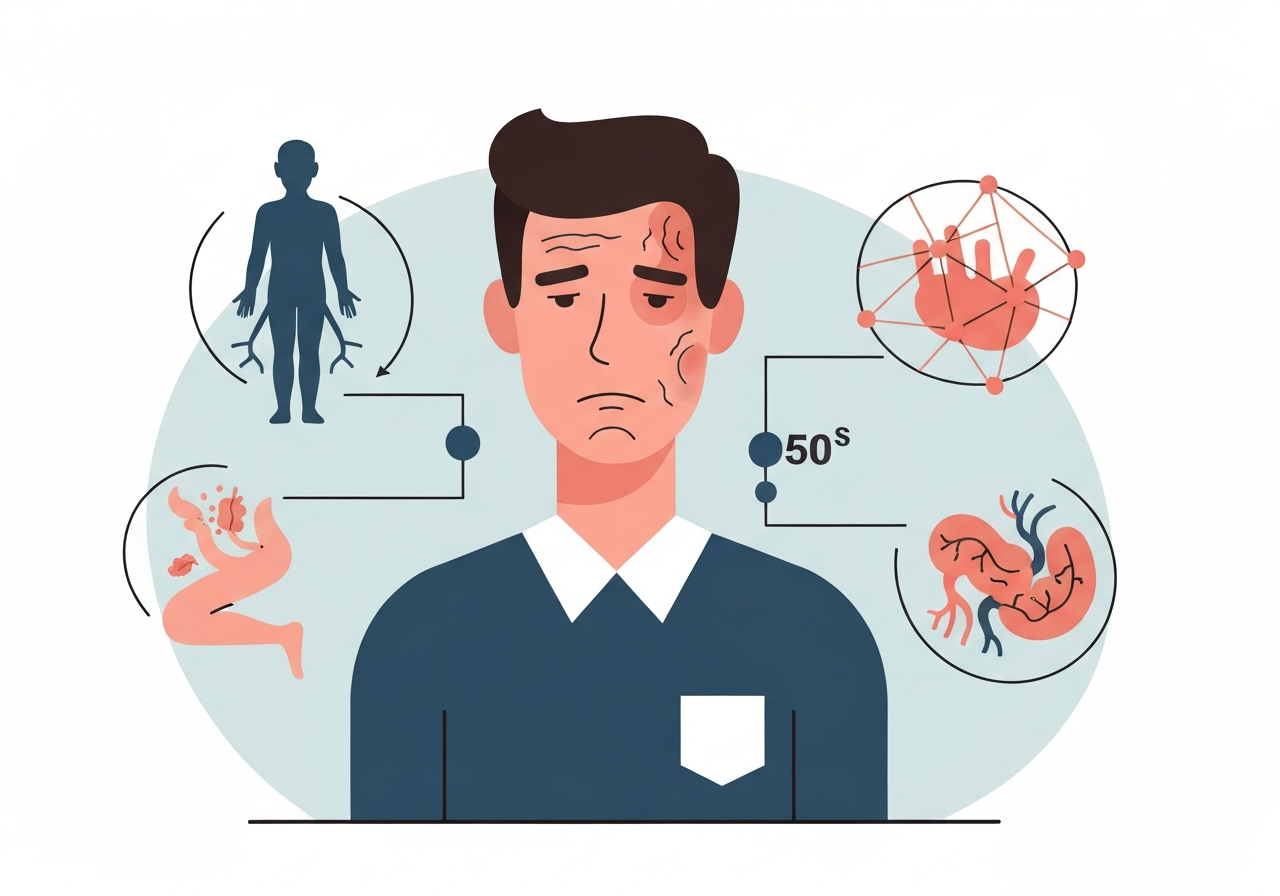
Lead: A new analysis published 26 February 2026 finds that exposure to per- and polyfluoroalkyl substances (PFAS) correlates with faster epigenetic aging in men roughly aged 50–65. Researchers examined blood samples and DNA methylation from a randomly selected group of 326 adults enrolled in the US National Health and Nutrition Examination Survey in 1999–2000 and ran the data through multiple biological “epigenetic clocks.” The strongest associations were observed in men in midlife; associations in younger men, older men and women were smaller or inconsistent. Authors caution the results show association, not proven causation, and call for larger, contemporary studies.
Key Takeaways
- The study used public NHANES data on 326 participants enrolled in 1999–2000 and measured 11 PFAS in blood along with DNA methylation patterns.
- PFAS exposure correlated with accelerated epigenetic aging most strongly in men aged about 50–65, with weaker and generally non‑significant links in other groups.
- Two less‑studied compounds—perfluorononanoic acid (PFNA) and perfluorooctanesulfonamide (PFOSA)—were particularly strong predictors of faster epigenetic aging in middle‑aged men in the analysis.
- Per the National Academies, an estimated 98% of Americans have detectable PFAS in their blood, reflecting widespread exposure from decades of industrial and consumer use.
- Authors and external experts emphasize these findings are associative; industry groups note the study used a small, older dataset and call it exploratory.
- Practical exposure reductions suggested include certified water filtration, following local advisories, and limiting contact with stain‑ and grease‑resistant materials, while systemic risk reduction depends on regulation and cleanup.
Background
PFAS are a broad family of synthetic chemicals introduced into consumer products in the 1950s to confer nonstick, water‑ and oil‑repellent and temperature‑resistant properties. Their strong carbon‑fluorine bonds make many PFAS highly persistent in the environment and organisms, which is why they are often called “forever chemicals.” Over decades, research has linked certain legacy PFAS—such as PFOS and PFOA—with cancer, thyroid disease, reproductive harm, high cholesterol, and liver damage.
Because PFAS have been used across industries and in many household products, human exposure is widespread: the National Academies estimates about 98% of Americans have detectable PFAS in blood. International controls have targeted some legacy PFAS; for example, PFOS and PFOA are among substances listed for elimination under the 2001 Stockholm Convention on Persistent Organic Pollutants. In the United States, federal regulatory attention has increased in recent years but policy measures and implementation timelines remain contested.
Main Event
The paper, published in Frontiers in Aging on 26 February 2026, analyzed NHANES participants enrolled in 1999–2000. Investigators measured 11 PFAS compounds in archived blood samples and profiled DNA methylation—the methylome—of blood cells to estimate biological age using about a dozen established epigenetic clocks. Those clocks produce an epigenetic age estimate that can be compared with chronological age to infer accelerated or decelerated biological aging.
Senior author Xiangwei Li, a professor of epidemiology at Shanghai Jiao Tong University School of Medicine, reported the strongest associations between PFAS concentrations and accelerated epigenetic age were concentrated in men aged approximately 50–65. In several analyses, PFNA and PFOSA emerged as the most consistent predictors of faster epigenetic aging in that male subgroup, while associations in women were generally smaller and less consistent.
Independent experts emphasized the biological plausibility of a sex‑specific effect. Jane Muncke of the Food Packaging Forum noted chemicals that disrupt the endocrine system can have sex‑differentiated outcomes; prior literature reports that PFAS can affect testosterone, sperm quality and certain cancer risks in men. The study authors and outside commentators stressed the results do not establish causation and must be interpreted alongside limitations such as sample size and the historical timing of the samples.
Analysis & Implications
Epigenetic clocks estimate biological aging by measuring DNA methylation patterns that change predictably with age and with some exposures. If PFAS exposure is associated with accelerated epigenetic aging, it suggests these chemicals may influence pathways related to cellular senescence, inflammation, or metabolic regulation—mechanisms that could raise long‑term disease risk. However, association alone cannot separate direct toxic effects from correlated lifestyle, occupational or community exposures that also affect methylation.
The sex difference observed aligns with previous findings that women often eliminate certain PFAS more rapidly than men—factors such as menstruation, pregnancy and breastfeeding can reduce body burden—while men may accumulate higher steady‑state concentrations. Those differences, combined with potential endocrine disruption, could help explain why middle‑aged men showed the clearest signal in this analysis.
From a public‑health perspective, the study highlights two needs: (1) larger, longitudinal and more recent cohorts with repeated exposure and epigenetic measures to test temporality and causality; and (2) regulatory and remediation actions to reduce community‑level exposure pathways, since individual avoidance is often impractical where contamination is present in water or soil.
Comparison & Data
| PFAS category | Examples | Known concerns | Regulatory status |
|---|---|---|---|
| Legacy PFAS | PFOS, PFOA, PFHxS | Linked to cancer, thyroid dysfunction, reproductive and metabolic harms | Listed or targeted for elimination under Stockholm Convention; subject to regulatory review |
| Less‑studied PFAS | PFNA, PFOSA | Fewer human studies; emerging links to metabolic and epigenetic endpoints per new analysis | Regulatory attention increasing but evidence base smaller |
| Population prevalence | — | ~98% of Americans have detectable PFAS in blood (National Academies estimate) | Exposure reduction relies on policy, cleanup and consumer guidance |
The table summarizes how the new findings fit into an existing regulatory and scientific landscape: some legacy PFAS are well characterized and regulated internationally, while many newer or less‑studied variants remain underexamined despite potential biological activity. The study’s use of archived NHANES data gives historical insight but also raises questions about present‑day exposures and chemical mixtures now in use.
Reactions & Quotes
“The associations between PFAS exposure and accelerated epigenetic aging were strongest in men aged 50–65.”
Xiangwei Li, Senior author, Shanghai Jiao Tong University School of Medicine
Li emphasized these are associations from cross‑sectional data and urged caution about interpreting causality, while recommending feasible exposure reductions at the individual level and calling for regulatory cleanup to achieve broader risk reduction.
“We see a sex‑specific effect consistent with endocrine disruption, but these results are pieces of biological plausibility rather than proof of cause and effect.”
Jane Muncke, Food Packaging Forum (science communication nonprofit)
Muncke noted the finding fits prior mechanistic and epidemiologic work on PFAS but said confirmatory studies are needed to move from plausibility to certainty.
“This exploratory study used a small sample and older data and does not prove PFAS causes aging.”
Tom Flanagin, American Chemistry Council (industry group)
The industry response highlighted study limitations and warned against overinterpreting associative results as definitive evidence of causation.
Unconfirmed
- Whether PFAS exposure directly causes accelerated epigenetic aging remains unproven; the study design shows correlation, not causation.
- It is not yet clear that the specific PFNA and PFOSA signals observed in this cohort generalize to current populations with different mixtures and exposure sources.
- The extent to which accelerated epigenetic age measured in blood predicts concrete clinical outcomes (for example, earlier onset of chronic disease) in this setting requires further prospective study.
Bottom Line
This study adds to a growing body of evidence that PFAS exposures track with biological markers linked to aging, and it highlights a pronounced signal in men in midlife. The analysis is valuable for generating hypotheses—particularly about less‑studied PFAS such as PFNA and PFOSA and sex differences in accumulation and effect—but its cross‑sectional nature and small, historical sample limit causal claims.
For individuals, modest exposure‑reduction steps (certified water filters, heeding local advisories, limiting contact with certain treated textiles) are sensible. For population health, meaningful progress will depend on updated, comprehensive exposure assessments, targeted epidemiologic and mechanistic studies, and regulatory and environmental remediation measures to reduce community‑level PFAS burden.
Sources
- CNN (news report)
- Frontiers in Aging (peer‑reviewed journal)
- National Academies of Sciences, Engineering, and Medicine (independent scientific body)
- NHANES, National Center for Health Statistics (federal survey data)
- Stockholm Convention on Persistent Organic Pollutants (international treaty)
- American Chemistry Council (industry organization)