
Lead
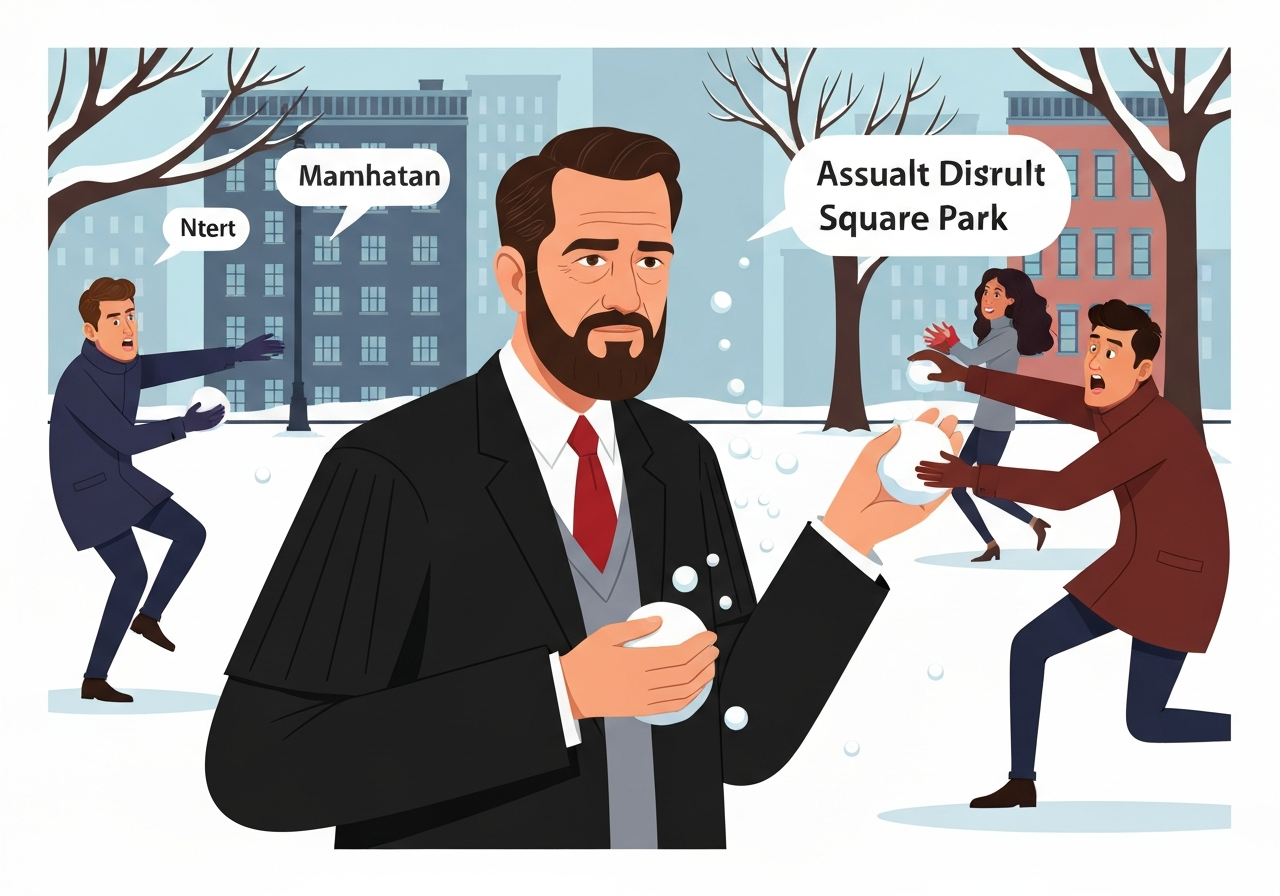
Manhattan prosecutors on Thursday night declined to pursue an assault charge against 27-year-old Gusmane Coulibaly in connection with a large snowball fight at Washington Square Park following Monday’s blizzard. Instead, prosecutors arraigned Coulibaly on a misdemeanor obstructing government administration charge and a harassment violation; he was released on supervised release later that evening. The decision came after prosecutors said they could not show an officer suffered a physical injury directly caused by Coulibaly’s actions. The office said the broader investigation remains ongoing.
Key Takeaways
- Defendant: Gusmane Coulibaly, 27, was arraigned Thursday evening in Manhattan Criminal Court and released on supervised release.
- Charges filed: misdemeanor obstructing government administration and a harassment violation; assault charges were not filed.
- Prosecutors’ rationale: after reviewing evidence, they said they could not prove a direct physical injury to an officer caused by Coulibaly.
- Related facts: Coulibaly was previously arrested earlier this month in Bronx County in an unrelated case, cited by prosecutors at arraignment.
- On-scene impact: the large, social-media promoted snowball fight prompted a heavy NYPD response; two officers were treated for minor injuries (a bruised eye and a headache).
- Courtroom presence: about a dozen uniformed officers and union leadership, including PBA President Patrick Hendry, attended the arraignment.
- Legal defense: attorney George Vomvolakis argued the conduct amounted at most to a summonsable offense and pushed for release without bail.
Background
Monday’s blizzard prompted widespread public activity across New York City, including an event at Washington Square Park that was amplified on social media and drew a sizeable crowd. Large informal gatherings after storms are not unprecedented in the city, but the combination of high attendance and icy projectiles raised safety concerns among law enforcement. The NYPD responded to the park during the gathering and later announced an arrest as part of its enforcement actions.
Prosecutors and police often weigh multiple factors when deciding whether to bring felony assault charges against civilians alleged to have struck officers. In this case, the Manhattan DA’s office reviewed video and other evidence before filing charges and concluded the standards for assault had not been met. The decision reflects a prosecutorial threshold that requires proof linking alleged conduct directly to physical injury sustained by a named victim.
Main Event
According to court filings and public statements relayed in court, police arrested Coulibaly after the snowball fight in Washington Square Park, asserting officers were struck with snow and ice during the incident. The NYPD initially described the arrest as involving alleged assaults on officers. Video of the scene circulated widely on social platforms and formed part of the evidence package reviewed by prosecutors.
At arraignment, prosecutors told the judge that after a review they could not establish that any officer’s injury was directly caused by Coulibaly’s conduct, and therefore did not include an assault count in the charging documents. They did, however, proceed with a misdemeanor obstruction charge and a harassment violation, keeping some accountability measures in place while continuing the inquiry.
The courtroom appearance drew visible law-enforcement support: roughly a dozen uniformed officers and Police Benevolent Association leadership attended, signaling union concern about the incident and charging decision. PBA President Patrick Hendry publicly questioned the absence of assault charges immediately following the arraignment.
Analysis & Implications
The DA’s decision highlights prosecutorial discretion in balancing public safety, evidentiary sufficiency and the standards required to prove assault on an officer. When video is ambiguous about causation—who threw what, and whether a particular blow produced a particular injury—prosecutors may opt for lesser charges they are confident they can prove beyond a reasonable doubt.
For law enforcement unions and many officers, the choice to omit an assault charge can feel like a narrowing of accountability and may fuel tensions between prosecutors and police. The PBA’s strong reaction underscores a broader debate about how aggressively misconduct against officers should be pursued in court versus resolved through administrative channels.
From a defense and civil-liberties perspective, the outcome illustrates how public gatherings and spontaneous acts—especially where projectiles are snow and ice—create murky legal territory. Defense counsel framed Coulibaly’s conduct as not rising to criminal assault, arguing for conditions or dismissal that reflect the incident’s chaotic, crowd-driven nature.
Comparison & Data
| Item | This Case | Typical Assault Threshold |
|---|---|---|
| Charges Filed | Obstruction (misdemeanor), harassment | Assault on officer (felony) when direct physical injury proven |
| Evidence Cited | Video, officer accounts | Clear causation linking defendant action to injury |
| Immediate Outcome | Supervised release | Possible bail or detention if felonies charged |
This simplified comparison shows why prosecutors might decline felony counts: establishing causation and direct injury is often decisive. Data on similar public disturbance prosecutions indicate prosecutors frequently pursue lesser offenses when video evidence is inconclusive or when multiple actors complicate attribution.
Reactions & Quotes
This was a blatant attack on the uniform that they wear so proudly every day.
Patrick Hendry, Police Benevolent Association President (union leadership)
Hendry spoke to reporters after the arraignment, questioning the DA’s decision and emphasizing officers’ sense of being targeted during the incident.
It didn’t look like an attack to me.
George Vomvolakis, Defense Attorney for Gusmane Coulibaly
Vomvolakis, representing Coulibaly, pointed reporters to circulated video and argued the conduct did not meet the threshold for an assault charge, urging the court to release his client without bail.
Unconfirmed
- Whether any specific individual definitively caused the bruised eye or headache suffered by officers remains unresolved in public filings.
- Claims circulating on social media about the motive of the organizers or participants have not been substantiated by prosecutors in court documents.
- The full scope of the ongoing investigation, including whether additional charges may be brought, has not been publicly confirmed by the DA’s office.
Bottom Line
The Manhattan DA’s choice to forego an assault charge against Gusmane Coulibaly reflects a prosecutorial determination about what can be proved beyond a reasonable doubt rather than a judgment that no wrongdoing occurred. By filing misdemeanor obstruction and harassment counts, prosecutors preserved an enforcement response while signaling limits in the available evidence.
Observers should expect continued scrutiny from both law enforcement unions and civil-liberties advocates, and the investigation could yield additional developments if new evidence clarifies causation. For now, the case underscores how social-media driven mass gatherings can create complex legal and evidentiary challenges for prosecutors and police alike.
Sources
- Gothamist (local journalism) — original reporting on arraignment, charges and statements cited in this article.