
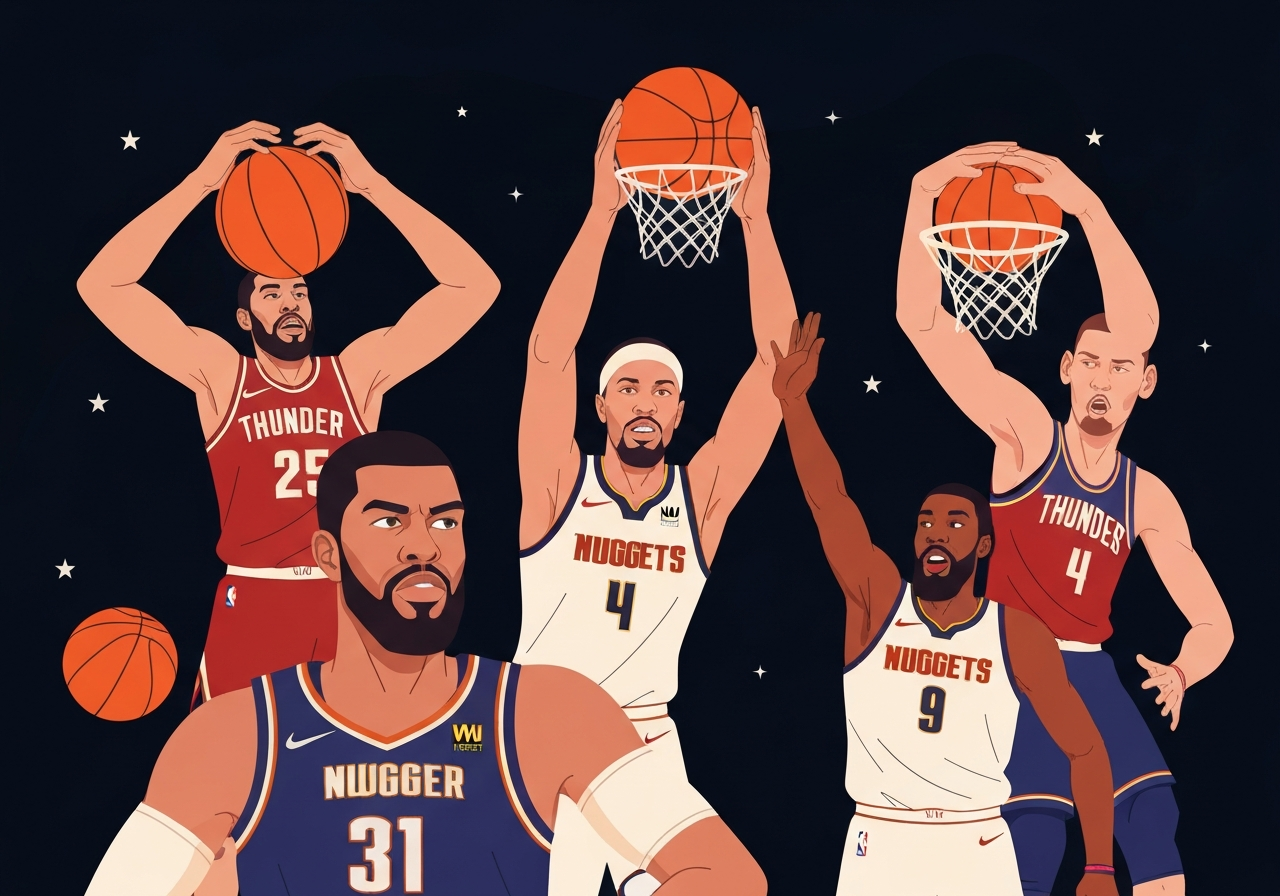
Following tonight’s Denver at Oklahoma City game, AP’s Cliff Brunt interviewed crew chief James Williams to clarify multiple officiating decisions. Williams explained why Nikola Jokić was not assessed a technical foul for a pre-whistle forearm contact, why Luguentz Dort’s foul was upgraded to a flagrant 2 and resulted in ejection, and why the separate confrontation between Jokić and Jaylin Williams did not produce ejections. The crew chief’s responses were provided in the official postgame pool report and outline how the crew interpreted the plays under current NBA rules.
Key Takeaways
- Jokić was not given a technical for the initial post-whistle left-forearm contact because officials determined it did not meet the unsportsmanlike-act threshold.
- Lu Dort’s foul was upgraded to a flagrant foul penalty 2 because the crew judged the contact unnecessary, excessive and with a high potential for injury; that classification mandates an automatic ejection.
- The separate physical confrontation between Jokić and Jaylin Williams did not lead to ejections; both players received offsetting unsportsmanlike technicals instead.
- The exchange and subsequent calls were reviewed by the on-court crew after the game under standard pool-report procedures conducted by Crew Chief James Williams.
- The pool interview was conducted by Cliff Brunt for The Associated Press and summarized the crew chief’s on-the-record explanations.
Background
NBA officiating protocol directs crew chiefs to review incidents during and after games and issue a pool report when requested by media. Pool reports document the crew’s rationale for penalties and are intended to increase transparency on subjective decisions such as flagrant and technical fouls. The league defines a flagrant foul penalty 2 as unnecessary and excessive contact with a high potential for injury; that classification carries an automatic ejection, while unsportsmanlike technicals address altercations or gestures that do not meet flagrant thresholds.
Games between the Denver Nuggets and Oklahoma City Thunder have featured physical matchups in recent seasons, raising scrutiny whenever hard contact leads to escalation. Officials must weigh intent, force, location of contact, and whether an altercation continued or de-escalated when applying rules. The crew chief’s postgame explanations are a routine mechanism to provide context for decisions that can materially affect player availability and game flow.
Main Event
In the first quarter, play resumed after a whistle and footage showed Nikola Jokić make contact with an opponent using his left forearm before Shai Gilgeous-Alexander threw the ball in his direction. The pool report records Williams’ assessment that Jokić’s forearm contact did not rise to the level of an unsportsmanlike act, and therefore no technical foul was assessed on that sequence. The crew distinguished the forearm contact’s degree and intent from actions that would earn a technical.
Shortly afterward, Luguentz Dort committed a foul on Jokić that the crew later upgraded to a flagrant 2 on review, citing unnecessary and excessive contact with a high potential for injury. Because the rulebook prescribes an automatic ejection for flagrant 2, Dort was removed from the game under that standard. Williams noted that the contact also provoked an altercation that did not dissipate quickly, which informed the upgrade decision.
Later, a physical confrontation between Nikola Jokić and Jaylin Williams occurred; after review the crew determined neither player’s actions met the ejection threshold. Both players were assessed unsportsmanlike technical fouls that offset, meaning neither ejection nor additional in-game suspensions resulted from that specific exchange. Williams summarized these distinctions in the pool interview to explain why different sequences produced different penalties.
Analysis & Implications
Officials must apply subjective standards consistently, and small distinctions in force or follow-through can change a call from no foul to a technical or flagrant. The crew’s explanation underscores that the same ongoing sequence can contain multiple discrete incidents, each judged on its own merits under the rulebook. In this case, the initial forearm by Jokić was judged insufficiently severe, while Dort’s later contact crossed the line into a flagrant 2.
The immediate consequence was Dort’s ejection and reduced availability for the Thunder in-game rotation; that ejection can affect competitive balance and short-term coaching decisions. For Denver, avoiding an ejection on Jokić kept their primary playmaker on the floor, which has clear tactical implications. Beyond the single game, any flagrant-2 ejection is subject to league review for potential supplemental discipline, which could affect roster availability in subsequent contests.
Officiating explanations in pool reports also influence public perception of consistency. Teams and fans often compare similar incidents across games to argue for or against perceived bias; clear, rule-based explanations help mitigate disputes but rarely eliminate debate. The league’s follow-up reviews, if any, will test whether the in-game ruling aligns with broader enforcement patterns and precedent.
Comparison & Data
| Foul Type | Typical Definition | Immediate Game Penalty |
|---|---|---|
| Unsportsmanlike Technical | Non-violent acts or gestures judged unsportsmanlike | Technical assessed; no ejection if offset |
| Flagrant 1 | Unnecessary contact; not excessive | Free throws and possible possession; no automatic ejection |
| Flagrant 2 | Unnecessary and excessive contact; high injury risk | Free throws, possession, and automatic ejection |
The table above summarizes how the league typically categorizes these common contact fouls and their immediate consequences. In tonight’s game, the crew applied the flagrant-2 standard to Dort’s contact because they judged it both unnecessary and excessive, while other contacts were treated as technicals or not penalized. Such distinctions determine whether a player remains in the contest and whether the league may open a postgame disciplinary review.
Reactions & Quotes
Below are the crew chief’s on-record explanations and the formal rule context the crew referenced. Each excerpt is presented with context to show why officials reached their determinations.
After being asked why Jokić was not given a technical for the pre-whistle contact, Williams emphasized the crew’s threshold for an unsportsmanlike act and explained that this particular forearm contact did not meet that threshold.
“We did not believe the contact by Jokić’s left forearm rose to the level of an unsportsmanlike act.”
James Williams, NBA crew chief (pool report)
Regarding Dort’s foul, Williams detailed the factors that led to an upgrade to flagrant 2, highlighting unnecessary and excessive force and the altercation that followed as central reasons for ejection.
“Lu Dort was assessed a flagrant foul penalty 2 because we deemed his contact on Jokić to be unnecessary and excessive with a high potential for injury.”
James Williams, NBA crew chief (pool report)
To place the crew chief’s assessment in formal rule language, the league defines flagrant-2-level contact in terms of excessiveness and injury risk. That rulebook framing is what governs automatic ejection and helps explain the game’s outcomes when such a call is made.
“A flagrant foul penalty 2 is unnecessary and excessive contact with a high potential for injury, and it carries an automatic ejection.”
NBA rulebook (official)
Unconfirmed
- Whether the NBA’s league office will open a formal supplemental-discipline review of Dort’s flagrant-2 ejection is not yet announced by the league.
- Any potential fines or further penalties for involved players beyond in-game ejections/technicals remain unconfirmed pending league follow-up.
Bottom Line
The crew chief’s pool-report explanations make clear that officials applied the rulebook’s threshold tests to distinct incidents in tonight’s Nuggets–Thunder game. Jokić’s initial forearm contact was judged below the unsportsmanlike threshold, Dort’s contact was judged sufficiently severe to merit a flagrant 2 and ejection, and the Jokić–Williams confrontation produced offsetting technicals rather than ejections.
Those distinctions matter for game management, roster availability, and potential league discipline. Fans and teams will likely scrutinize the decisions, but the official rationale—grounded in rulebook language about unnecessary/excessive contact and injury potential—provides the governing framework the crew cited in its postgame pool report.
Sources
- Pool Report on Tonight’s Nuggets at Thunder Game — Official NBA pool report (league)
- NBA Rule No. 12: Fouls and Penalties — Official NBA rules (league)
- Associated Press — News agency (interview conducted by Cliff Brunt)