
Lead
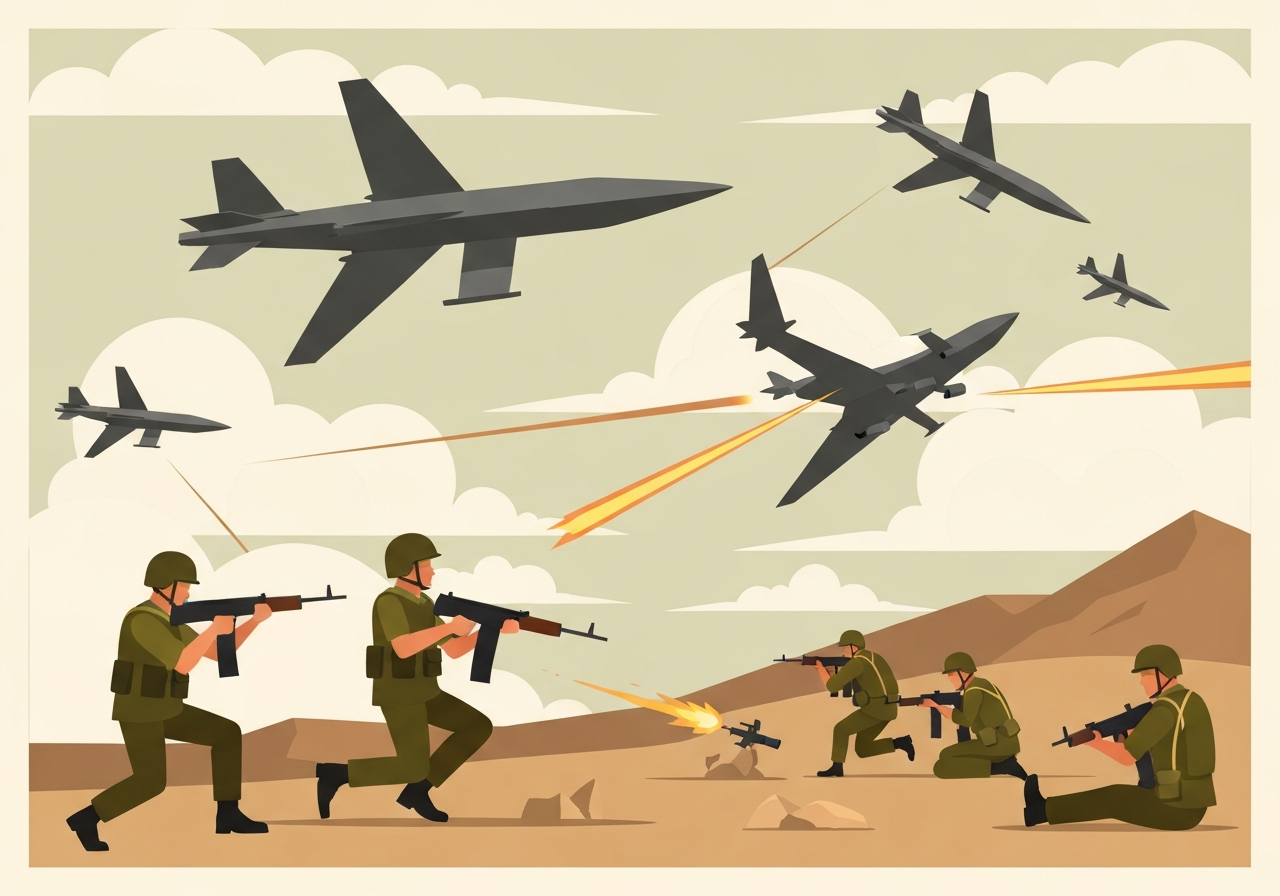
On February 28, 2026, U.S. forces engaged in active air-defense operations across the Middle East as Iran launched retaliatory missile strikes at multiple countries in the region. A U.S. official, speaking anonymously, said American land, air and naval units were participating to protect U.S. bases and personnel. Iran’s semi-official Fars News Agency reported the IRGC fired missiles at U.S. bases in Qatar, Bahrain, Kuwait and the United Arab Emirates. Intercepts and defensive actions were reported, and at least one person was killed by rocket shrapnel in the UAE.
Key Takeaways
- U.S. land, air and naval forces are conducting air-defense operations in the Middle East, according to an anonymous U.S. official spoken to Business Insider.
- Iran reportedly launched missiles at U.S. bases in Qatar, Bahrain, Kuwait and the UAE, per Fars News Agency; several incoming munitions were intercepted.
- Qatar’s defense ministry said it shot down missiles in multiple waves; Bahrain’s state news agency reported an attack on U.S. 5th Fleet facilities.
- At least one civilian in the UAE was killed by rocket shrapnel, officials in the UAE reported.
- More than a dozen U.S. warships, including two aircraft carriers, are operating in the region alongside U.S. fighter jets and air-defense batteries.
- President Donald Trump said the U.S. had begun “major combat operations” in Iran aimed at degrading nuclear and military capabilities.
- Israeli F-35 and F-15 aircraft were reported to have participated in strikes; the UK was not involved, according to available reports.
Background
Tensions that led to the February 28 actions have been building after a cycle of strikes between the United States, Israel and Iran through 2025 and into 2026. In June 2025 the United States conducted strikes on Tehran’s nuclear facilities under Operation Midnight Hammer, signaling a marked escalation from prior covert and proxy clashes. Israel has periodically launched strikes it deemed preemptive, and the two countries have coordinated in recent confrontations over Iranian assets and facilities.
The U.S. has bolstered its regional posture in recent weeks, sending additional ships, aircraft and air-defense batteries to the Eastern Mediterranean and the Middle East. Key regional hubs hosting U.S. forces include Al Udeid Air Base in Qatar—the largest U.S. base in the region—and Naval Support Activity Bahrain, home to the U.S. Navy’s 5th Fleet. Gulf states hosting U.S. installations play a direct role in regional deterrence and logistics.
Main Event
An anonymous U.S. official told Business Insider that American forces were actively engaged in layered air-defense operations across the region on February 28, 2026. The official said land-based batteries, fighter aircraft and naval assets were coordinating to intercept incoming threats and protect U.S. bases and personnel. The statement did not enumerate every unit involved but emphasized a tri-service defensive posture.
Iran’s semi-official Fars News Agency reported that the Islamic Revolutionary Guard Corps launched missiles targeting U.S. bases in Qatar, Bahrain, Kuwait and the UAE. Qatar’s defense ministry said it shot down missiles in multiple waves; Bahrain’s state news agency reported the U.S. 5th Fleet was targeted. The UAE said it intercepted several incoming munitions and that rocket shrapnel caused at least one fatality.
Israeli military sources said multiple waves of missiles fired from Iran were detected and that regional air-defense systems were actively engaging intercepts. Prior to the missile launches, U.S. embassies in Qatar, Bahrain and Jordan issued warnings urging American citizens to shelter in place. These alerts signaled U.S. officials expected imminent strikes and sought to minimize civilian harm.
U.S. forces have been operating a substantial maritime and aerial formation in the area: more than a dozen warships and two aircraft carriers were reported to be present in the Middle East and Eastern Mediterranean. American fighter jets and air-defense batteries have been employed for both defensive coverage and to support allied forces when necessary. U.S. and Israeli forces were reported to have conducted strikes earlier in the sequence of events that triggered Iran’s retaliation.
Analysis & Implications
The immediate implication is a heightened risk of wider military escalation across the Gulf and Levant. With U.S. land, air and naval assets actively defending bases in multiple host nations, the complexity of coordinating defensive and offensive maneuvers grows, increasing the chance of miscalculation or collateral damage. Host countries that host U.S. facilities now face direct security threats and must balance domestic stability with alliance obligations.
Operationally, sustaining prolonged air-defense missions demands significant logistics: munitions resupply, maintenance for interceptors and fighter sorties, and resilient command-and-control links. The presence of two aircraft carriers and over a dozen warships provides capacity for sustained air operations, but high-tempo intercepts can deplete inventory and stress crews, especially if attacks continue in waves.
Politically, the U.S. declaration of “major combat operations” and Israel’s reported preemptive strike raise legal and diplomatic questions internationally, particularly among partners in the region and countries advocating de-escalation. Gulf states hosting U.S. bases may face domestic pressure and foreign policy dilemmas as they absorb direct effects of the strikes and defensive actions.
Economically and globally, renewed and sustained Gulf hostilities could disrupt energy markets, shipping through the Strait of Hormuz and investor confidence. Even short-lived spikes in tensions historically have driven oil prices and shipping insurance costs higher, with knock-on effects on global trade and inflationary pressures.
Comparison & Data
| Asset | Count / Note |
|---|---|
| U.S. warships reported | More than a dozen in region |
| U.S. aircraft carriers present | 2 carriers (Eastern Mediterranean / Middle East) |
| Major U.S. regional bases | Al Udeid (Qatar), Naval Support Activity Bahrain, bases in Kuwait and UAE |
The table summarizes the force posture publicly reported: a substantial maritime grouping including two carriers and multiple surface combatants, plus deployed air-defense batteries and fighter squadrons. That combination supports layered defense and potential power-projection operations, but exact unit types and munitions levels are typically withheld for operational security.
Reactions & Quotes
U.S. and regional officials issued terse public statements while investigations and damage assessments continued.
“We have begun major combat operations aimed at degrading Iran’s nuclear and military capabilities.”
President Donald Trump / White House statement
Trump’s brief video statement framed U.S. action as intentional and targeted; it signaled escalation to a strategic campaign objective rather than an isolated response.
“Multiple waves of missiles were detected and our air-defense systems responded to intercept them.”
Israeli military
The Israeli military description emphasized detection and defensive action and did not provide an exhaustive tally of incoming rounds or intercept results.
“Missiles targeting our territory were engaged in multiple waves and defensive measures were taken.”
Qatar defense ministry (official statement)
Qatar’s notice to the public included a call for shelter and confirmed active defensive measures, underlining the immediate civilian protection focus.
Unconfirmed
- Independent verification of which IRGC units — or other Iranian elements — fired specific missiles has not been publicly confirmed.
- The full civilian and military casualty toll, beyond the UAE report of one fatality from shrapnel, remains unverified and may change as assessments continue.
- The exact scope of damage, if any, to U.S. bases or assets in the struck countries has not been fully disclosed by U.S. or host-nation officials.
Bottom Line
Events on February 28, 2026 represent a marked escalation in direct strikes and counterstrikes involving the U.S., Israel and Iran, with Gulf states caught in the crossfire. U.S. air-defense operations across land, sea and air assets aimed to protect bases and personnel, but they also signal a higher-stakes phase of the confrontation that could persist if reciprocal strikes continue.
Key indicators to watch in the coming days are independent casualty and damage assessments, the pace and scale of further missile or drone launches, and diplomatic moves by Gulf hosts and other powers to de-escalate. The operational tempo will test logistics and command structures, and international responses may shape whether the episode remains limited or expands into a broader regional conflict.
Sources
- Business Insider — news report citing anonymous U.S. official and regional statements
- Fars News Agency — semi-official Iranian outlet reporting IRGC missile launches
- Reuters — international news agency reporting on strikes and regional reactions