
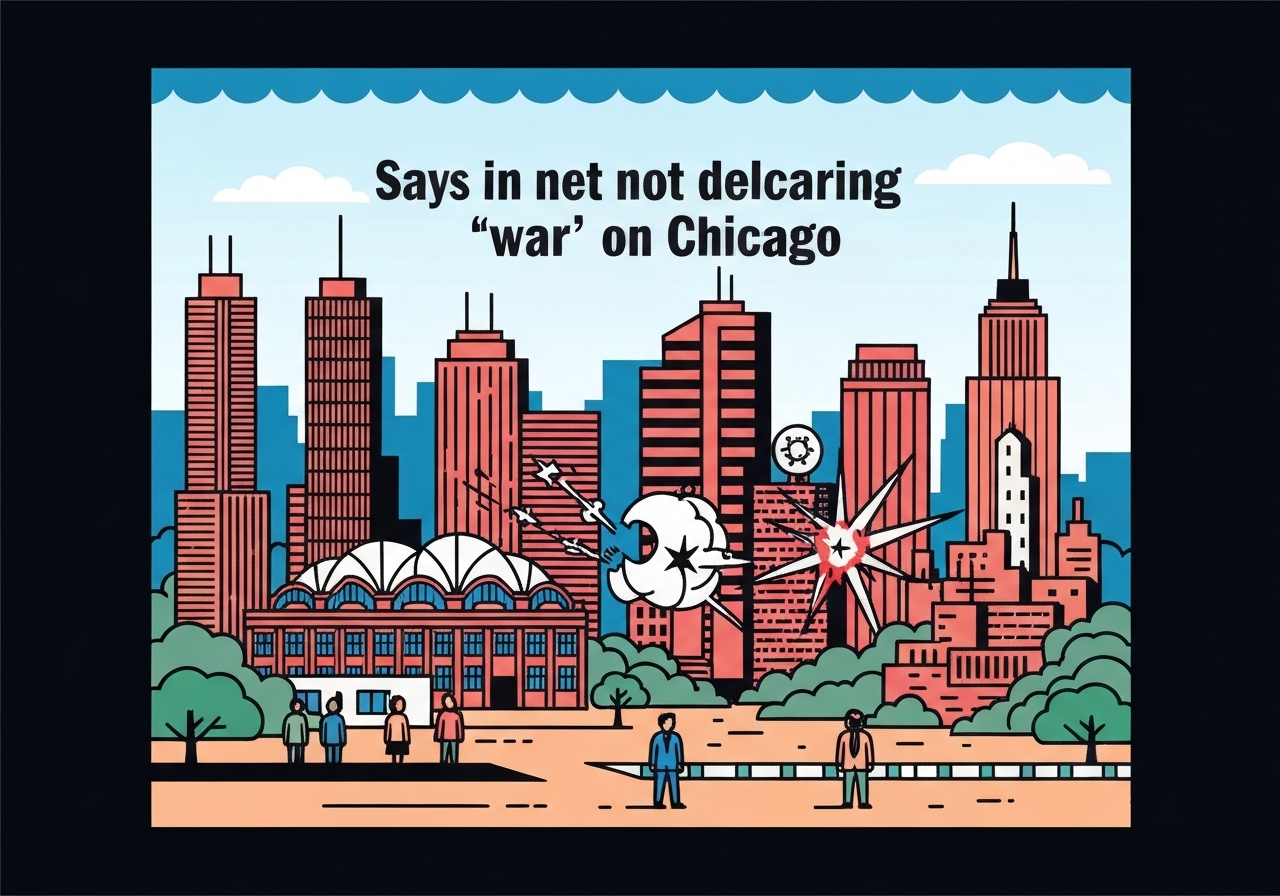
Lead: On Sept. 7, 2025, President Donald Trump sought to walk back a social media post that many interpreted as a threat to “declare war” on Chicago, saying instead that the administration intends to “clean up our cities.” The remark followed a weekend post that used imagery of helicopters, flames and the Chicago skyline and referenced the newly rebranded “Department of War.” The comment intensified a national debate over domestic deployments of federal forces and came as the president attended the U.S. Open in Flushing, Queens, where his appearance briefly delayed the men’s final. Local and state officials in Illinois responded with sharp rebukes and large street protests.
Key Takeaways
- On Sept. 6–7, 2025, President Trump posted an image referencing the “Department of War” and Chicago, then told reporters on Sept. 7 that the post did not mean he would “go to war” with the city.
- White House border czar Tom Homan said federal action, including possible National Guard deployments, could come to Chicago “this week,” though he declined to specify troop numbers.
- The president attended the U.S. Open on Sept. 7; enhanced security tied to his visit contributed to a 45-minute delay of the men’s final, which began at 2:48 p.m. ET.
- Chicago officials, including Gov. J.B. Pritzker and Mayor Brandon Johnson, condemned the post as an unprecedented threat against an American city and mobilized protests that drew thousands.
- The administration’s rebranding of the Defense Department as the “Department of War” remains ceremonial without congressional action but has already altered messaging and prompted legal and budget questions.
- Recent immigration enforcement operations, including a Sept. 4 raid at a Georgia battery plant that led to 475 arrests, are cited by the administration as part of a broader crackdown that it says informs its posture toward cities with high undocumented populations.
- Legal, congressional and civil-rights experts warned that unilateral domestic military deployments or an expanded federal law enforcement footprint risk constitutional and political pushback.
Background
Since taking office for a second term, President Trump has repeatedly framed criminality and irregular immigration as threats warranting expanded federal action. In early September 2025 he issued an executive order directing the executive branch to adopt the secondary name “Department of War” for the Defense Department, a symbolic change that the White House says signals resolve but that critics call provocative. The symbolic renaming does not change statutory authority; only Congress can alter department names in law.
Those moves came on the heels of a series of high-profile enforcement actions. On Sept. 4, U.S. immigration authorities staged a large-scale raid at a Hyundai-LG electric vehicle battery plant site in Ellabell, Georgia, detaining 475 people, roughly 300 of whom were South Korean citizens. The administration has pointed to such operations as part of a broader effort against criminal organizations and illegal employment, arguing federal assets are needed to support cities overwhelmed by crime and migration-related challenges.
Chicago sits at the center of the dispute. The city has about 2.7 million residents and estimates that roughly 150,000 people in the city are undocumented, making immigration enforcement a politically sensitive issue. Local leaders have repeatedly urged federal cooperation that is coordinated with city and state authorities, and they have warned that unilateral federal actions could inflame public safety and civil liberties concerns.
Main Event
The controversy began with a weekend social media post that featured an image of the president, helicopters, flames and the Chicago skyline with a caption invoking “Department of War.” The post was widely shared and quickly drew condemnation from Illinois officials. Gov. J.B. Pritzker called the message “not normal” and said the president’s language resembled that of a dictator. Mayor Brandon Johnson and other city leaders said the post threatened constitutional norms and fueled fear in immigrant communities.
On Sept. 7, as he departed the White House for the U.S. Open, the president addressed reporters and said, ‘We’re not going to war, we’re going to clean up our cities.’ He reiterated that his administration intended to target criminal cartels and illegal immigration rather than declare armed conflict against a U.S. municipality. The White House has sought to recast the image as rhetorical and aimed at criminal networks.
Tom Homan, the administration’s border czar, amplified the enforcement framing on CNN and said federal action, including potential National Guard deployments to Chicago, could occur immediately, while declining to specify numbers or the legal authority that would be used. Homan said the post was “taken out of context” and emphasized prior targeted operations that removed violent offenders and individuals convicted of serious crimes.
The president’s appearance at Arthur Ashe Stadium on Sept. 7 created a separate point of friction. Enhanced security for the presidential visit produced extensive entry delays and a 45-minute postponement of the men’s final, which began at 2:48 p.m. ET. When the president was shown on the stadium scoreboard, he was met by predominantly loud booing, with some cheers mixed in; the visit concluded after the trophy presentation.
Analysis & Implications
Political and legal experts say the episode illustrates tensions between symbolic presidential messaging and the practical limits of federal authority. Renaming the Defense Department in executive branch communications is largely ceremonial without congressional action, but the rhetoric can change expectations about how and when the administration will use military or quasi-military forces domestically. That rhetoric alone can prompt local officials to alter policing or public-safety plans and can heighten already fraught public debate.
Any actual deployment of National Guard troops or federal agents to a state over a governor’s objection raises constitutional and statutory questions. Governors control state National Guard forces unless they are federalized, and the Posse Comitatus Act and related statutes constrain the use of active-duty forces for domestic law enforcement. Legal scholars warn that using federal combat forces inside U.S. cities to carry out law-enforcement functions could trigger litigation and congressional oversight battles.
Politically, the episode is likely to deepen polarization. For supporters of the administration, aggressive language and high-profile raids signal decisive action on crime and immigration. For opponents, the same tactics and language suggest an expansion of executive power and a willingness to use intimidation for political ends. Midterm and local elections, public safety budgets, and law-enforcement cooperation agreements could all be affected by the trajectory this dispute takes over the coming months.
Comparison & Data
| Topic | Recent Example | Key Figures |
|---|---|---|
| U.S. Open match delay | Arthur Ashe Stadium, Sept. 7, 2025 | 45-minute delay; match began 2:48 p.m. ET |
| Georgia plant raid | Ellabell, Ga., Sept. 4, 2025 | 475 arrests; ~300 South Korean citizens detained |
| Chicago undocumented estimate | City data/estimates | ~150,000 undocumented residents (~8% of households) |
Context: The table highlights discrete events that informed the administration’s messaging in early September 2025. The U.S. Open delay illustrates the operational effects of high-profile presidential travel; the Georgia raid underscores the administration’s intensified immigration enforcement; and Chicago’s undocumented population helps explain why federal actions there are politically charged.
Reactions & Quotes
We’re not going to war, we’re going to clean up our cities, we’re going to clean them up so they don’t kill five people every weekend.
President Donald J. Trump (remarks to reporters, Sept. 7, 2025)
Context: The president used the phrase to differentiate enforcement actions aimed at criminal networks from armed conflict with a U.S. city, but critics said the imagery and earlier post contradicted that explanation.
The President of the United States is threatening to go to war with an American city. This is not a joke. This is not normal.
Gov. J.B. Pritzker (Illinois, social media statement)
Context: Illinois leaders mobilized protests and framed the post as an unprecedented escalation, underscoring local political resistance to unilateral federal enforcement actions.
The words were taken out of context. We are going to war with the criminal cartels and illegal aliens, public safety threats — not with a city.
Tom Homan, White House Border Czar (CNN interview)
Context: Homan suggested federal operations could begin quickly but did not provide details about authority, scope or troop levels, leaving legal and procedural questions open.
Unconfirmed
- Precise timing and size of any National Guard or federal deployments to Chicago remain unconfirmed; administration officials have not provided troop numbers or legal justifications.
- There is no verified public record confirming an immediate surge in ICE activity inside Chicago tied directly to the weekend post.
- The total cost of implementing the “Department of War” rebranding across the Defense Department remains unclear; administration figures have not been substantiated.
Bottom Line
The episode exposes a fault line between presidential rhetoric and the practical, legal limits on federal power inside U.S. cities. While the president insists the intent is targeted enforcement against criminal networks and illegal immigration, the imagery and language used created a perception of military threat that galvanized local political leaders and residents.
Look ahead: watch for concrete decisions that will determine whether this becomes a legal and constitutional standoff or a rhetorical skirmish. Key indicators include formal orders or memoranda that specify legal authority for deployments, any public troop movements or federal-agent surges in Chicago, congressional oversight activity, and litigation challenging deployments or the use of executive resources for domestic law enforcement.
Sources
- The New York Times — news media reporting and timeline of events (Sept. 7, 2025)
- CNN — interview with Tom Homan, White House border czar (TV network)
- United States Tennis Association (USTA) — event logistics and stadium information (official organizer)
- Reuters — reporting on Georgia plant immigration raid (news agency)