
Lead
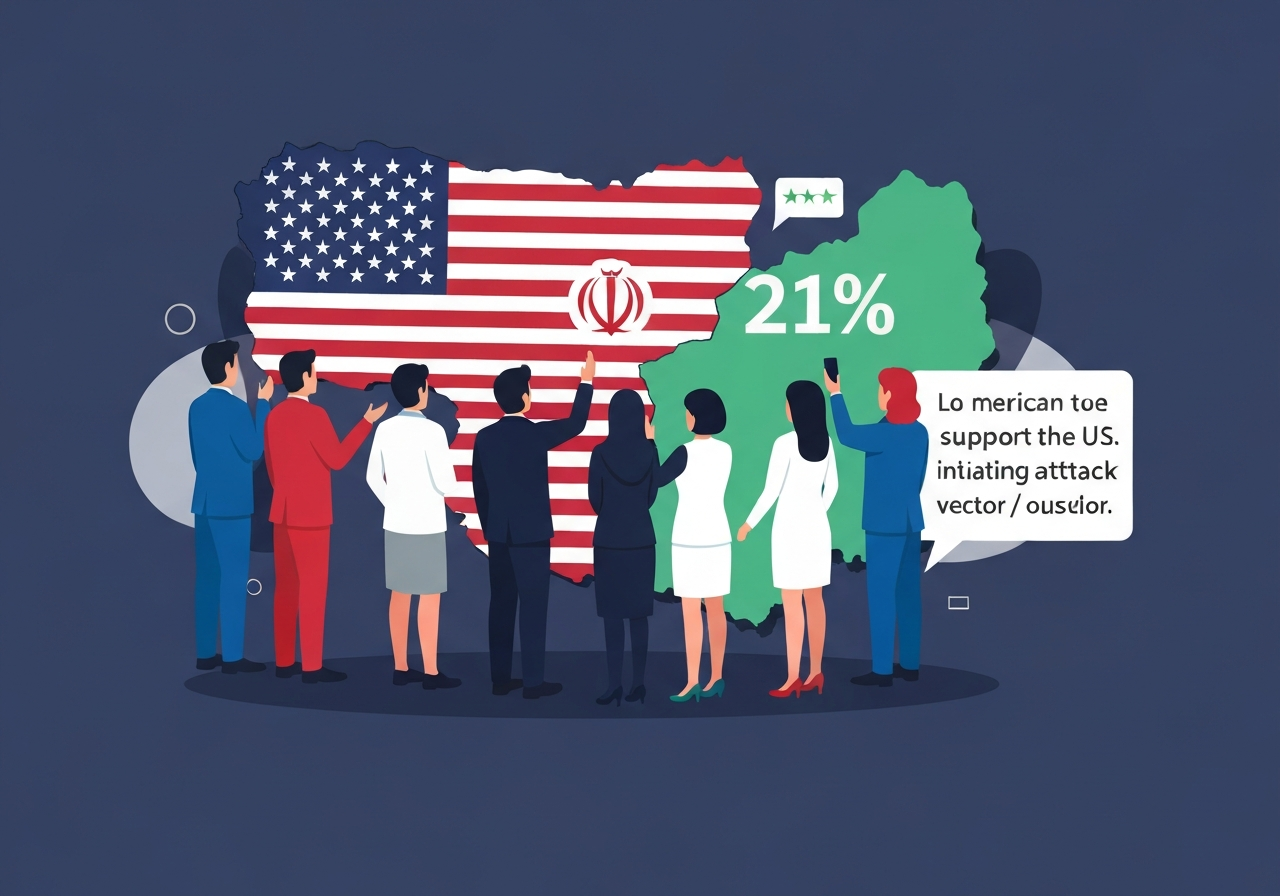
A University of Maryland poll conducted in mid-February found that only 21 percent of U.S. adults said they would support the United States initiating a military strike on Iran. The survey, taken roughly two weeks before Feb. 28, 2026, showed 49 percent opposed such action and 30 percent were unsure. An AP-NORC poll taken the week before Feb. 28 also reported low public confidence in President Trump’s handling of military force. The findings suggest limited public appetite for a new U.S. military initiative against Iran ahead of the moves by President Trump and Israel on Saturday.
Key Takeaways
- Just 21% of Americans said they would support the United States initiating an attack on Iran, according to the University of Maryland poll conducted in mid-February.
- Forty-nine percent of respondents opposed such an attack, while 30% were undecided, leaving nearly four in five Americans not in favor.
- Among Republicans surveyed, 40% favored a strike, 25% opposed it and 35% reported they did not know.
- An AP-NORC poll conducted the week before Feb. 28 found only 27% of U.S. adults trusted President Trump to make the right choices on using military force; just 14% of independents expressed that trust.
- Concern about Iran’s nuclear program is high: almost half of adults said they were extremely or very concerned, and another 31% said they were moderately concerned.
Background
Debate over U.S. military action toward Iran has intensified amid rising tensions in the region and recent Israeli operations. Historically, American public opinion on foreign military engagements has varied by perceived threat, partisan leanings and confidence in presidential leadership. The mid-February University of Maryland poll captured sentiment before public attention was refocused by actions taken on Saturday by President Trump and Israel.
Polling on Iran often shows a separation between concern about Iran’s activities and support for direct U.S. military intervention. Respondents frequently express worry about nuclear proliferation while also preferring diplomatic or multilateral responses. Political party affiliation and trust in executive decision-making power are recurring predictors of willingness to support the use of force.
Main Event
The University of Maryland poll, fielded roughly two weeks before Feb. 28, recorded that 21% of respondents would back a U.S.-initiated attack on Iran; 49% were against and 30% unsure. That distribution indicates a substantial base of opposition or uncertainty across the electorate at that moment. The survey also highlighted intra-party divisions: a plurality of Republicans (40%) favored a strike, but a significant share remained opposed or undecided.
Separately, the AP-NORC poll published the week before Feb. 28 found limited confidence in President Trump’s judgment on the use of military force abroad, with only 27% of adults overall expressing trust. Political independents reported particularly low trust at 14%. These trust metrics correlate with lower public willingness to authorize offensive action under presidential direction.
At the same time, polling indicates elevated public concern about Iran’s nuclear program: nearly half call their concern “extremely” or “very” high, and 31% are moderately concerned. That mix—high concern about nuclear developments but low support for unilateral military action—frames the central tension in public sentiment documented by the surveys.
Analysis & Implications
The divergence between high anxiety about Iran’s nuclear ambitions and low support for a U.S. strike suggests Americans prefer alternatives to immediate military escalation. Options likely to be more politically acceptable include sanctions, diplomatic pressure, and multilateral efforts through international institutions. Policymakers face a constrained window for seeking broad public or congressional endorsement of offensive military steps.
Partisan splits are meaningful but not absolute. While a plurality of Republicans in the poll favored a strike, sizable shares were opposed or unsure, underscoring internal caution. Independents’ low trust in President Trump on use-of-force decisions (14% in AP-NORC) is particularly salient: policymakers who rely on independent voters for broader legitimacy may find it harder to secure backing for unilateral action.
Internationally, limited U.S. domestic support could reduce American leverage in coalition building. Allies weighing participation will factor U.S. public opinion into political calculations, especially if congressional authorization is required or if long-term commitments emerge. Conversely, Iranian and regional actors may interpret low domestic appetite for military action as a constraint on U.S. coercive options.
Comparison & Data
| Measure | Share |
|---|---|
| Support for U.S. initiating attack on Iran (national) | 21% |
| Oppose | 49% |
| Undecided/Don’t know | 30% |
| Republicans favoring strike | 40% |
| Trust Trump on military decisions (AP-NORC) | 27% (14% independents) |
These figures show a clear majority of respondents were not in favor of initiating an attack at the time of the surveys. The Republican subgroup is more favorable than the national average, but even there a plurality position is not an overwhelming majority. Low trust in presidential military judgment, particularly among independents, amplifies political constraints.
Reactions & Quotes
Polling organizations and observers framed the numbers as indicative of public caution rather than unconditional opposition to countering perceived threats.
“Just 21 percent of Americans said they would support the United States initiating an attack on Iran.”
University of Maryland (poll finding)
The AP-NORC results were cited to underline limited confidence in executive military judgment.
“Only 27 percent of Americans said they trusted President Trump to make the right choices when it comes to the use of military force abroad.”
AP-NORC (poll finding)
Unconfirmed
- Whether public opinion shifted materially after the actions taken by President Trump and Israel on Saturday remains to be confirmed by post-event polling.
- How congressional leaders will respond to the poll findings and whether those reactions will influence any formal authorization for force is not yet determined.
- Detailed subgroup movement (by age, religion, or region) on this question after the weekend developments has not been publicly released.
Bottom Line
The mid-February polls show limited public readiness for the United States to initiate military action against Iran: 21% in favor, 49% opposed and 30% unsure. High concern about Iran’s nuclear program coexists with reluctance to authorize unilateral U.S. military action, reflecting a preference for nonmilitary or multilateral approaches among many Americans.
For policymakers, these results imply political headwinds for a new offensive campaign without broader public persuasion or international coalition-building. Observers should watch for follow-up surveys after the Feb. 28 weekend actions to assess whether public sentiment has shifted and whether trust in executive decision-making on force changes in response to unfolding events.
Sources
- The New York Times (news report summarizing poll results)
- AP-NORC Center (independent polling organization; AP-NORC poll on trust in presidential use-of-force)
- University of Maryland (academic institution; source of the mid-February public-opinion survey)