
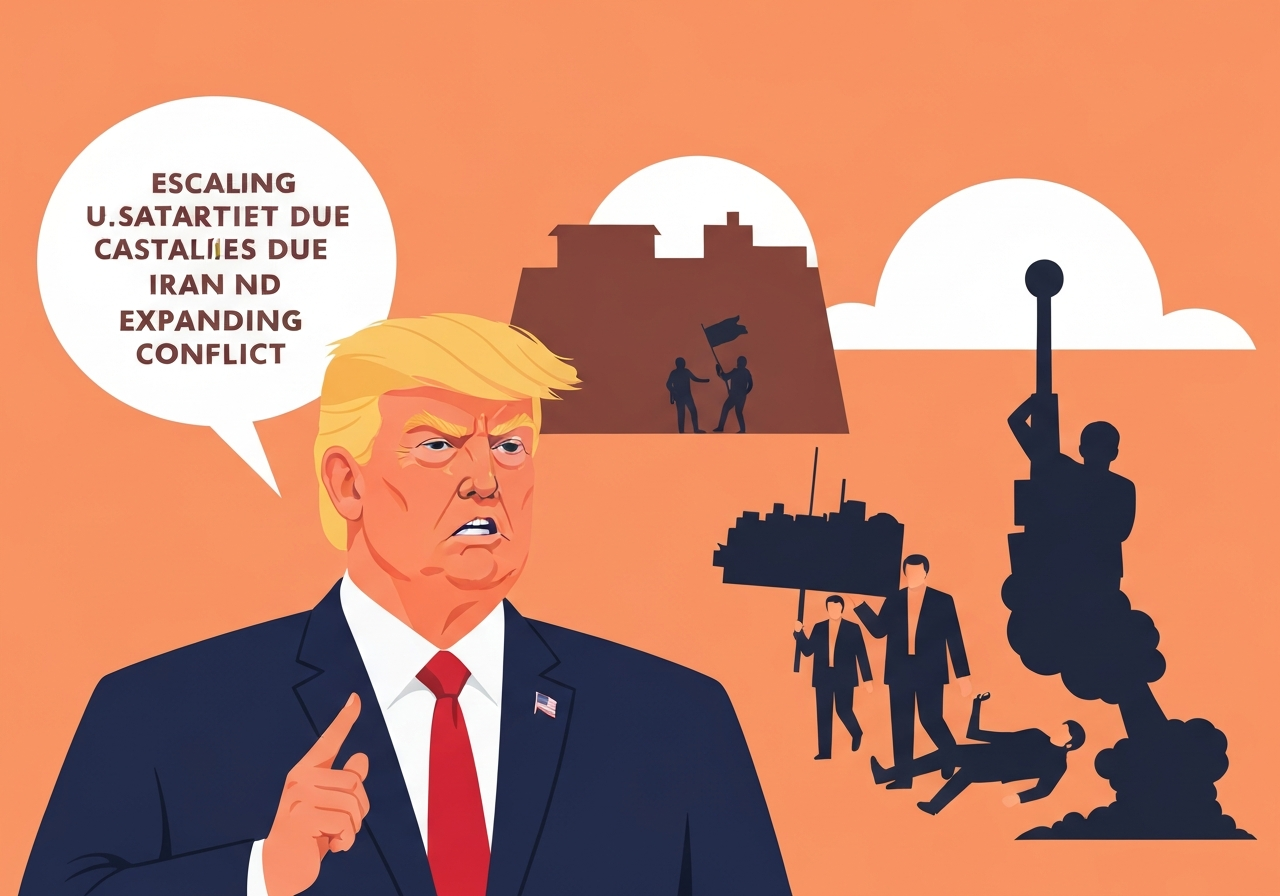
Lead: President Donald Trump warned Sunday that U.S. military deaths could rise after three American service members were killed in a suspected drone strike in Kuwait, as the confrontation between the United States, Israel and Iran widened across the region. Hezbollah said it had launched missiles and drones at an Israeli army base in retaliation for the killing of Iran’s Supreme Leader Ayatollah Ali Khamenei, and Israeli strikes hit Lebanese areas including Beirut’s southern suburbs. Explosions were reported in Tehran and Karaj and governments across Asia and the Gulf scrambled to evacuate or protect citizens and facilities. Airspace closures and damage to major infrastructure, including reports of strikes near Dubai International Airport and an attack at a British base in Cyprus, have disrupted travel and markets.
Key takeaways
- Three U.S. service members were killed in a suspected drone strike in Kuwait; President Trump said casualty projections could be “quite a bit higher” than three.
- Hezbollah confirmed it launched “missiles and a swarm of drones” at an Israeli army base south of Haifa, marking its first rocket fire since November 2024.
- Pentagon briefers told congressional staff that Iran was not planning strikes on U.S. forces unless Israel attacked Iran first, undercutting White House assertions of an imminent threat.
- At least 10 people have died and 238 casualties were treated or evacuated in Israel since operations began, according to Magen David Adom, with 221 classified as mildly injured.
- Airspace over a broad Middle East corridor was closed, Dubai International Airport suffered reported damage, and oil futures jumped—U.S. crude rose roughly $8 (about 12%) to near $75 a barrel in early trades.
- Countries including Thailand (about 110,000 nationals in the region), Pakistan and India announced evacuation preparations or facilitation routes for citizens in affected areas.
- The UK said a suspected drone struck RAF Akrotiri in Cyprus at midnight; no casualties were reported and the base raised force-protection levels.
- U.S. Central Command posted footage of “Operation Epic Fury,” saying strikes continued to remove imminent threats attributed to the Iranian regime.
Background
Fighting escalated after U.S. and Israeli strikes killed Iran’s Supreme Leader Ayatollah Ali Khamenei and, officials say, several senior figures in the Iranian command structure. The strikes prompted Iran to conduct retaliatory missile and drone attacks on the region, leading to a rapid expansion of hostilities that now involve state and nonstate actors across multiple borders. Tensions since late 2023 have involved proxy engagements, cyber operations and maritime incidents; the current round is the most direct confrontation between those forces in months.
Hezbollah, an Iran-backed militant and political movement based in Lebanon, had observed a U.S.-brokered ceasefire with Israel since November 2024, but its statement that it launched projectiles and drones represents a clear reentry into kinetic operations. Regional partners and Gulf states—many of which host large expatriate workforces from South and Southeast Asia—are grappling with mass displacement and the logistics of evacuating civilians. Global markets and air travel have been sensitive to each development: oil prices and equity futures moved sharply on reports of strikes and base damage, while NATO members and allied partners reviewed force posture and base access in the eastern Mediterranean and Gulf.
Main event
On Sunday and into Monday local time, multiple explosions were reported across Tehran and the nearby city of Karaj, while Iranian state outlets and social media circulated footage showing underground drone tunnels said to belong to the Islamic Revolutionary Guard Corps. Iran’s state media reported that patients were evacuated from Gandhi Hospital in Tehran after damage was recorded; international agencies are seeking to verify those accounts. Tehran’s state and semi-official outlets framed the footage and reports as evidence of Iran’s retaliation and defensive posture following the strikes.
Hezbollah publicly claimed it targeted an Israeli army base south of Haifa with missiles and drones “in revenge” for Khamenei’s death; the Israel Defense Forces said it intercepted projectiles and struck what it described as senior Hezbollah operatives in and around Beirut. Lebanese authorities reported evacuations from the southern suburbs of Beirut and ordered urgent Cabinet-level meetings. The IDF also issued evacuation calls and stated that residents should move at least 1,000 meters from villages near reported Hezbollah positions.
In the Gulf, Dubai International Airport was reported damaged in missile strikes, and the UK said RAF Akrotiri in Cyprus suffered limited damage from a suspected unmanned drone; Cyprus and British officials reported no casualties. Several countries tightened protections for their facilities and citizens: Japan, Thailand, Pakistan and India announced contingency plans or evacuation measures, pointing out the region’s large migrant-worker populations—India, Pakistan, Bangladesh, Thailand and the Philippines have millions working across Gulf states and in Israel and Jordan.
On the U.S. side, CENTCOM released brief footage of operations it called “Operation Epic Fury” and the Department of Defense scheduled a briefing with Secretary of Defense Pete Hegseth and Chairman Gen. Dan Caine. The administration has defended strikes as necessary to eliminate imminent threats, while internal Pentagon briefings reportedly told congressional staff that Iran had not planned direct attacks on U.S. forces absent Israeli action against Iran.
Analysis & implications
Strategically, the conflict’s expansion risks a widening regional war that would involve state actors, proxy militias and critical maritime and energy routes. If Hezbollah sustains or increases its direct engagement with Israel, Lebanon could again face large-scale displacement and infrastructure damage; repeated cross-border strikes raise the prospect of a protracted low- to mid-intensity campaign along the northern Israeli-Lebanese frontier. For Iran, a combination of direct strikes and proxy activity allows deniability in some eyes while still signaling capability and deterrent will to domestic and regional audiences.
Politically, the U.S. administration’s public justification for strikes—centering on imminent threats to American forces—was complicated by Pentagon briefings to congressional staff indicating Iran was not planning strikes on U.S. forces unless Israel struck Iran first. That discrepancy creates pressure on policymakers and lawmakers to reconcile public claims with internal assessments, and may shape oversight hearings and allied consultations in the coming days. The administration’s references to prior operations, including the removal of Nicolás Maduro in Venezuela earlier this year, frame one possible political endgame but also highlight the uncertainty about Iran’s post-strike leadership dynamics.
Economically, the immediate effects are visible in energy markets and equities: a sharp spike in oil prices increases costs for import-dependent economies and raises inflationary pressure worldwide. Prolonged disruption to Gulf production or shipping lanes would exacerbate these pressures and could force governments to coordinate strategic petroleum releases or diplomatic moves to stabilize markets. For regional partners and diaspora communities, the logistics and human costs of large-scale evacuations will be a near-term humanitarian and diplomatic challenge.
Comparison & data
| Indicator | Recent change / figure |
|---|---|
| U.S. crude (approx.) | Up ~$8, ≈12% to about $75/barrel |
| Brent crude (approx.) | Up >12% to about $82/barrel (settled just over $73 Friday) |
| Nikkei 225 (Japan) | Down ~1.26% (opening figures) |
| Hang Seng (Hong Kong) | Down ~0.9% |
| ASX 200 (Australia) | Down ~0.5% |
The market snapshot above shows how energy and equity markets reacted within hours of the strikes. Oil’s double-digit intraday moves reflect traders pricing higher geopolitical risk and potential supply disruptions from the Gulf; Asian equity declines are consistent with risk-off sentiment and higher commodity prices. Historical comparisons show that sustained interruptions can push global energy prices higher for prolonged periods, amplifying inflation and fiscal strains for energy-importing countries.
Reactions & quotes
Senior U.S. officials and allied governments issued firm condemnations and described coordinated responses, while regional governments focused on citizen protection and base defense. The following statements capture official tone and immediate policy posture from key actors.
Context before quote: President Trump spoke to The New York Times about casualty projections and framed previous operations as a model for outcomes he favors. His remarks underline the administration’s public posture about both operations and possible political outcomes in Iran.
“Three is three too many as far as I’m concerned… it could be quite a bit higher than that.”
President Donald Trump (to The New York Times)
Context after quote: The president reiterated a willingness to pursue leadership change in Iran and referenced prior U.S. action in Venezuela as a template. Those comments underscore uncertainty about U.S. strategic objectives beyond degrading immediate threats and may shape congressional scrutiny.
Context before quote: World Health Organization Director-General Tedros Ghebreyesus addressed reports of damage to Tehran’s Gandhi Hospital and stressed protections for medical facilities under international law.
“Reports of Tehran’s Gandhi Hospital being damaged … are extremely worrying.”
Tedros Adhanom Ghebreyesus (WHO)
Context after quote: WHO said it was working to verify the reports; independent verification remained pending at the time of reporting. Statements like this signal international concern for civilian infrastructure and may prompt humanitarian response planning if confirmed.
Context before quote: The Israel Defense Forces issued public guidance to civilians in northern Israel and described operations against Hezbollah following projectile launches from Lebanon.
“The IDF will operate against Hezbollah’s decision to join the campaign, and will not enable the organization to constitute a threat to the State of Israel.”
Israel Defense Forces (official statement)
Context after quote: The IDF also ordered evacuations across 52 southern Lebanese-border settlements and reported strikes on alleged Hezbollah positions; Lebanon’s government called for restraint and vowed to protect civilians. Those measures reflect both tactical responses and concern about escalation on multiple fronts.
Unconfirmed
- Reports that Gandhi Hospital in Tehran was directly struck remain unverified by independent on-the-ground sources; WHO said it was seeking confirmation.
- Footage released by Iran’s Fars News Agency showing underground drone tunnels has not been independently dated or geolocated, and its direct link to the recent retaliatory strikes is unconfirmed.
- The precise location inside Kuwait where the three U.S. service members were killed is not immediately clear, according to clarifications from reporting outlets.
- Projections of U.S. casualty totals beyond the confirmed three are based on modeling and internal estimates and should be treated as provisional until official tallies are released.
Bottom line
The confrontation that began with targeted strikes has broadened into a multi-front regional crisis involving state militaries, proxy forces and critical infrastructure. Immediate priorities for governments include protecting civilians, securing evacuation routes and preventing further escalation between Israel and Hezbollah while managing allied coordination on basing and force posture.
Markets and humanitarian systems will feel pressure in the coming days: energy-price volatility threatens broader economic spillovers, and large expatriate populations in the Gulf and Israel mean evacuation logistics and consular coordination will remain complex. Transparent reporting of verified facts, prompt humanitarian access if civilian infrastructure is damaged, and clear congressional and allied oversight of military claims will be essential to manage risks and public confidence.