
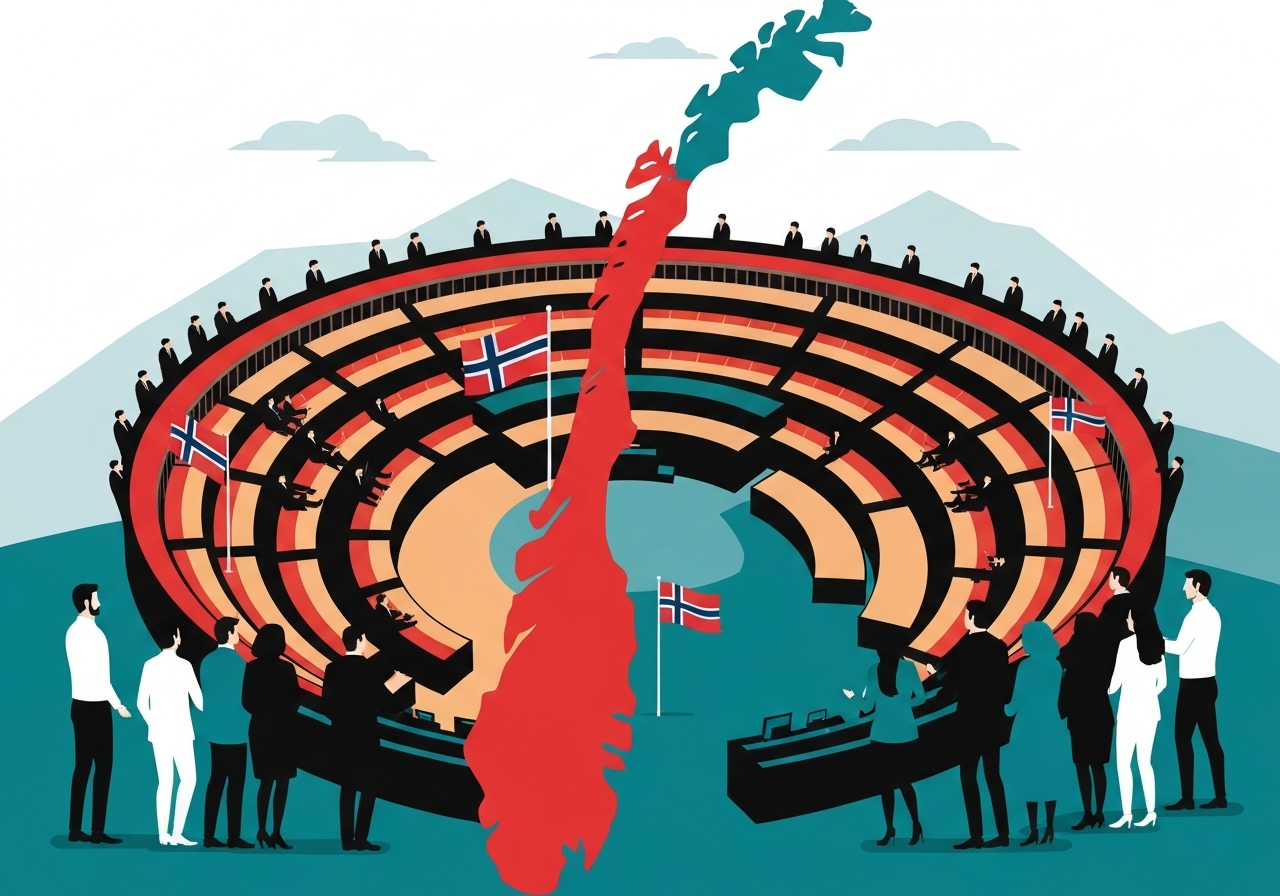
— Norwegians are casting ballots in a closely contested election to decide whether to renew Jonas Gahr Støre’s Labour leadership or hand power to a centre‑right bloc led by the Progress Party and Høyre. The campaign has been shaped by international crises including the wars in Gaza and Ukraine, but domestic concerns — notably rising living costs and debates over a 1% wealth tax — dominated the final stretch. Norway’s sovereign wealth fund and debates over taxation and migration have sharpened the choice. Votes will be counted on Monday evening, and the balance of coalition arithmetic will determine who governs in the 169‑seat Storting.
Key takeaways
- Election day is 8 September 2025; Norway’s 4 million voters choose between Labour and a centre‑right bloc.
- The Storting has 169 seats; a majority requires 85 seats and coalitions or minority arrangements are likely.
- A central campaign flashpoint is the 1% wealth tax on assets above 1.76m NOK (about £130,000 / $175,000), with pressure from the Progress Party and Høyre to reduce or exempt business capital.
- Labour, led by 65‑year‑old Jonas Gahr Støre, is campaigning for a second term and has enlisted Jens Stoltenberg to lead finance policy discussions.
- Right‑wing Progress under Sylvi Listhaug (47) and Høyre under former PM Erna Solberg (67) are in a competitive bloc; which leader would become prime minister remains uncertain.
- Norway’s $1.9tn sovereign wealth fund (managed by NBIM) recently divested holdings in many Israeli companies, a move that has politicized the campaign.
- Norway is outside the EU but in the EEA and Schengen; EU membership is not an active topic in this election.
Background
Norway is a founding NATO member with about four million eligible voters; it sits on the Arctic border with Russia and participates in the EU single market via the European Economic Area. The country’s politics are shaped by its energy wealth — oil and gas revenues helped build the world’s largest sovereign fund — and by strong public services financed through substantial taxation. That fiscal model is central to the debate over a 1% wealth tax that applies once net assets exceed 1.76m NOK, with exemptions that effectively reduce the taxable value of primary residences.
Since 2021 Norway has seen alternating minority governments and coalition negotiations are the norm in a proportional system of 19 constituencies. After the last election, Labour governed in a minority arrangement with the Centre party, but that alliance broke down in January over EU energy policy, leaving Støre to seek stability while campaigning for a renewed mandate. On the right, the Progress Party’s surge has complicated traditional Høyre leadership plans and created a contest within the centre‑right for credibility and prime ministerial ownership.
Main event
The campaign’s final televised debates, including exchanges at the Arendal political festival, focused on domestic bread‑and‑butter issues as well as foreign policy. Leaders debated taxation, welfare spending, and infrastructure, while also fielding questions about Norway’s international role. Støre emphasized continuity on social investment and a cautious approach to tax cuts, arguing a sudden rollback could hollow out public services.
Sylvi Listhaug and Erna Solberg presented competing centre‑right visions: Listhaug advocating sharper tax relief and stricter migration controls, and Solberg pressing a pragmatic conservative platform that would seek to protect business investment while courting moderate voters. Both have suggested different formulas for changing the wealth tax, with Høyre proposing exemptions for working capital such as shares and Progress calling for more comprehensive abolition.
The sovereign wealth fund’s recent decision to remove investments in many Israeli companies over alleged rights violations added an international dimension to the closing days of campaigning. NBIM’s chief executive publicly characterized the episode as one of the fund’s most difficult moments, intensifying scrutiny on how foreign policy and ethical guidelines intersect with Norway’s economic assets.
Analysis & implications
Short term, the election outcome will shape fiscal policy and the pace of tax reform. A centre‑right victory could push for substantive reductions to the wealth tax or targeted exemptions, which proponents argue would stem the emigration of wealthy individuals and boost investment. Labour warns such moves could exacerbate inequality and erode public revenue for health, education and infrastructure.
Politically, the result will test whether Norway’s electorate prefers continuity in the face of geopolitical instability or a clearer shift toward market‑friendly policy. If neither bloc reaches 85 seats, negotiations will determine whether a minority government can secure issue‑by‑issue support or whether a broader coalition is cobbled together. That uncertainty could slow large reform packages and affect investor confidence in the near term.
Internationally, a government change might recalibrate Norway’s posture on EU relations, defence cooperation and fund governance. While EU membership is not on the immediate agenda, a centre‑right administration with an explicit pro‑EU wing could reopen discussions about closer integration — likely contingent on a future referendum. Meanwhile, the stewardship of the sovereign fund will remain a sensitive political issue, linking domestic tax choices to global investment strategies.
Comparison & data
| Metric | Value / context |
|---|---|
| Storting seats | 169 total; majority threshold 85 |
| Wealth tax | 1% on net assets above 1.76m NOK (discounts apply to main home) |
| Sovereign fund size | Approx. $1.9 trillion (managed by NBIM) |
The table highlights the institutional constraints: proportional representation produces fragmented parliaments and frequent coalition bargaining, while the wealth tax and the sovereign fund are central levers that link domestic redistribution to Norway’s global economic footprint. These figures underpin both parties’ strategic calculations in negotiations after the vote.
Reactions & quotes
Political leaders and institutional figures framed the election as a test of priorities. The finance discussion has been elevated by prominent figures offering stark warnings on the trade‑offs of tax reform.
“We must avoid a tax system that leaves the wealthiest paying little or nothing while others shoulder the burden.”
Jens Stoltenberg, former NATO secretary general (Labour finance advisor)
NBIM’s management has also been brought into public view as ethical investment decisions reverberate at home.
“This has been my worst‑ever crisis,”
Nicolai Tangen, CEO, Norges Bank Investment Management
Voters and commentators described the election atmosphere as preoccupied with daily costs and long‑term fairness rather than abstract geopolitics, though security issues remain a background factor after Russia’s invasion of Ukraine.
“Cost of living, schools and roads are what decides my vote,”
Andreas, voter from Arendal
Unconfirmed
- Which centre‑right leader would become prime minister if the bloc wins remains unresolved until post‑vote coalition talks conclude.
- Whether recent tax proposals would reverse the emigration of wealthy Norwegians to Switzerland is unproven and depends on the final form of any reform.
- Final vote distributions and exact seat counts will only be known after official counting concludes on Monday evening and provisional poll leads may not predict coalition outcomes.
Bottom line
The 8 September vote is a close contest about who should shape Norway’s post‑pandemic social contract: a Labour continuation placing emphasis on public services and cautious fiscal change, or a centre‑right pivot toward tax cuts and business incentives. Regardless of the winner, coalition arithmetic will be decisive and the next government will likely face early tests on taxation, infrastructure spending and how to balance ethical investment guidance with international economic pressures.
For readers, the most consequential developments to watch after polls close are the seat tallies, the immediate coalition talks over the 85‑seat threshold, and any rapid policy signals on the wealth tax and sovereign fund governance. Those outcomes will determine whether Norwegian policy follows a steady course or embarks on a marked policy shift within months.