
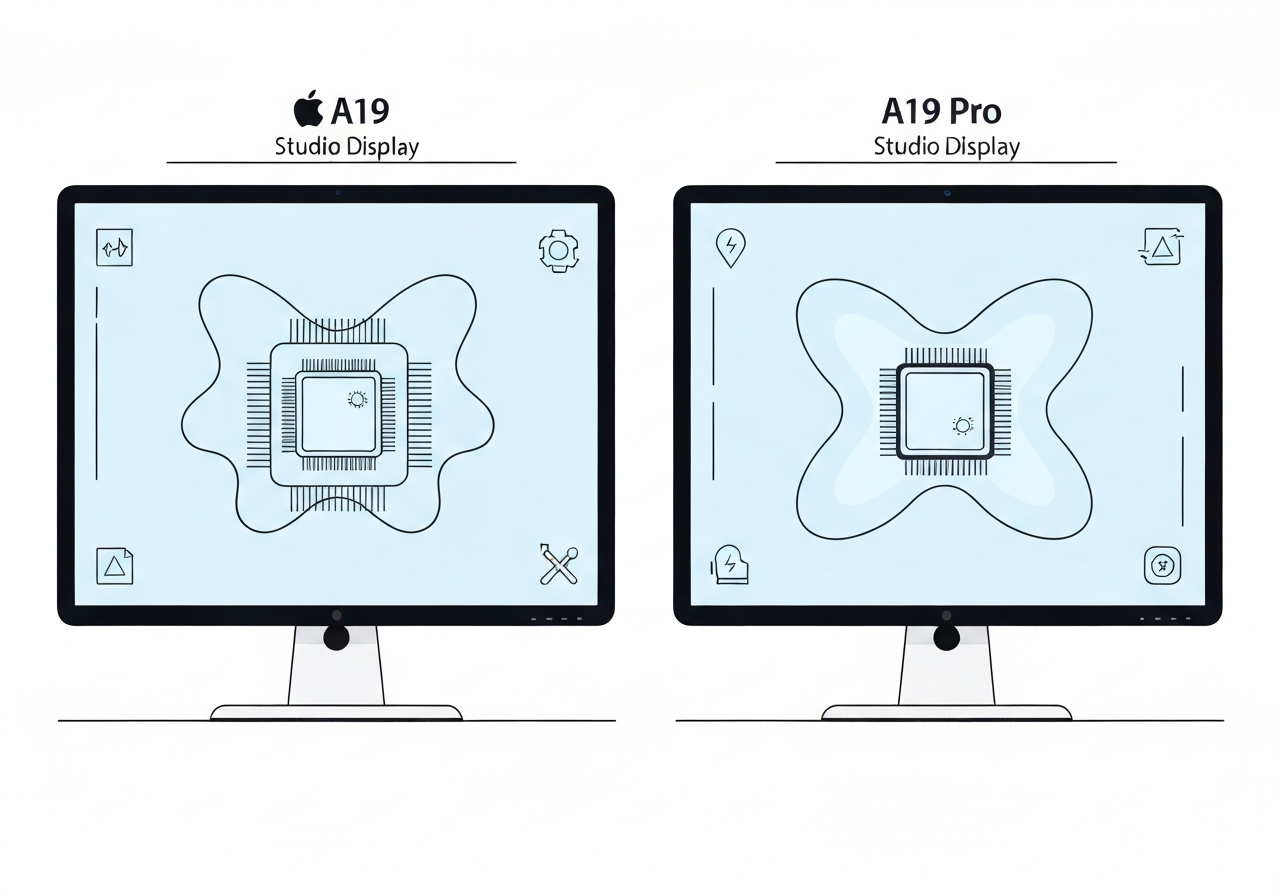
Apple’s latest Studio Display models were revealed to contain different A19-series silicon after a firmware review published on March 4, 2026. MacRumors’ analysis of the new Studio Display firmware shows the standard second-generation model runs an A19 chip while the higher-end Studio Display XDR contains an A19 Pro. Both monitors are available for pre-order now and are scheduled to ship on Wednesday, March 11, 2026. The split in SoC choice helps explain feature and performance differences between the two displays.
Key Takeaways
- Firmware reviewed March 4, 2026 identifies the second-generation Studio Display as using an A19 chip and the Studio Display XDR as using an A19 Pro chip, according to MacRumors code analysis.
- The original 2022 Studio Display used an A13 Bionic (introduced with iPhone 11 in 2019), which Apple publicly listed at the time.
- A19 and A19 Pro were rolled out across the iPhone 17 and iPhone Air families in 2025, making them much newer than the A13.
- Apple advertises a six-speaker system in both new displays that delivers 30% deeper bass than the prior generation.
- The XDR model includes higher-end hardware—120Hz refresh, mini-LED backlighting and greater peak brightness—which aligns with the presence of an A19 Pro.
- Apple has not listed the internal chip choices in its public marketing materials; the firmware extraction provided the first explicit confirmation.
Background
Apple has integrated system-on-chip (SoC) silicon into its standalone displays since the first Studio Display shipped in 2022. The A13 Bionic in that model supported camera features such as Center Stage, audio processing for Spatial Audio, and on-device Siri activation. Historically, Apple has used Apple-designed A-series chips to handle camera framing, audio DSP tasks, and certain real-time features that benefit from localized processing.
Chip distinctions have become a product-differentiation tool across Apple’s lineup, with higher-tier devices receiving Pro variants of silicon that unlock additional performance or efficiency. Bringing newer A-series chips into displays continues that approach: the silicon can offload tasks from a connected Mac, run camera-compute features independently, and enhance audio processing for improved speaker response. The A19 family entered Apple’s mobile lineup in 2025, and placing those chips into desktop displays is a recent extension of that trend.
Main Event
On March 4, 2026, MacRumors published findings from a review of the Studio Display firmware that revealed distinct chip identifiers for the two models. Contributor Aaron Perris examined code entries in the firmware image and identified device labels mapping to an A19 in the standard Studio Display and an A19 Pro in the Studio Display XDR. Apple’s public product pages and press materials did not disclose those chip models.
The identification helps clarify which silicon is powering specific features. Apple has described a Desk View camera mode that shows both a face and an overhead desk view simultaneously; heavy image processing of that kind typically benefits from modern neural engines and ISP resources found in newer A-series chips. Similarly, the audio improvements Apple cites—30% deeper bass over the prior generation—likely rely on on-chip DSP and dedicated accelerators.
Why Apple placed an A19 Pro in the XDR model is not explicitly stated in product copy, but it is consistent with the XDR’s more demanding hardware profile: a 120Hz refresh rate, mini-LED local dimming and higher brightness targets all increase processing needs. Apple and independent teardown teams will provide fuller confirmation when hardware reviews and dissections are published after launch.
Analysis & Implications
The split between A19 and A19 Pro is a deliberate product-segmentation move. By reserving the Pro silicon for the XDR, Apple differentiates the premium model not only by panel and backlight technology but also by its internal compute capacity. That differentiation supports higher refresh rates, more advanced camera modes, and potentially more sophisticated audio processing, strengthening the value proposition for pro users who buy the XDR.
For developers and third-party accessory makers, integrated Apple silicon in displays means certain tasks can be performed on the display itself rather than on the connected Mac. This could reduce latency for camera-driven features and enable localized AI tasks tied to the display’s sensors. However, it also creates a platform dependency: Apple-specific software hooks and firmware updates will determine the long-term feature set.
From a repair and teardown perspective, the presence of newer A-series chips raises questions about serviceability and upgrade paths. If the chip is tightly integrated on a display motherboard, replacing or repairing silicon-level failures will be more complex than swapping an external accessory. Conversely, on-device processing may improve privacy and offline capability for camera and audio features, since more work happens locally on the display’s SoC.
Comparison & Data
| Chip | Introduced | Example Devices | Reported Role in Studio Display |
|---|---|---|---|
| A13 Bionic | 2019 | iPhone 11 series; 2022 Studio Display | Enabled Center Stage, Spatial Audio, voice activation in 2022 display |
| A19 | 2025 | iPhone 17, iPhone Air (2025) | Confirmed in second-generation Studio Display (firmware) |
| A19 Pro | 2025 | Higher-tier iPhone 17 Pro models; Studio Display XDR | Confirmed in Studio Display XDR (firmware); aligns with 120Hz and mini-LED features |
The table summarizes confirmed introduction years and reported roles in Apple displays. While performance metrics and core counts for A19 vs A19 Pro are not published by Apple in the display context, the product positioning and firmware labels provide a reliable mapping of silicon to model. Upcoming teardowns and benchmark testing will supply precise performance comparisons.
Reactions & Quotes
The firmware clearly lists distinct A19 identifiers for the two models, pointing to different SoC choices between the base and XDR versions.
Aaron Perris / MacRumors (news site)
Apple describes the new six-speaker array as delivering 30% deeper bass compared with the previous generation.
Apple (official product information)
Putting a Pro-level A-series chip into the XDR is logical: the additional compute headroom supports higher refresh, brighter peak luminance and more complex camera processing.
Independent display analyst
Unconfirmed
- The exact technical differences between the A19 and A19 Pro as implemented in the displays (core counts, clock speeds, NPU throughput) have not been published by Apple and remain to be verified by teardowns and benchmarks.
- Which specific display features (for example, Desk View vs. speaker DSP) rely exclusively on the A19 Pro rather than the A19 is not confirmed.
- Whether firmware or software locks certain capabilities to the XDR model despite similar hardware present in both units has not been established.
Bottom Line
The Studio Display firmware reveal on March 4, 2026 establishes that Apple split A19-series silicon between its two new monitors: A19 in the standard second-generation Studio Display and A19 Pro in the Studio Display XDR. That split is consistent with the XDR’s premium hardware package—120Hz panel, mini-LED backlighting and higher brightness—and helps explain the product tiering Apple is pursuing.
Full confirmation of internal specifications and performance will arrive from hands-on reviews, benchmarks and teardowns after the March 11, 2026 launch. For buyers, the firmware disclosure offers a clearer basis for choosing between the models: the XDR’s Pro silicon and panel technology target professionals who need higher refresh and brightness, while the standard model offers updated silicon and improved audio at a lower price point.
Sources
- MacRumors — news site reporting firmware analysis and code review (March 4, 2026)
- Apple Studio Display product page — official Apple product information and specifications