
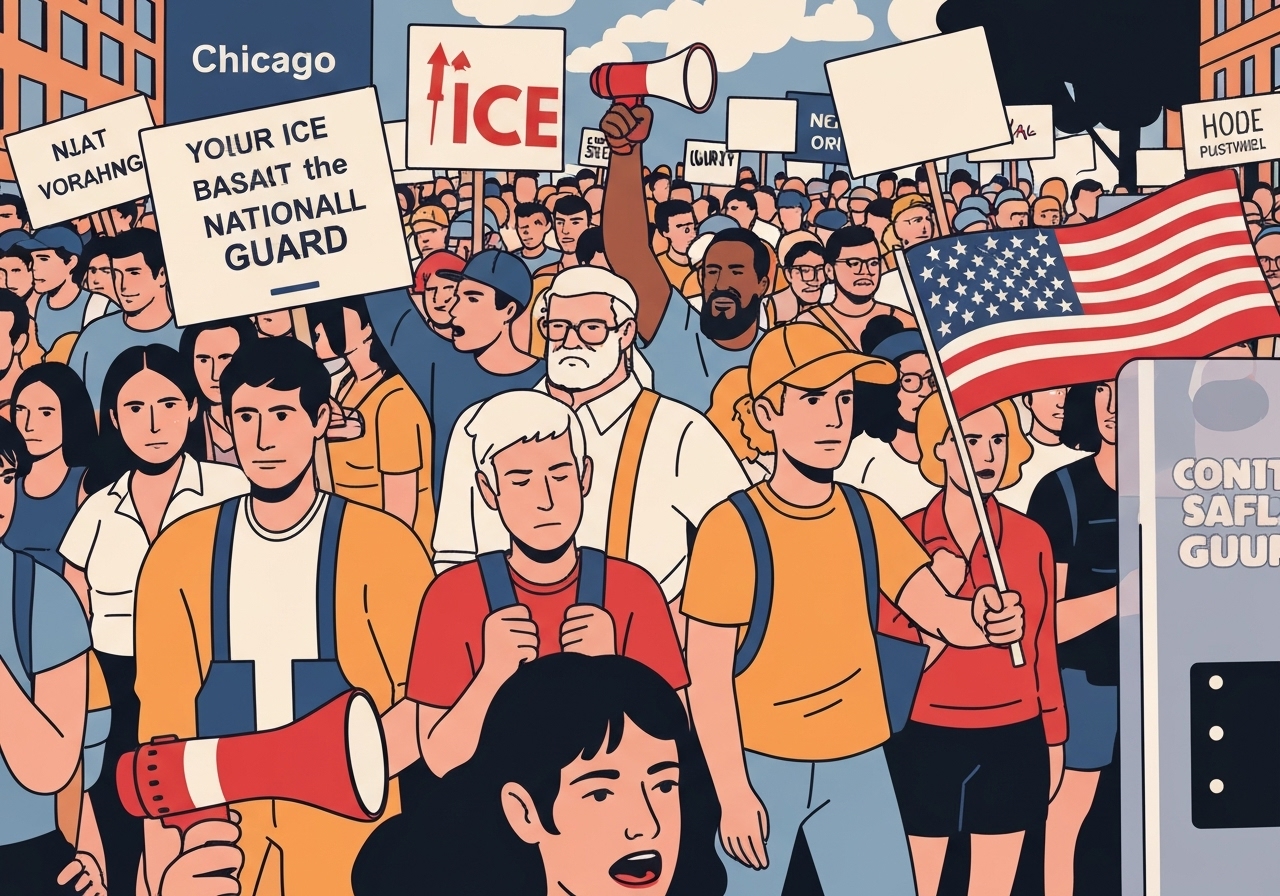
Lead: Thousands of people marched through downtown Chicago on Saturday, Sept. 6, 2025, to protest U.S. Immigration and Customs Enforcement (ICE) and President Donald Trump’s announced plan to send National Guard troops and additional immigration agents to the city. The demonstration, organized under the banner “Chicago Says No Trump No Troops,” drew wide public attention and visible police presence. Photographs by AP photographer Carolyn Kaster documented large crowds of marchers, signage and bystanders across key downtown corridors. Organizers said the protest was intended to oppose federal intervention and to call for protection of immigrant communities.
Key Takeaways
- When and where: The march took place in Chicago on Saturday, Sept. 6, 2025, with organizers reporting turnout in the thousands and multiple downtown routes photographed by AP.
- Organizers and slogan: The Illinois Coalition for Immigrant & Refugee Rights led the event under the name and chant “Chicago Says No Trump No Troops.”
- Target of protest: Demonstrators staged the march to oppose ICE operations and the Trump administration’s plan to deploy National Guard personnel and immigration agents to Chicago.
- Security posture: Local police were visibly monitoring the rally; AP images show officers present but the demonstration proceeded without widely reported clashes or large arrests in the photo record.
- Documentation: AP photographer Carolyn Kaster captured multiple images of the crowd, signage, and city landmarks during the protest, forming the basis of a curated photo gallery.
- Political context: The demonstration adds to a series of national protests sparked by federal immigration actions and executive directives in 2025.
- Public messaging: The protest combined calls for immigrant protections, civil rights language, and opposition to federal troop deployments in U.S. cities.
Background
The immediate cause of the demonstration was President Trump’s public plan to send National Guard troops and additional immigration agents to Chicago. Federal deployments to U.S. cities have become a flashpoint in recent years, prompting disputes over local control, policing, and civil liberties. Organizers framed Saturday’s march as a preemptive community response to any expanded federal enforcement actions in Illinois’ largest city.
Chicago has a long history of large-scale demonstrations on immigration, policing and labor issues; civil-society groups and faith organizations have frequently coordinated mass actions to influence policy and protect residents. Local leaders and advocacy organizations have repeatedly pushed for sanctuary-style protections and limits on cooperation with federal immigration enforcement, arguing such measures preserve public safety and trust between immigrant communities and local authorities.
Main Event
Demonstrators assembled at planned meeting points across downtown Chicago and paraded past landmarks photographed by AP staff. Signs, banners and chants emphasized opposition to federal immigration raids and to the presence of military-style forces in civilian neighborhoods. Organizers maintained a visible marshaling effort and encouraged peaceful, nonviolent protest; the photo record shows coordinated groups, families and faith leaders among the participants.
Police maintained a monitored presence along the march routes. Photographs show officers observing from sidewalks and intersections but do not depict major confrontations in the images released by AP. The demonstration’s marchers passed by the Chicago Theatre and other central locations, drawing bystanders who documented the event on mobile devices.
Speakers and leaders at the rally reiterated demands for municipal autonomy in immigration enforcement and called for protections for undocumented residents. The crowd’s messaging targeted both ICE operational practices and the broader policy decision to deploy National Guard troops to U.S. cities, characterizing such moves as escalatory and harmful to immigrant communities’ sense of safety.
Analysis & Implications
Federal deployment of troops and additional immigration agents to American cities is rare and politically consequential. Such moves shift the operational mix of law enforcement and can strain relations between city officials and the federal government. For Chicago, visible resistance from large civic coalitions raises the political cost of aggressive federal action and signals sustained local opposition that could complicate implementation.
From a legal and administrative perspective, the use of the National Guard in domestic contexts is governed by a mix of federal and state authorities; coordination and command arrangements determine the scope of activities Guard members can undertake. The prospect of Guard deployments for immigration enforcement tends to provoke debate about roles, oversight, and the possibility of mission creep into areas of traditional civilian law enforcement.
Economically and socially, high-profile confrontations over immigration enforcement can affect community trust in policing and public services. If immigrant communities feel targeted, they may be less likely to report crimes, cooperate with investigations or access public health and social services—outcomes public-safety experts warn can have broader negative effects on urban governance and social cohesion.
Reactions & Quotes
People march during Illinois Coalition for Immigrant & Refugee Rights’ “Chicago Says No Trump No Troops” protest Saturday, Sept. 6, 2025, in Chicago.
AP photo caption / Carolyn Kaster
People march by Chicago Theater during Illinois Coalition for Immigrant & Refugee Rights’ “Chicago Says No Trump No Troops” protest Saturday, Sept. 6, 2025, in Chicago.
AP photo caption / Carolyn Kaster
Police watch as people hold up signs as they gather during Illinois Coalition for Immigrant & Refugee Rights’ “Chicago Says No Trump No Troops” protest Saturday, Sept. 6, 2025, in Chicago.
AP photo caption / Carolyn Kaster
Unconfirmed
- Exact deployment: The precise number of National Guard troops or immigration agents potentially earmarked for Chicago was not confirmed in the photo gallery and remains publicly unclear.
- Timetable for action: No firm, publicly released timeline for any planned federal deployment to Chicago had been confirmed as of Sept. 6, 2025.
- Operational scope: The specific duties federal or Guard personnel would perform in Chicago—patrol, arrests, logistical support, or advisory roles—were not detailed in the photographed material.
Bottom Line
The Sept. 6, 2025, Chicago march reflects deep community mobilization against proposed federal immigration actions and a broader national debate over the role of military-style forces in domestic policing. Photographs from the day capture the scale, organizational messaging and visible civic opposition that will shape how local officials and the federal government navigate next steps. For policymakers, the protest underscores the political sensitivity and potential social costs of moving forward with troop deployments or expanded ICE operations in large U.S. cities.
Observers should watch for official statements from the White House, the Department of Homeland Security, the Illinois governor’s office and the City of Chicago for clarifications on any deployment plans. Continued documentation from independent news outlets and civic groups will be important to verify what, if any, federal actions occur and how they are executed on the ground.
Sources
- AP News photo gallery / Carolyn Kaster — news/photo documentation
- AP Images (photographer portfolio) — photo agency/visual record