
Lead
Representative Thomas Massie of Kentucky has become the focal point of a GOP intra-party fight after he publicly opposed the U.S. and Israeli strikes on Iran. Five days after his statement, a prominent Republican outreach group for Jewish voters ran a hard-hitting advertisement attacking him, an ad Mr. Massie then reposted to his X account as a fundraising tool. The May primary in his Ohio River district has turned into a referendum on loyalty to former President Donald Trump and on Republican appetite for the Iran conflict.
Key Takeaways
- Rep. Thomas Massie (R-Ky.) openly criticized the recent U.S.-Israel action against Iran; the dissent came into public view five days before a major ad targeted him.
- A leading GOP outreach group for Jewish voters produced an ad portraying Mr. Massie as aligned against the party’s wartime posture; he reposted the commercial as part of his fundraising effort.
- The May primary is a high-profile test of Mr. Trump’s influence in removing Republicans who cross him; a Trump-backed challenger is actively contesting Massie’s seat.
- Massie’s district, along the Ohio River, is conservative but long known for a streak of independence that has sustained him politically until now.
- National Republican apparatus and outside groups are diverting resources into the race; Massie says he is being significantly outspent by opponents.
- Public opinion nationally appears more skeptical of the Iran war than the GOP leadership, making this race a potential indicator of intra-party divisions on foreign policy.
Background
Thomas Massie, first elected to Congress in 2012, represents a predominantly conservative Kentucky district that includes communities along the Ohio River. Over his tenure he has cultivated a reputation for libertarian-leaning independence, frequently breaking with GOP leaders on issues ranging from spending to foreign engagements. The current dispute centers on the U.S. and Israeli military action involving Iran; the broader Republican caucus has largely rallied behind President Trump’s decision to strike, while some rank-and-file Republicans and independents have expressed reservations.
Primary politics in Kentucky have recently reflected national GOP dynamics — loyalty to Trump is a decisive factor in many contests, and Trump-endorsed challengers have successfully unseated incumbents perceived as insufficiently aligned. Outside groups, including targeted outreach organizations, routinely run ads aimed at persuading primary voters, and this cycle has seen an escalation of national money and messaging funneled into local races. For Massie, that means his long-standing local brand of independence is being tested by a wave of external pressure tied to the Iran conflict and party unity questions.
Main Event
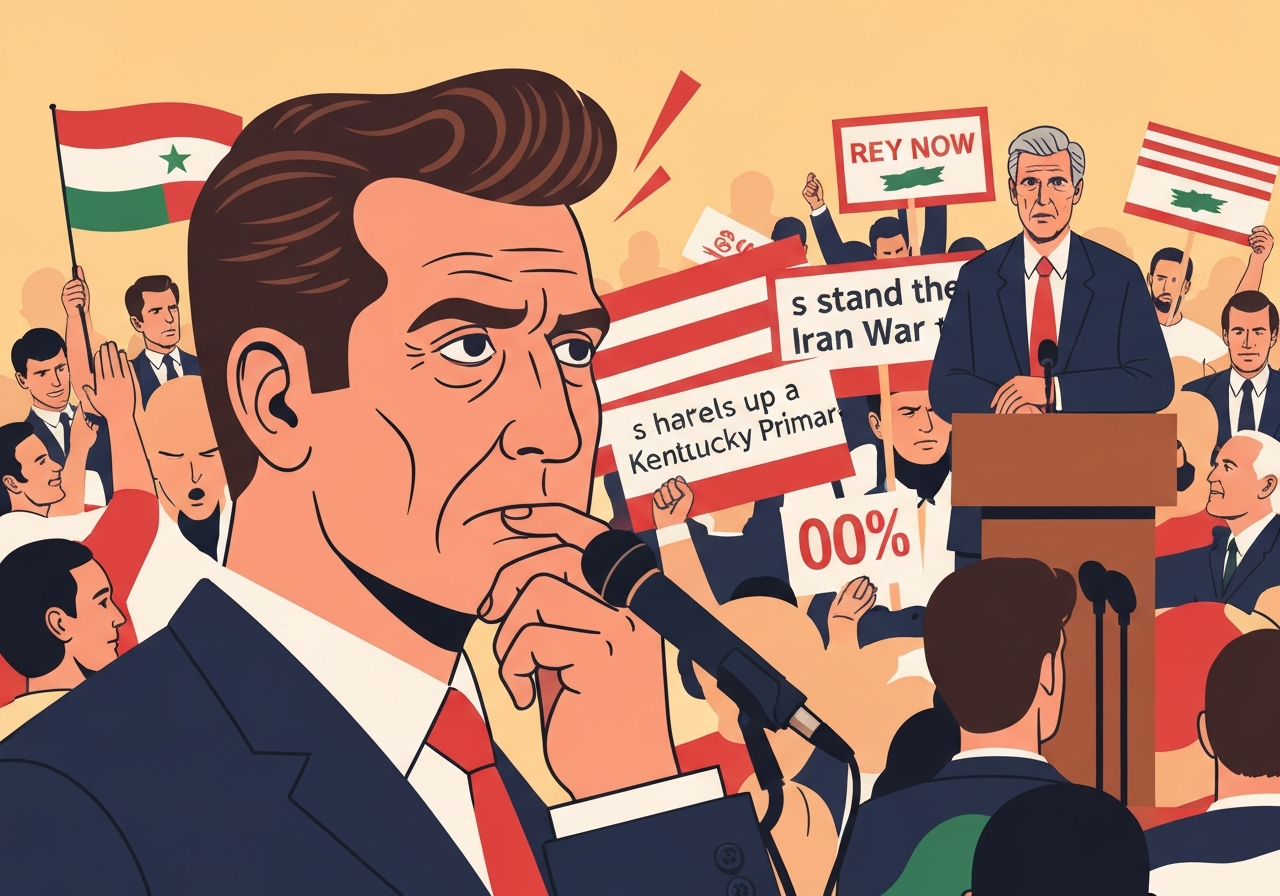
The immediate flashpoint began after Mr. Massie publicly denounced the Iran war; five days later a Republican outreach organization focused on Jewish voters released a dramatic commercial attacking his position. The ad features stark imagery and a narrator framing Massie as opposed to the president’s wartime posture. Rather than remove or ignore the clip, Mr. Massie posted the advertisement on his X account, framing the attention as an opportunity to raise campaign funds amid what he describes as heavy outside spending against him.
Campaign operatives and outside groups have escalated media buys in the district, turning a traditionally low-profile primary into a midterm bellwether. A Trump-backed challenger has received visible national support, seeking to tie Massie to a narrative of disloyalty to the president and to broader party strategy. Massie counters by emphasizing his consistent philosophical objections to foreign interventions and by arguing that the district values independence over partisan orthodoxy.
On the ground, voters in the Ohio River communities describe a mix of priorities: national security and economic issues both matter, and local sentiment is uneven. Some Republican primary voters told reporters they view the Iran strikes as necessary, while others worry about escalation and long-term costs. The primary’s outcome will hinge on which message — party unity behind the president or reprieve for dissenting conservatism — better mobilizes the base in May.
Analysis & Implications
The Massie contest illuminates a broader tension within the Republican Party between Trump-aligned consolidation and pockets of traditional conservative independence. If Massie holds his seat, it could signal room within GOP primaries for dissent on foreign policy, especially where incumbents have established local credibility. Conversely, a Trump-backed victory would reinforce the former president’s ability to enforce party conformity on key strategic issues like the Iran conflict.
Beyond party mechanics, the race could shape how Republican elected officials calculate risk on future military questions. A decisive primary loss for an antiwar incumbent may chill public dissent among Republicans in Congress; a narrow survival or win could encourage targeted opposition to further overseas commitments. National groups are watching closely because the result will help determine whether right-leaning donors and operatives invest in primaries to enforce a hawkish foreign-policy line.
Economically and electorally, the campaign also highlights the growing influence of outside ad spending in shaping local outcomes. Massie’s claim of being outspent — if borne out by Federal Election Commission filings after the primary — would exemplify how national money can alter the dynamics of a congressional race confined to a single district. For voters, the flood of external messaging risks overwhelming local issues and reframing the contest as a litmus test on allegiance to Trump and on the Iran war.
Comparison & Data
| Actor | Stated Position |
|---|---|
| Rep. Thomas Massie | Opposed recent U.S.-Israel action on Iran; emphasizes restraint |
| Trump-backed challenger | Supports president’s decision and criticizes Massie’s dissent |
| Republican Jewish outreach group | Ran ad framing Massie as opposing party and wartime posture |
| Broader U.S. public (reported) | Appears more skeptical of the Iran war than congressional GOP consensus |
The table above summarizes public positions as reported. While exact spending totals and polling margins in the district were not fully disclosed at the time of reporting, the qualitative pattern is clear: organized national actors have intensified involvement, and public skepticism at the national level contrasts with GOP congressional alignment behind the president.
Reactions & Quotes
“I may be on the wrong side of polling right now, but I think I’ll eventually be shown to be right on this, and the American people will come around, too.”
Rep. Thomas Massie
This remark captures Massie’s argument that principled dissent may be temporarily unpopular but could gain acceptance over time. He used the line to frame his resistance as consistent with long-term conservative values rather than mere opposition to party leadership.
“The ad accuses Mr. Massie of siding against the president’s wartime stance and links him to congressional opponents of that policy.”
Advertisement by a Republican Jewish outreach group (reported)
The commercial’s narrative employed dramatic imagery meant to drive urgency among primary voters and to paint Massie as disconnected from the party’s defense posture.
Unconfirmed
- Precise polling shifts within the district following the ad remain unclear until local polls are released and verified.
- Exact totals and sources of outside spending in the race have not been fully documented in public campaign finance filings as of this report.
- Whether the ad will materially change turnout patterns among different Republican voter cohorts in May is currently uncertain.
Bottom Line
The Massie primary has evolved into more than a local contest: it is a litmus test for how much ideological independence the Republican electorate will tolerate amid a wartime foreign-policy posture championed by the party’s dominant figure. The combination of a high-profile ad campaign, national money, and a Trump-backed opponent has transformed a traditionally steady incumbent’s race into a nationalized showdown.
Outcomes in May will offer insight into whether GOP primary voters prioritize alignment with the president on security matters or will reward long-standing contrarian incumbents for principled dissent. For observers, the result will help forecast not only intraparty discipline but also how future congressional debates on military action may unfold.
Sources
- The New York Times — news reporting on the Massie primary and related advertisements (reported)