
Lead
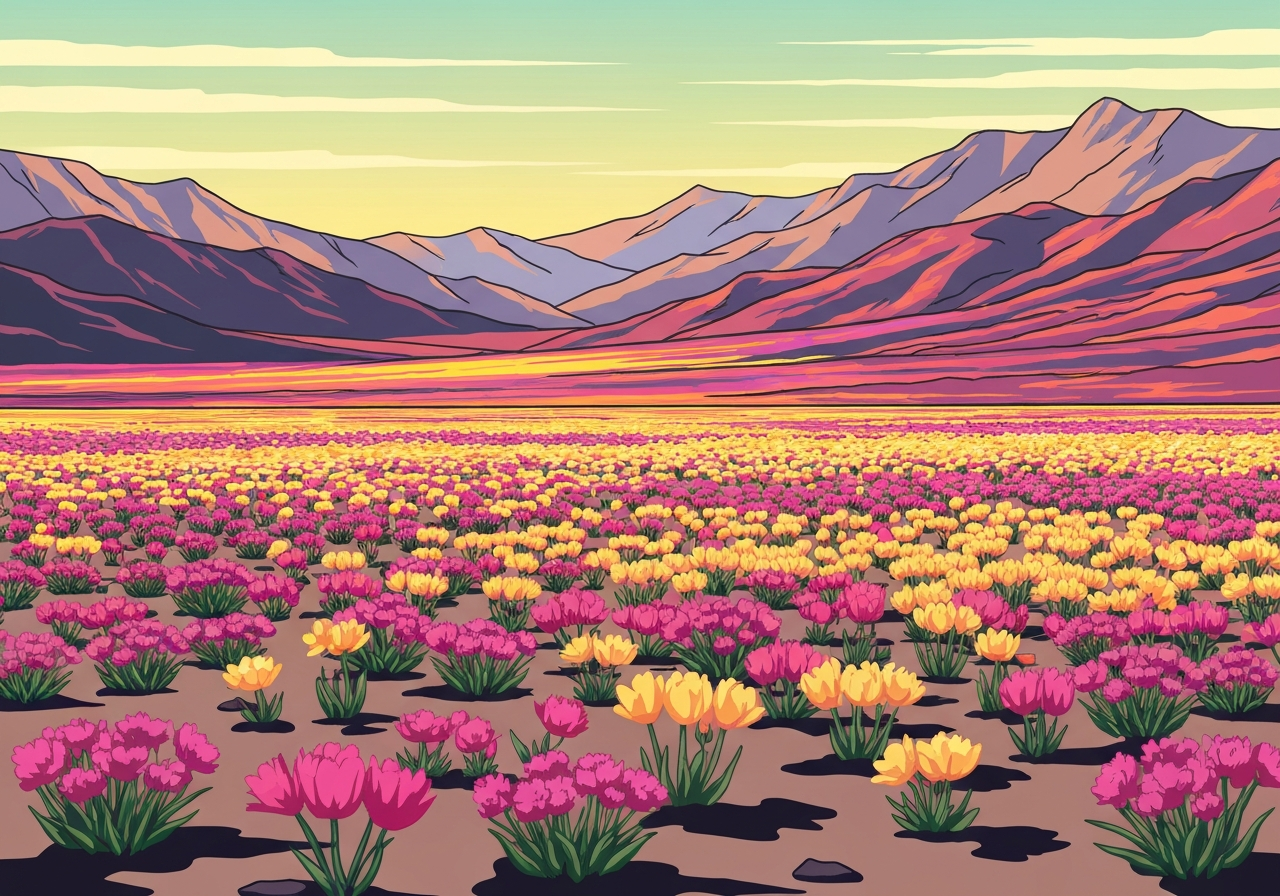
On March 8, 2026, Death Valley National Park experienced a superbloom that has transformed its famously barren basins into swathes of pink, purple and yellow. Park officials say this is the most dramatic display the park has seen since 2016, driven by wetter-than-normal conditions last fall and early winter. The bloom is most vivid at low elevations now, with displays expected to persist into mid- to late March before moving upslope. Park staff and local guides warn that timing is weather-dependent and urge visitors to respect protections such as the ban on picking wildflowers.
Key Takeaways
- National Park Service describes the 2026 bloom as the most spectacular in a decade, comparable to the 2016 event.
- Death Valley typically averages about 2 inches of rain annually; the park recorded roughly 2.5 inches between November and early January 2026.
- Low-elevation blooms are expected to remain through mid- to late March, while higher-elevation displays may appear from April through June, weather permitting.
- Best accessible viewing includes the southern end of Badwater Road; quieter spots include Mud Canyon and Beatty Cutoff Road.
- Desert wildflowers involved are ephemerals that persist as dormant seeds until suitable rains trigger germination and flowering.
- Park staff report increased recent visitation and emphasize Leave No Trace practices; picking flowers is prohibited to protect fragile habitats.
Background
Death Valley National Park is among the hottest, driest places in North America, where average annual precipitation is about 2 inches and vegetation is sparse at low elevations. Superbloom events in desert parks are episodic and depend on an unusual sequence of seasonal rains that allow dormant seeds—often lying in the soil for years—to germinate and flower simultaneously. The phenomenon drew national attention in 2016 when a widespread bloom transformed broad tracts of the park; officials now say 2026 has produced a similarly extensive display.
Botanists classify the plants involved as ephemerals: species that complete their visible life cycle quickly after a rain event and then return to seed. These seeds are adapted to remain dormant until multiple conditions align—sufficient soil moisture, mild temperatures and an absence of destructive heavy flows or late heat. Local stakeholders include the National Park Service, the Death Valley Natural History Association, conservation volunteers, and tour operators who monitor bloom locations and advise visitors on safe viewing practices.
Main Event
Park and nonprofit officials reported that relatively gentle, soaking rains in late 2025 and early 2026 allowed seeds across broad low-elevation areas to germinate, producing continuous carpets of wildflowers in many basins. Abby Wines, acting deputy superintendent at Death Valley National Park, noted that between November and early January the park received about two and a half inches of rain—more than the typical annual total—helping trigger widespread emergence.
David Blacker, executive director of the Death Valley Natural History Association, described routes where blooms are especially abundant, recommending the southern end of Badwater Road for easy viewing and Mud Canyon or Beatty Cutoff Road for less crowded scenes. Rangers report rising day-use traffic in recent weeks and are advising visitors to plan ahead for parking and to stay on designated routes to avoid trampling plants.
The flower spike is concentrated at low elevations right now; as spring advances and temperatures moderate, observers expect peak displays to shift upslope. Park staff say that if weather follows a typical warming pattern, low-elevation carpets will fade by mid- to late March while higher valleys and slopes may reach their peak between April and June.
Analysis & Implications
Ecologically, superblooms are short-lived but significant events: they provide pulses of nectar and pollen that benefit insects, migratory birds and small mammals, and they replenish the seed bank for years to come. Because the underlying seeds can remain viable for long periods, a single wet season can reset the visible landscape without indicating a long-term shift in desert climate or vegetation patterns.
From a conservation and management perspective, superblooms present both opportunity and risk. Increased visitation brings economic benefit to nearby communities and raises public interest in desert ecosystems, but it also heightens the chance of trampling, off-road driving and illegal picking. Park managers must balance access with protective measures—temporary closures of sensitive patches, educational outreach and targeted ranger patrols—to limit damage.
Climate scientists note that an isolated wet season does not necessarily reflect a trend toward wetter conditions in arid regions. However, variability in rainfall patterns tied to broader climate drivers can change the frequency and distribution of superblooms over decades, affecting plant community dynamics and dependent wildlife. Continued monitoring of flowering events, precipitation records and visitor impacts will be essential for informed park planning.
Comparison & Data
| Metric | 2016 Event | 2026 Event | Park Annual Average |
|---|---|---|---|
| Notable year | 2016 | 2026 | — |
| Reported Nov–early Jan rainfall | Varied regionally (recorded wet fall) | ~2.5 inches (Nov–early Jan) | ~2.0 inches |
| Visibility | Low-elevation expanses | Low-elevation expanses, moving upslope | Generally sparse |
The table summarizes the key numerical context: Death Valley’s usual annual precipitation is roughly 2 inches, while this season’s concentrated November–January rainfall was about 2.5 inches—enough, in combination with mild early-spring temperatures, to trigger an extensive floral display. Comparisons to 2016 are qualitative because precise localized rainfall totals and bloom coverage varied across the park in both years.
Reactions & Quotes
Park and nonprofit staff offered concise descriptions of the scene and guidance for visitors.
“This area that’s known basically for hot weather, sand and dirt has just become this amazing landscape of colors,”
David Blacker, Death Valley Natural History Association
Blacker emphasized both the sensory surprise of the bloom and the need for visitors to seek less-trafficked viewing spots to reduce impact.
“From November through early January, we had about two and a half inches of rain, so we had more than our annual average in just two and a half months,”
Abby Wines, Acting Deputy Superintendent, Death Valley National Park
Wines framed the event in measurable hydrologic terms and reiterated timelines for low- and high-elevation displays. An external botanist added ecological context:
“You can think of it like drought evasion,”
Erik Rakestraw, Curator of Botany, Arizona-Sonora Desert Museum
Rakestraw summarized why desert plants remain as seeds for long periods and then bloom vigorously when conditions align.
Unconfirmed
- Duration of peak displays at specific high-elevation sites remains weather-dependent and cannot yet be precisely predicted.
- Exact visitor counts and economic impacts for nearby towns for the 2026 bloom season have not been published.
- Long-term trend implications for bloom frequency tied to climate variability require continued scientific monitoring and peer-reviewed analysis.
Bottom Line
Death Valley’s 2026 superbloom is a striking, but ephemeral, natural phenomenon driven by an unusual run of fall and early-winter rains that exceeded the park’s typical annual precipitation. For visitors, the next few weeks represent the best opportunity to see vivid low-elevation carpets before blooms contract or shift upslope.
Managers face the dual task of facilitating public access while protecting fragile desert soils and plant communities; simple steps by visitors—staying on roads and trails, not picking flowers, and following ranger guidance—can help preserve the event’s legacy. Scientists will watch whether similar conditions recur in coming years to judge if superbloom frequency is shifting with broader climate variability.
Sources
- NBC News — national media report summarizing park statements and field observations
- National Park Service (Death Valley) — official park information and visitor guidance
- Death Valley Natural History Association — nonprofit partner providing wildflower reports and local expertise
- Arizona-Sonora Desert Museum — academic/curatorial source on desert botany