
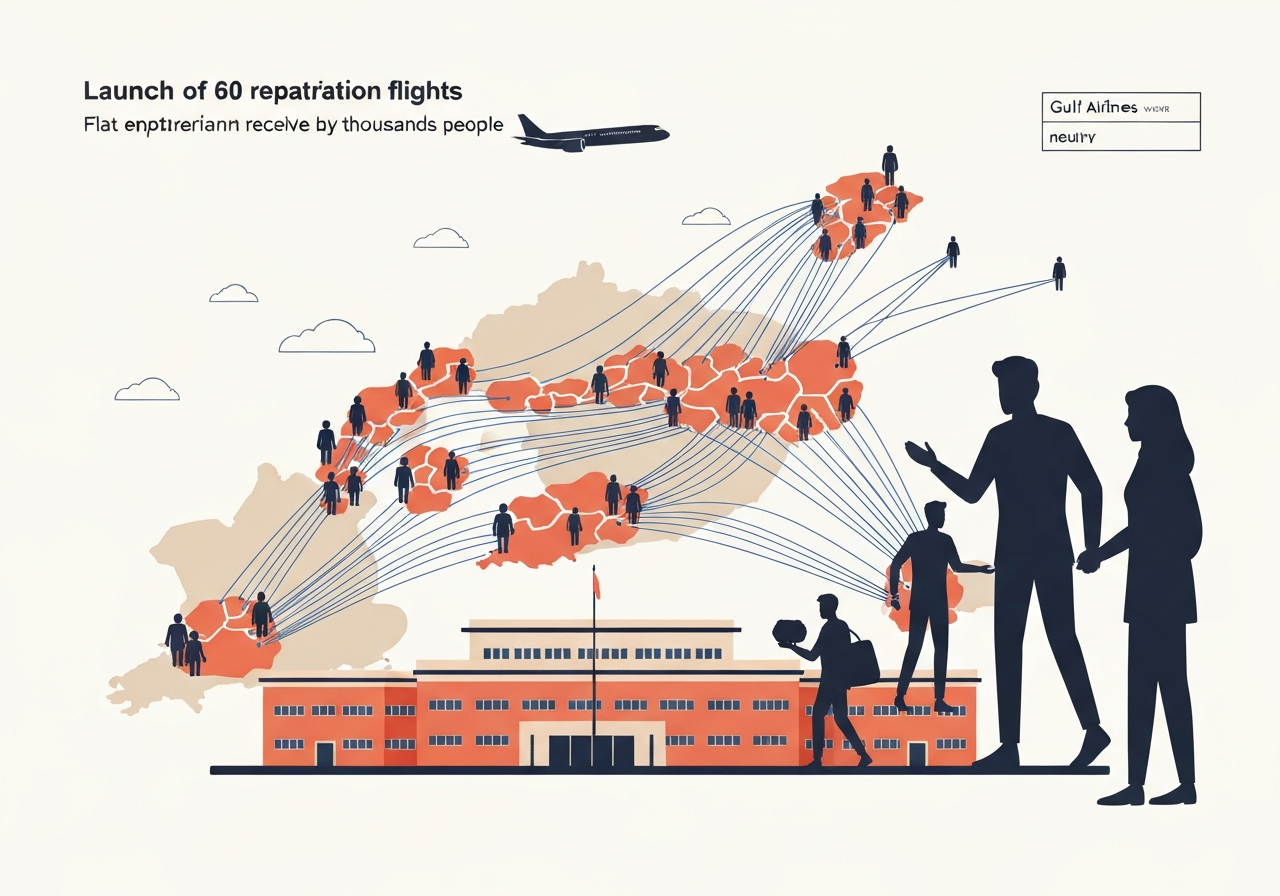
Lead: On 8 March 2026, airlines and governments coordinated a large-scale repatriation effort after regional airspace instability left thousands of international travelers stranded across Gulf transit hubs. Carriers including Qatar Airways, Emirates, Etihad and IndiGo operated a combined 60 repatriation flights from the UAE, Oman and Saudi Arabia to destinations such as the UK, US, Canada, Spain, Germany, the Netherlands, Thailand and India. Host and transit states implemented emergency measures—free hotel stays, meal support and visa extensions—to shelter travelers while operations were restored. The actions helped clear airport backlogs and move large groups of passengers back toward home countries.
Key Takeaways
- Sixty repatriation flights were launched from UAE, Oman and Saudi Arabia on and around 8 March 2026, operated by Qatar Airways, Emirates, Etihad and IndiGo.
- Doha’s Hamad International Airport received long-haul arrivals from London, Paris, Madrid, Rome, Frankfurt and Bangkok between 07:00 and 09:00 local time on 8 March 2026, with those flights landing safely.
- Destination countries receiving returning passengers include the UK, US, Canada, Spain, Germany, the Netherlands, Thailand and India, among others.
- Several governments and local authorities—Sri Lanka, Turkey, UAE, Qatar, Bahrain and Oman—provided emergency hospitality: free hotel rooms, meal programs and short-term visa extensions to prevent homelessness or legal issues for stranded travelers.
- Regional hubs (Dubai, Doha, Abu Dhabi, Muscat) remained operational but adjusted routings and schedules, underscoring their continued importance in global connectivity despite elevated risk.
- Airlines prioritized safety and coordination with civil aviation authorities while rerouting and concentrating repatriation capacity to relieve airport congestion.
- The disruption exposed vulnerabilities in global transit networks but also demonstrated rapid multinational coordination to protect passengers and tourism reputations.
Background
The disruption that prompted the repatriation effort followed a sudden escalation of regional tensions in the Middle East, which led aviation authorities to impose temporary airspace restrictions and compel carriers to adjust routings. Major Gulf transit hubs, which normally channel high volumes of onward passengers between Europe and Asia, saw unexpected accumulations of travelers when connecting services were delayed or suspended. Historically, large-scale disruptions—whether geopolitically driven or caused by hazards such as volcanic ash—have tested the resilience of international airline networks and prompted emergency responses from states and carriers.
Gulf carriers and host governments rely on a finely tuned system of slots, ground handling, immigration and hotel capacity to process transiting travelers. When flights are concentrated or cancelled en masse, airports can quickly reach operational limits. In this instance, states in the wider region moved to reduce humanitarian strain on airports and cities by offering temporary shelter, simplified immigration steps and coordinated transport, measures aimed at preserving both public safety and tourism sector confidence.
Main Event
On 8 March 2026, Qatar Airways operated a series of long-haul arrivals to Hamad International Airport from principal European and Asian hub cities; aircraft from London, Paris, Madrid, Rome, Frankfurt and Bangkok landed in the 07:00–09:00 Doha window without incident. These scheduled arrivals affirmed Doha’s role as a functioning transit link while broader regional routing adjustments were underway. Airport authorities reported normal arrival processing for these flights, emphasizing passenger safety and continuity of services.
From Dubai, Emirates maintained an extensive departure program on 8 March 2026 while also allocating seats on repatriation rotations to countries with large numbers of affected nationals. Emirates’ network adjustments included flights to New York, Dallas, Manchester, London, Paris and several regional destinations, enabling evacuees and stranded passengers to depart as commercial services permitted. Simultaneously, Etihad preserved critical India-Gulf connections through Abu Dhabi, underpinning onward movement for many South Asian travelers.
IndiGo expanded its international operations on the same day, running multiple services between Indian cities (Mumbai, Delhi, Hyderabad, Bengaluru, Kozhikode) and Gulf/European points such as London, Manchester, Amsterdam, Abu Dhabi, Dubai, Jeddah, Muscat and others. The carrier also fitted select flights to assist in the repatriation wave, especially on routes with high numbers of returning nationals or pilgrims. Collectively, these carrier actions accounted for the approximately 60 repatriation rotations reported from the UAE, Oman and Saudi Arabia.
Host countries and transit states implemented emergency hospitality and immigration measures in parallel. Sri Lanka and Oman provided visa extensions to prevent lapses in legal status; the UAE and Qatar offered complimentary hotel nights and meal assistance for vulnerable travelers; Turkey and Bahrain coordinated transit assistance and onward travel logistics. These interventions aimed to stabilize conditions for travelers while operational continuity was restored.
Analysis & Implications
Operationally, the rapid assembly of 60 repatriation flights highlights the ability of airlines to redeploy aircraft and crews under stress, but it also underscores systemic fragility. Rerouting and ad hoc repatriation increase fuel burn, crew duty complexities and slot management burdens—factors that raise costs and complicate scheduling in the following days. Carriers that can absorb these costs will protect brand trust; smaller operators may face greater financial strain if disruptions persist.
For national governments, the response was a reputational test as much as a logistical one. Providing temporary shelter, food and visa relief preserves tourism and diplomatic ties by preventing humanitarian incidents, but it requires rapid cross-agency coordination and budgetary flexibility. The visible cooperation among Gulf states, South Asian governments and European destinations suggests a pragmatic consensus: keep people safe and move them home, while avoiding politicized narratives that could further destabilize travel flows.
Economically, concentrated disruptions in the Gulf ripple into global supply chains and business travel. Slower connectivity can delay cargo movement that transits passenger networks and can hamper time-sensitive commerce. Longer term, repeated episodes could prompt airlines and governments to diversify hub strategies, encourage more point-to-point services, or invest in contingency reserves for passenger accommodation and alternate routings.
Comparison & Data
| Item | Detail |
|---|---|
| Repatriation flights | ~60 rotations from UAE, Oman, Saudi Arabia (8 March 2026 period) |
| Doha arrivals (sample) | Flights from London, Paris, Madrid, Rome, Frankfurt, Bangkok landed 07:00–09:00 (Doha time) |
| Key carriers involved | Qatar Airways, Emirates, Etihad, IndiGo |
The table above summarizes the core operational facts confirmed for 8 March 2026. While a precise passenger tally varies by carrier and origin city, official statements and airport manifests indicate that the combined effort moved thousands of travelers out of overloaded transit hubs. These figures reflect aircraft rotations rather than seat-by-seat counts; airlines and aviation authorities retain the detailed manifests used for official tallies and consular follow-up.
Reactions & Quotes
“Our immediate priority was to keep passengers safe and provide clear options for onward travel. Teams worked through the night to process arrivals and repatriation flights.”
Hamad International Airport (official)
Doha authorities emphasized safety and continuity in a short official message accompanying the arrival wave on 8 March 2026.
“We are coordinating closely with governments and partners to offer accommodation and visa relief where needed so that no traveller is left without shelter or legal status.”
UAE Civil Aviation and Immigration Coordination (official)
UAE officials highlighted emergency hospitality measures—hotel stays and meal support—deployed to ease pressure on airport facilities and protect tourists’ welfare.
“Carriers adjusted schedules to prioritize repatriation capacity while ensuring compliance with all safety and crew-rest rules.”
Regional airline industry statement (industry/press)
An industry communique stated airlines balanced rapid redeployment against regulatory constraints on crew time and maintenance.
Unconfirmed
- Exact total number of stranded passengers across all affected Gulf hubs remains unconfirmed pending consolidated manifests from all carriers and consular tallies.
- Attribution of the initial airspace restrictions to specific military or diplomatic actions is not independently verified in public records and remains subject to official clarification.
Bottom Line
The coordinated repatriation effort of 8 March 2026—about 60 flights operated by major Gulf and Indian carriers—moved thousands of travelers out of constrained transit hubs and prevented immediate humanitarian stress for many. Host governments and airlines combined logistical responses (hotels, meals, visa extensions) with focused flight operations to restore mobility and reinforce confidence in key international corridors.
While the immediate crisis response succeeded in reducing airport backlogs and returning large numbers of passengers, the episode highlights persistent vulnerabilities in global aviation to regional disruptions. Policymakers and carriers will likely review contingency planning and cooperative measures to shorten response times and reduce economic knock-on effects should similar events reoccur.
Sources
- Travel & Tour World (media report summarizing repatriation flights and government responses)
- Qatar Airways (airline official communications and airport coordination pages)
- Emirates (airline newsroom/press statements)
- Etihad (airline official communications)
- IndiGo (airline operations and schedule information)