
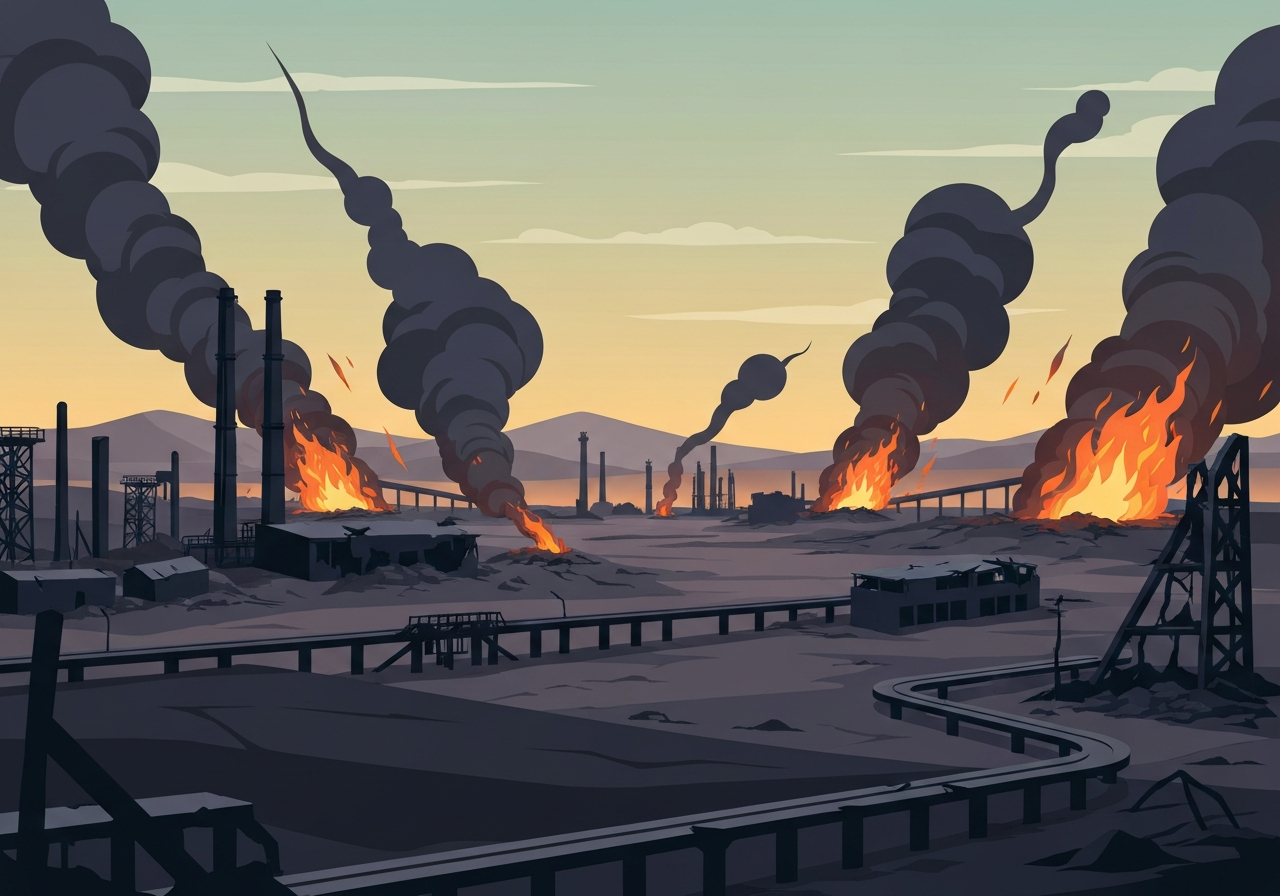
On Sunday 8 March 2026, residents of Tehran woke to a city shrouded in thick black smoke after airstrikes struck multiple oil storage sites in and around the capital. Witnesses described streets, balconies and cars coated in soot and reported burning eyes and sore throats as authorities warned of poisonous runoff and potential acid rain. Local officials said four oil depots and a petroleum logistics facility were hit; one site alone suffered six confirmed fatalities and 20 wounded. The strikes and resulting fires forced closures, fuel rationing and urgent health advisories across a metropolis of about 10 million people.
Key takeaways
- Four oil depots and one petroleum logistics site in and around Tehran were struck on the night of 8 March 2026, producing large fires and prolonged smoke plumes.
- Authorities reported six deaths and 20 wounded at one of the attacked facilities; emergency services responded overnight and into Sunday morning.
- Tehran residents reported widespread soot and respiratory irritation; the national Red Crescent warned of toxic chemicals, possible acid rain and cautioned against using air conditioners immediately after rainfall.
- Public services and businesses briefly reopened but many closed again as the toxic air persisted; fuel distribution was rationed in some areas, with limits reported as low as five litres per vehicle.
- Medical and environmental experts warned that fine particulates and gases could exacerbate asthma, chronic lung and heart disease, and carry longer-term cancer risks.
- Shortages and price increases were reported: an inhaler was cited at 850,000 tomans (about £4.50), and basic goods and fuel became harder to obtain for daily wage earners.
Background
Tehran is the political and economic centre of Iran, home to roughly 10 million people whose daily life depends on a tightly connected urban infrastructure. Oil storage facilities on the capital’s periphery supply fuel and industrial inputs to a large metropolitan economy; damage to these sites therefore has immediate effects on transport, commerce and household energy. The country has faced repeated cross-border strikes and escalating regional tensions in recent months, which have targeted energy and logistics infrastructure in multiple provinces. Civilian vulnerability is compounded by pre-existing economic strain, fuel shortages and the high cost of medical and protective supplies for low-income households.
Iranian emergency and environmental bodies have contingency plans for industrial fires and pollutant releases, but those measures are strained when several large facilities burn simultaneously. Public messaging has emphasised sheltering indoors, avoiding contaminated food and preventing run-off, while health services prepared for increases in respiratory complaints. Access to real-time information was hampered in places by intermittent internet restrictions, complicating residents attempts to verify which sites were hit and how to respond safely. International actors and media have reported on the strikes, but attribution and the full sequence of events remain contested in the immediate aftermath.
Main event
The attacks began late on Saturday and continued into the night, with large flames visible across the Tehran skyline and billowing plumes of black smoke seen from many districts. Citizen videos circulated showing conflagrations at storage tanks near Shahran and Shahr-e Rey; authorities confirmed multiple storage sites and a logistics facility were affected. Firefighters and emergency crews attended the scenes, battling intense blazes while working under hazardous conditions due to the volatile materials burning.
By Sunday morning, rain mixed with combustion by-products, prompting warnings about toxic acid rain from environmental officials and the Red Crescent. Many residents reported burning eyes, sore throats and breathing difficulties; hospitals and clinics logged a rise in acute respiratory visits. Local governors and health officials advised people to remain indoors, wear protective masks if going outside, and to avoid running air conditioning systems immediately after rainfall to limit the spread of contaminants indoors.
Supply disruptions emerged quickly. Fuel distribution points imposed rationing and long queues formed as motorists sought limited allocations; some pumps reportedly limited customers to five litres. Shops and workplaces that briefly reopened closed again as the toxic haze made outdoor activity unsafe, particularly for those with pre-existing health conditions. The economic toll was immediately felt by daily wage workers and small-business owners who said sales and operations had halted amid fears over water and food contamination.
Analysis & implications
In the short term, the most urgent consequence is public health: inhalation of fine particulates and combustion gases can cause acute respiratory distress, especially among children, the elderly and people with chronic illnesses. Medical experts emphasised that exposure in a dense urban population will lead to a surge in clinic visits and could overwhelm local capacity if the contamination persists. Beyond immediate effects, aerosolised petrochemical residues pose a risk to water sources and soil, raising concerns about contamination of food supply chains and long-term environmental clean-up costs.
Economically, damage to storage and logistics constrains fuel availability and drives price spikes that disproportionately impact lower-income households. Rationing measures, reduced mobility and rising prices for essentials such as medication and food could deepen humanitarian stress for daily wage earners. If fires compromise reservoir catchments or water treatment facilities — a scenario local residents feared — the public health footprint would expand to include waterborne hazards and secondary displacement of vulnerable populations.
Politically, the strikes intensify domestic frustration with perceived government inability to protect civilians and critical infrastructure, while also raising regional diplomatic stakes. Attribution of responsibility for the strikes shapes international reaction; if foreign actors are found responsible, the incident could prompt renewed diplomatic, legal and possibly military responses. Conversely, if the attacks further degrade civilian infrastructure without accountability, public trust in authorities may erode and opposition voices could gain greater traction.
Comparison & data
| Item | Reported figure |
|---|---|
| Oil depots struck | 4 depots + 1 logistics site |
| Fatalities at one site | 6 confirmed |
| Wounded at one site | 20 |
| Tehran population | ~10 million |
| Fuel ration reported | 5 litres per vehicle (some stations) |
| Inhaler price cited | 850,000 tomans (~£4.50) |
The table above summarises verified figures reported by local authorities and residents on 8 March 2026. While casualty and damage assessments are preliminary, the numbers indicate both immediate human cost and logistical strain. Comparing these figures with past industrial incidents in the region shows that simultaneous strikes on multiple depots amplify both emergency response challenges and downstream supply interruptions. Cleanup and monitoring will require independent environmental testing to determine contaminant levels and to plan remediation.
Reactions & quotes
Residents, aid organisations and medical professionals voiced alarm and frustration at the human cost and long-term risks.
This is apocalyptic; smoke has covered the entire city and many people have severe shortness of breath.
Negin (activist, alias)
Her message highlighted both acute health effects and a sense of abandonment felt by many residents.
We are scared to touch the soot and uncertain if water is safe; this regime has left people on their own.
Mehdi (restaurant owner, alias)
Mehdi underlined the economic shock to small businesses and the fear driving decisions to close or flee the city.
When the birds abandon the sky, you are truly on your own; the night was so dark it looked like a new moon.
Mehnaz (resident, alias)
Mehnaz described the surreal visibility conditions and her decision to leave Tehran for her parents’ home outside the province.
Unconfirmed
- Attribution: some reports named Israel and referenced allied involvement; definitive, independently verified attribution of responsibility for the strikes remains unconfirmed.
- Extent of chemical contamination: the precise chemical composition of the smoke and rainwater has not yet been published by independent laboratories.
- Long-term water contamination of major reservoirs and dams is feared by residents but requires testing to confirm levels and potential health impacts.
Bottom line
The immediate crisis in Tehran combines acute public-health hazards with rapid economic and social disruption: large fires have caused deaths, widespread respiratory complaints and curtailed access to fuel and daily income for many residents. Authorities have issued shelter-in-place guidance and advised precautions, but the scale of the incident and the number of affected sites complicate rapid control and assessment.
In the coming days, independent environmental testing, transparent casualty and damage reporting, and sustained humanitarian support will be essential to protect vulnerable populations and to guide remediation. The event also carries political and diplomatic consequences; how attribution is established and how authorities manage recovery will shape both domestic sentiment and international responses.
Sources
- The Guardian — news article with eyewitness accounts and local reports (media).
- Associated Press — contributed reporting and agency coverage (news agency).
- Agence France-Presse (AFP) — contributed reporting and agency coverage (news agency).