
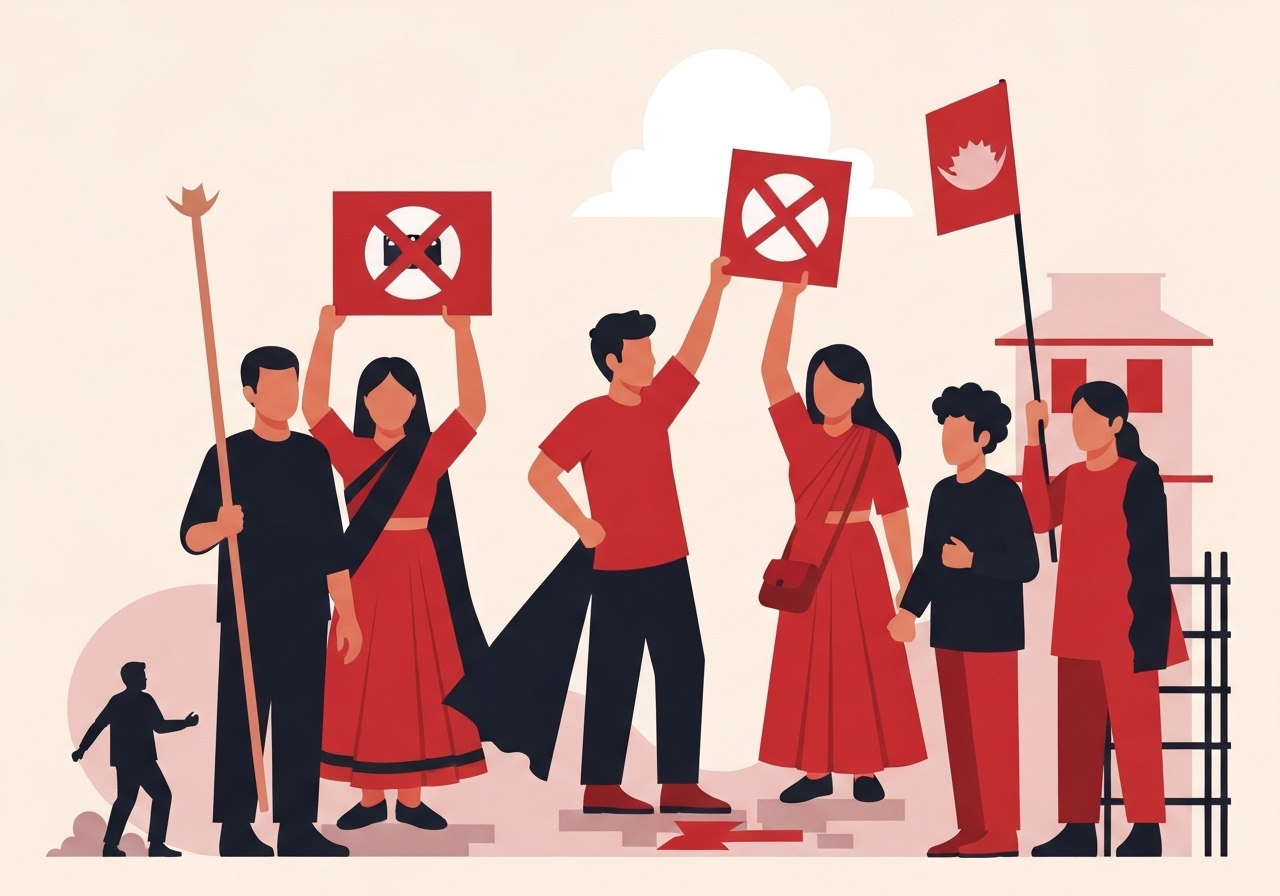
, thousands of predominantly young demonstrators gathered in Maitighar, Kathmandu, to protest corruption and a government ban on major social media platforms. Clashes between protesters and security forces escalated into lethal use of force that officials say left 19 people dead and more than 100 injured, and prompted curfews around New Baneshwor and key official residences. Organizers and witnesses say the demonstration, organized by Hami Nepal, was driven by long‑running grievances about corruption, lack of accountability and the abrupt social media restrictions announced on 4 September. The events have triggered national and international calls for an independent investigation while the government defends measures as necessary for public order.
Key Takeaways
- At least 19 people were killed and over 100 injured after security forces opened fire during protests in Kathmandu on 8 September 2025.
- Protests began at 09:00 local time in Maitighar and by midday some demonstrators had entered the Parliament compound in New Baneshwor, prompting a curfew effective 12:30pm until 10:00pm local time.
- The protests were organized by Hami Nepal and drew heavy participation from school and university students, according to multiple eyewitnesses.
- The government had blocked 26 social media platforms after giving a registration deadline of 3 September; platforms were asked to name local contacts and grievance handlers.
- Longstanding corruption grievances — including the 2017 Nepal Airlines Airbus deal that an inquiry said cost the treasury 1.47 billion rupees (~$10.4m) — helped fuel anger among youth.
- About 90% of Nepal’s ~30 million people used the internet as of 2021 (NTA report); roughly 7.5% of the population lived abroad in 2021, increasing reliance on cross‑border messaging apps.
- Amnesty International and other rights groups called for an independent probe into the use of lethal force and urged restraint by authorities.
Background
Public frustration with corruption has been a recurring theme in Nepalese politics for years. High‑profile cases such as the 2017 Airbus procurement for Nepal Airlines produced a Commission for the Investigation of Abuse of Authority inquiry that found a 1.47 billion rupee loss to the state and led to convictions of several officials. For many young Nepalis, such cases symbolize persistent impunity and weak accountability mechanisms.
International protest movements in the region — notably anti‑establishment uprisings in Sri Lanka (2022) and Bangladesh (2024) — have shaped expectations among Nepal’s youth that sustained street pressure can produce political change. Social media has become a primary organizer and amplifier for this cohort, so the government’s requirement that major platforms register local contacts and grievance handlers ahead of 3 September touched a raw nerve.
Main Event
Protesters began gathering at Maitighar at 09:00 on 8 September 2025. Initial marches and slogans were peaceful, according to multiple attendees, and included many students in school uniforms. Organizers from Hami Nepal said they had obtained official permission from the Kathmandu District Administration Office for a demonstration in the area.
As the day progressed, eyewitnesses reported a growing crowd and confrontations with police. Some attendees described groups on motorcycles moving through the demonstration and, in a turn many witnesses called chaotic, a segment of the crowd breached barricades and entered the Parliament compound at New Baneshwor.
Authorities deployed tear gas, water cannon and, protesters and local media reported, rubber bullets. Medical personnel at Civil Hospital and the National Trauma Centre treated dozens with gunshot wounds; a doctor at the National Trauma Centre told local media that at least 10 people were in critical condition with gunshot wounds to the head or chest.
Local officials imposed a curfew covering New Baneshwor and surrounding areas from 12:30pm; the restriction was later extended to include the presidential and vice‑presidential residences in Shital Niwas and Lainchaur. Government statements framed the measures as necessary to restore order after security breaches at a sensitive national site.
Analysis & Implications
The immediate political implication is heightened polarization between a youthful urban constituency and an established political elite. The demonstrators’ explicit demands — rule of law, accountability for corruption, and reversal of the social media block — place pressure on a government already criticized for heavy‑handed approaches to dissent and information control.
Economically, the unrest risks short‑term disruptions to Kathmandu’s commerce and services and could deter tourism and investment if instability persists. For households that rely on remittance communications, the social media and messaging restrictions add an economic and social cost, complicating contact between migrants and families in Nepal.
Regionally, Nepal’s unrest will be watched by neighboring governments balancing information control with social stability; the movement echoes broader South Asian trends where youth activism has helped topple or significantly challenge incumbents. Internationally, the use of lethal force against largely young protesters will likely draw diplomatic scrutiny and could result in conditionalities or reputational costs in bilateral relations.
In governance terms, the crisis underscores weaknesses in dispute resolution institutions. Calls for independent probes — from domestic civil society and international rights groups — may become a focal point for negotiation, testing the government’s willingness to accept accountability mechanisms beyond internal reviews.
Comparison & Data
| Metric | Value |
|---|---|
| Fatalities (8 Sept 2025) | 19 |
| Reported injured | 100+ |
| Internet penetration (2021, NTA) | ~90% of 30 million |
| Population living abroad (2021) | ~7.5% |
| Noted procurement loss (Airbus 2017) | 1.47 billion NPR (~$10.4m) |
The table places the scale of the day’s violence alongside structural data: high internet use and a significant diaspora mean restrictions on platforms affect both domestic mobilization and international family communications. Historical precedents in the region show that youth‑led street movements can translate into institutional change, but outcomes vary widely depending on elite responses and the openness of political channels.
Reactions & Quotes
Authorities and political leaders offered competing narratives about responsibility and intent. Prime Minister KP Sharma Oli made remarks before the protest questioning organisers’ independence of thought, a comment that critics said downplayed youth grievances and may have inflamed tensions.
‘People themselves are not free, their thoughts themselves are not free,’ Prime Minister KP Sharma Oli said in remarks before the demonstration.
Prime Minister KP Sharma Oli (public statement)
Human rights groups demanded independent scrutiny of force used by security personnel and urged restraint.
‘We strongly condemn the unlawful use of lethal and less‑lethal force and call for an independent investigation,’ Amnesty International said in a statement urging accountability.
Amnesty International (international NGO)
Organisers stressed the protests were primarily about corruption and youth exclusion from decision‑making, while also protesting the social media restrictions.
‘At the core of our demands is the rule of law, fairness and accountability,’ Hami Nepal organisers said in a message to supporters.
Hami Nepal (organiser/NGO)
Unconfirmed
- Claims that specific organized motorcycle ‘mobs’ orchestrated the breach of Parliament barricades remain unverified by independent investigations or multiple corroborating sources.
- Precise identification and motives of the 19 deceased have not been publicly released; official confirmations and autopsy details are pending.
- Reports differ on whether security forces fired live rounds first or were responding to direct lethal threats; this sequence is not yet independently established.
Bottom Line
The 8 September protests in Kathmandu reflect a combustible mix of youth frustration over corruption, a sense of political exclusion, and anger at sudden online restrictions. The resulting violence and deaths mark a serious escalation with likely long‑term political and social consequences in Nepal.
Calls for independent, transparent investigations will be a key test of the government’s readiness to accept external scrutiny and to address deeper governance failures. How Kathmandu responds — through dialogue, accountability measures and potential recalibration of its information controls — will determine whether the unrest recedes or becomes a sustained national movement.
Sources
- Al Jazeera — (International news outlet reporting on the protests and eyewitness accounts)
- Reuters — (International news agency reporting on government directives and platform registrations)
- The Kathmandu Post — (Local English‑language newspaper reporting hospital casualty details)
- Amnesty International — (International human rights NGO statement calling for independent probe)
- Nepal Telecommunications Authority (NTA) — (Official regulator; reference for 2021 internet data and registration directive)
- Hami Nepal — (Organizer; nonprofit/youth movement communications channel)