
Lead
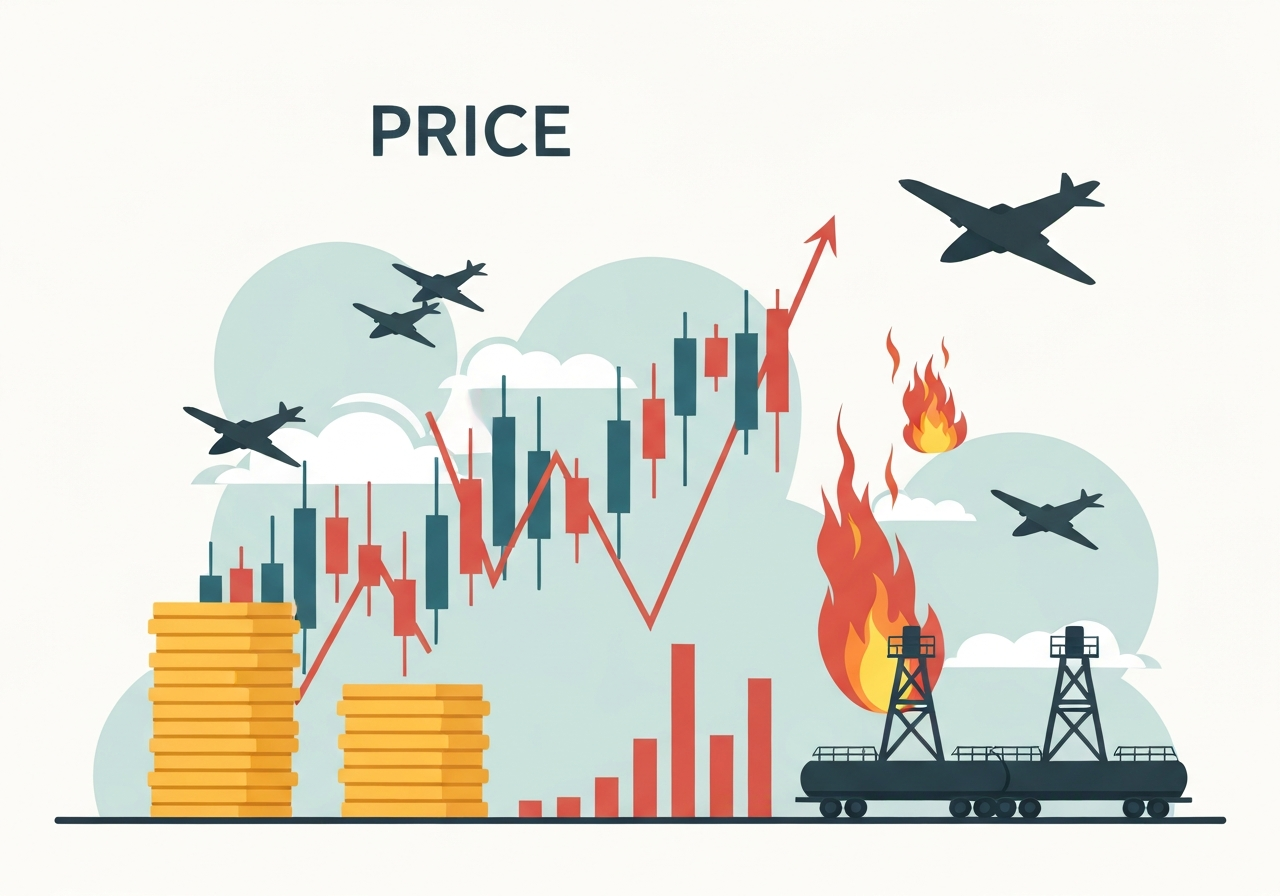
Global equity markets plunged Monday as the conflict involving Iran and other regional actors pushed oil prices sharply higher, briefly spiking near $120 a barrel and trading above $100 in major benchmarks. Asian bourses led losses: Japan’s Nikkei moved to a 5.2% decline to 52,728.72 and South Korea’s Kospi sank 6% to 5,251.87. Brent and U.S. crude were trading at $103.54 and $107.35 per barrel respectively as of 0600 GMT, roughly 15% above Friday’s close. Officials from China and South Korea urged restraint, warning that attacks on civilian infrastructure and market panic would worsen economic fallout.
Key Takeaways
- Japan’s Nikkei ended down 5.2% at 52,728.72 after a larger intraday plunge, reflecting heavy exposure to energy-cost shocks.
- South Korea’s Kospi dropped 6.0% to 5,251.87, one of the steepest regional declines reported Monday.
- Hong Kong’s Hang Seng fell 1.6% to 25,343.77 and the Shanghai Composite was down 0.7% at 4,097.69; Taiwan’s benchmark declined 4.4%.
- As of 0600 GMT, Brent crude was $103.54 per barrel and U.S. benchmark crude $107.35, both about 15% higher than Friday’s close; intraday trade hit near $120.
- Futures for the S&P 500, Nasdaq and Dow were trading over 1% lower early Monday after steeper falls late Sunday.
- Officials warned of immediate economic risks: South Korea urged against hoarding and collusion; a Chinese envoy called for an end to attacks on civilians.
- Analysts said prolonged elevated energy prices could revive inflation globally and dent growth for weeks to months.
Background
The market moves come in the second week of a widening regional conflict that has seen both sides strike new targets, including facilities that officials say are non-military. Markets are particularly sensitive because the fighting involves countries and infrastructure tied to Persian Gulf oil and gas flows — a supply source critical to many Asian economies. Energy markets had last crossed the $100-per-barrel threshold in the aftermath of Russia’s 2022 invasion of Ukraine; the current spike is the highest in at least 14 years by some measures. Investors are watching shipping lanes, refinery output and critical facilities such as desalination plants and oil depots, any damage to which could compress physical supply and amplify price volatility.
Monetary and fiscal settings in major economies complicate the outlook. Central banks, including the Federal Reserve, face the dilemma of slower growth and surging inflation — a situation that limits policy options because a rate cut to stimulate growth can worsen inflation, while rate hikes to curb inflation can deepen a slowdown. Many Asian economies are highly dependent on imported crude and gas, so a sustained period of higher energy prices would feed into consumer prices, trade balances and fiscal pressures. Additionally, recent trade and tariff frictions with major partners have left some export-driven economies with limited buffers against a large external shock.
Main Event
Markets moved sharply after reports over the weekend described new strikes on both military and civilian targets. Bahrain publicly accused Iran of hitting a desalination plant, a facility essential for potable water in several Gulf states, and Israeli strikes reportedly hit oil depots in Tehran, producing thick smoke and environmental alerts. Those developments heightened fears of disruption to regional energy infrastructure and shipping security, prompting a rapid risk-off move in equities and a jump in oil futures.
In trading, Asian shares experienced broad-based weakness. Japan’s Nikkei initially plunged by more than 5% before settling at a 5.2% loss, while South Korea’s Kospi plunged 6% to 5,251.87. Chinese mainland markets were relatively less volatile: the Shanghai Composite eased 0.7% to 4,097.69, and Hong Kong’s Hang Seng lost 1.6% to 25,343.77, reflecting a mix of domestic policy supports and partial insulation from global flows. Taiwan’s index fell 4.4%, and other regional markets also recorded significant declines.
In the United States, futures for the S&P 500, Nasdaq and Dow were down more than 1% early Monday after indices suffered notable declines Friday: the S&P 500 fell 1.3% on a weak jobs-related report and earlier oil price spikes, the Dow briefly plunged as much as 945 points before closing down 453 points (0.9%), and the Nasdaq slid 1.6%. The U.S. dollar strengthened as investors sought a safe haven, trading at 158.46 Japanese yen versus 158.09 late Friday, while the euro was near $1.1558.
Analysis & Implications
Short-term: The immediate effect is a classic risk-off episode driven by a supply-shock fear premium in oil markets. When physical infrastructure or shipping security is threatened, futures can move sharply on both real and anticipated supply losses. Markets punished companies and sectors most exposed to energy costs and earnings sensitivity, and currency moves favored safe-haven assets such as the dollar and government bonds.
Medium-term: If crude remains elevated for weeks or months, inflation metrics will likely accelerate, forcing central banks to weigh additional tightening at a time when growth is already slowing in several economies. Elevated energy costs act like a regressive tax on consumers and a cost shock for manufacturing and transport-intensive sectors, which could shave GDP growth across import-dependent countries in Asia and beyond.
Policy and geopolitical implications: Governments face a twin challenge — calming markets and preventing panic behaviors such as hoarding, while responding diplomatically to limit escalation. South Korea’s warning against collusion between refiners and gas stations underscores the risk of supply-chain or market manipulation during crises. Regional diplomacy, as signaled by China’s special envoy Zhai Jun urging an end to attacks, will be central to any de-escalation that can restore energy-market confidence.
Markets and trade flows: Elevated freight insurance costs, port disruptions and tighter tanker availability would raise the delivered price of crude and refined products beyond headline futures moves. That can magnify inflationary effects and amplify the impact on trade balances, particularly for economies reliant on Middle Eastern supplies. Central banks are likely to cite energy-driven inflation as a complicating factor in near-term policy statements.
Comparison & Data
| Index/Commodity | Move (approx.) | Level (Monday) |
|---|---|---|
| Nikkei 225 | -5.2% | 52,728.72 |
| Kospi | -6.0% | 5,251.87 |
| Hang Seng | -1.6% | 25,343.77 |
| Shanghai Composite | -0.7% | 4,097.69 |
| Brent crude | +~15% vs Fri | $103.54 / bbl (0600 GMT) |
| U.S. crude (WTI) | +~15% vs Fri | $107.35 / bbl |
Context: The table shows the sharp regional divergence: export-oriented Asian markets with direct energy exposure saw outsized declines, while mainland Chinese indices were relatively muted. The roughly 15% jump in headline crude versus Friday’s close reflects both physical-risk premiums and speculative repositioning in futures markets, and is comparable to prior spikes during major geopolitical shocks such as early 2022.
Reactions & Quotes
Officials and market participants reacted quickly, calling for calm and highlighting the broader economic stakes. Below are representative statements with context.
Before the market opened, China dispatched a special envoy to the Middle East to urge de-escalation amid civilian casualties and infrastructure strikes; the envoy emphasized the need to protect non-combatants and essential services. The message was part diplomatic, part market stabilizer, signaling Beijing’s concern about wider regional disruption and economic fallout.
“We call for an end to the attacks; strikes on non-military targets and civilians should be condemned,”
Zhai Jun, Chinese special envoy
South Korea’s president publicly warned against panic behavior that could exacerbate shortages and price spikes, urging regulators to monitor markets and prevent opportunistic price gouging. The appeal sought to limit domestic disruptions such as hoarding and alleged collusion among fuel suppliers.
“Please respond proactively to the growing volatility in the financial and foreign exchange markets, which are the lifeblood of our economy,”
President Lee Jae Myung of South Korea
Market strategists explained the trading psychology driving the sell-off: an abrupt shift from complacency to risk aversion when the threat to supply became clearer, compounded by weak U.S. labor data that left growth concerns on investors’ minds.
“The market woke up to the sound every macro trader dreads. The oil alarm bell. And this time it was not a polite chime. It was a fire siren,”
Stephen Innes, SPI Asset Management (market strategist)
Unconfirmed
- Bahrain’s accusation that Iran struck a specific desalination plant requires further independent verification of damage location and responsible party.
- Reports that Israeli strikes hit particular oil depots in Tehran generated environmental alerts, but the full extent of damage and operational impact on refining or storage capacity is not yet independently confirmed.
- Claims of collusion between refiners and gas stations in response to the crisis are allegations that regulators say they will investigate; concrete evidence has not been publicly released.
Bottom Line
Markets reacted sharply to heightened geopolitical risk that threatens energy infrastructure and shipping in a region central to global oil supplies. The immediate effect was a broad equity sell-off and a surge in crude prices, with Brent and WTI trading above $100 per barrel and intraday moves near $120. If the conflict continues to threaten production or transportation routes, elevated energy prices could persist for weeks or months, feeding inflation and slowing growth in import-dependent economies.
Policymakers face dual tasks: calming markets and ensuring domestic supply-chain integrity while pursuing diplomatic channels to limit further escalation. Investors should prepare for volatility: energy-sensitive sectors and currencies in smaller, import-reliant economies are likely to remain under pressure until the geopolitical picture stabilizes and physical-market signals normalize.