
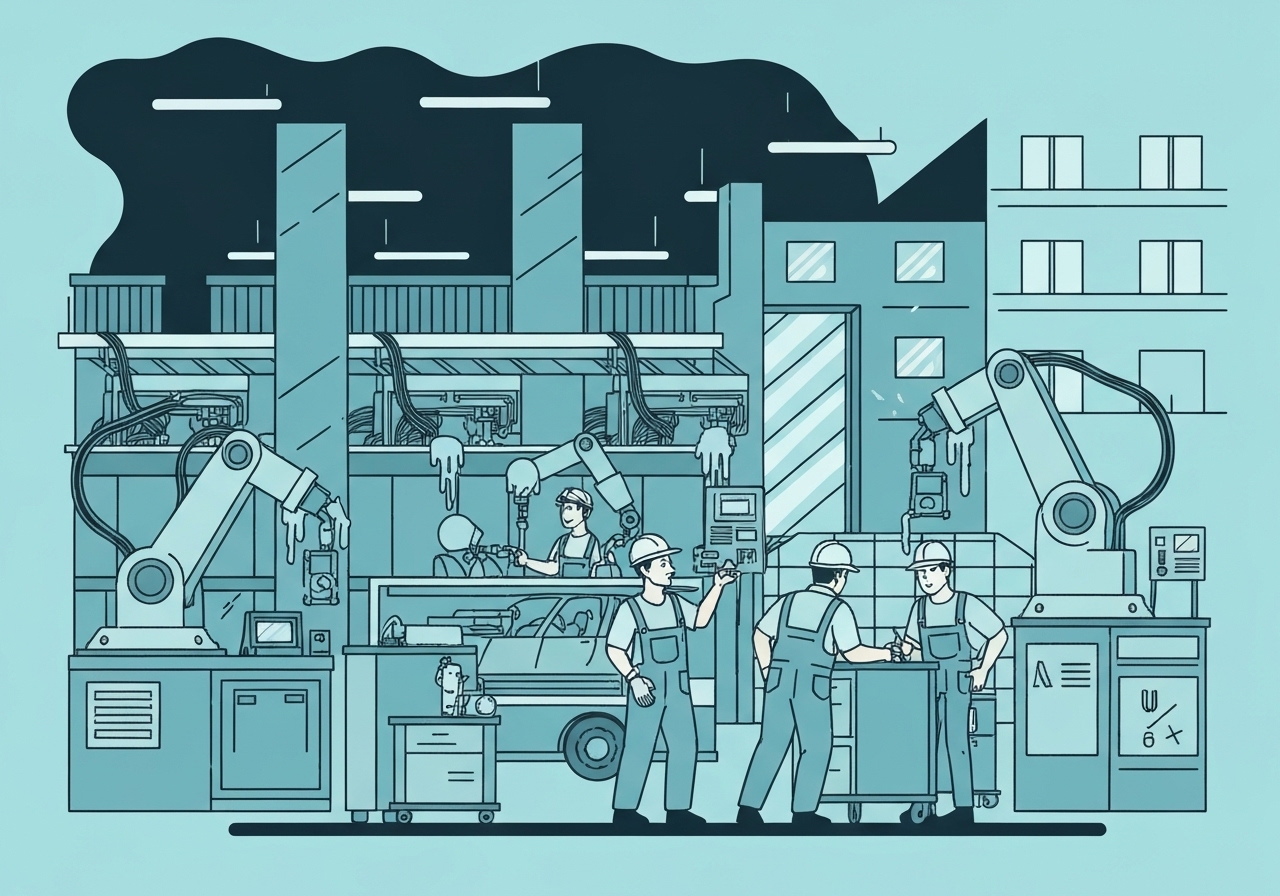
— Jaguar Land Rover (JLR) has extended a production shutdown after a cyber attack that began on 31 August disrupted IT systems. UK assembly plants at Halewood and Solihull and the Wolverhampton engine unit remain offline, alongside production sites in Slovakia, China and India. Staff on affected production lines have been told to stay at home while the company works with external cyber specialists and law enforcement to restore systems safely. The interruption has rippled through dealerships and suppliers, with some operations unable to register new vehicles or order parts.
Key takeaways
- Attack timeline: JLR shut down its IT systems on 31 August; production has been stopped for more than a week and closure is now expected to last until at least Wednesday, 10 September.
- Facilities affected: UK plants at Halewood and Solihull, the Wolverhampton engine plant, and production sites in Slovakia, China and India have been unable to operate since the outage began.
- Production impact: Under normal conditions JLR builds about 1,000 cars per day; the stoppage has therefore erased multiple days of global output and threatened supplier workloads.
- Dealer and parts disruption: Dealerships could not register new cars initially and service garages were unable to order parts; temporary workarounds have reportedly been implemented for some functions.
- Claimed perpetrators: A group that earlier targeted other UK companies, including M&S, has claimed responsibility and reportedly posted about the incident on Telegram; JLR says it is investigating.
- Company response: JLR is restoring networks in a controlled manner with third-party cybersecurity firms and law enforcement involvement; Tata Motors remains the parent company.
- Supply-chain consequences: Several suppliers have asked their own workers not to report to sites amid uncertainty, raising questions about the knock-on impact if the outage continues for weeks.
Background
Jaguar Land Rover is one of the UK’s largest automotive manufacturers and is owned by India’s Tata Motors. Its supply chain is extensive and time-sensitive: the company typically assembles roughly 1,000 vehicles a day under normal operating conditions, a tempo that depends on steady flows of parts and digital systems for registration and logistics.
Cyber incidents targeting manufacturers and retailers have increased in recent years, with threat actors often seeking to disrupt operations or extract payments. Earlier in 2025 a small group of hackers reportedly targeted other UK businesses, and those same actors have been named in press accounts as claiming responsibility for this JLR incident.
Main event
On 31 August JLR proactively took down critical IT systems to prevent further damage after detecting a compromise. That shutdown immediately halted production at multiple sites, including Halewood, Solihull and the Wolverhampton engine plant in the UK, as well as plants in Slovakia, China and India.
Employees who normally work on production lines were instructed to remain at home while engineers and external cyber teams performed controlled recovery procedures. Production staff were initially told to stay away until at least Tuesday; the firm later extended that guidance to at least Wednesday as recovery continued.
The outage occurred at a consumer-facing moment: the UK’s new-plate period began on Monday, 1 September, a common time for vehicle deliveries. Dealerships reported problems registering new vehicles, and some service centres temporarily could not order parts — though limited technical workarounds have been deployed to reduce immediate customer impact.
Some suppliers have already reported operational disruption. Qualplast, a parts supplier that counts JLR among its major clients, warned that a prolonged shutdown running into weeks would force the business to reassess its resilience and planning.
Analysis & implications
Short-term economic effects are concentrated in lost production and the immediate interruption of downstream logistics. At roughly 1,000 cars per day, each additional day of stoppage translates into significant value deferred, inventory shortfalls at dealerships and cashflow pressure for tier-one and tier-two suppliers.
Medium-term risks hinge on the outage duration. Suppliers with limited inventory buffers could scale back shifts or furlough workers, while dealers face concentrated delivery schedules when production resumes. The parts ordering problems for service centres also risk extended vehicle downtime for customers if backlogs grow.
Strategically, the incident underscores growing cyber risk for industrial manufacturers that increasingly depend on integrated IT and OT (operational technology) systems. JLR’s decision to take systems offline reflects a common containment strategy but also highlights the trade-off between security containment and operational continuity.
Internationally, the event may prompt closer scrutiny by firms and regulators of supplier cybersecurity practices and incident response readiness. If the attackers were seeking extortion, it will intensify debate over ransom payments versus law-enforcement-led responses and could influence insurers’ terms for cyber coverage.
Comparison & data
| Metric | Normal level | Current/affected |
|---|---|---|
| Daily vehicle build | ~1,000 cars/day | 0 (selected plants offline) |
| Primary UK sites affected | Halewood, Solihull, Wolverhampton | All closed since 31 Aug |
| Other countries affected | Slovakia, China, India | Production paused |
The table above places the immediate loss of daily production in context. Even a short interruption can create multi-week recovery needs because parts flows, staffing and registration backlogs must be coordinated when systems return.
Reactions & quotes
Company and industry voices have framed the event as a controlled but serious disruption, while suppliers voiced concern about cascading effects.
“If this starts progressing over weeks, then we would have to seriously look at what we need to future-proof.”
Shaun Adams, Qualplast (supplier)
JLR has described recovery as a round-the-clock effort involving external cyber specialists and law enforcement, aiming to restore networks in a controlled manner rather than rush systems back online.
“We are working to restart our networks in a controlled and safe manner and liaising with third-party cyber security specialists and law enforcement.”
Jaguar Land Rover (company statement)
Security commentators noted that the attackers’ early claims on Telegram and screenshots shared by the group, if authentic, suggest they may have accessed internal information. JLR says it is investigating such claims.
Unconfirmed
- The exact identity and full capabilities of the attackers remain unverified; claims made on messaging platforms have not been independently authenticated.
- Details about whether sensitive customer, employee or proprietary data were accessed or exfiltrated have not been publicly confirmed.
- Reports that the group sought a ransom are based on press accounts and social-media claims; JLR has not disclosed specific extortion demands or payments.
Bottom line
The incident has temporarily suspended production across multiple JLR sites and revealed vulnerabilities in a global, tightly scheduled supply chain. JLR’s measured approach to recovery — taking systems offline and working with specialists — aims to prioritize system integrity but prolongs the immediate operational pause.
For suppliers, dealers and customers the main risk is timing: the longer critical systems remain offline, the greater the danger of knock-on workforce reductions, delayed deliveries and extended service backlogs. Watch for further official statements from JLR, updates from Tata Motors, and any law-enforcement findings that clarify the attackers’ methods and motives.