
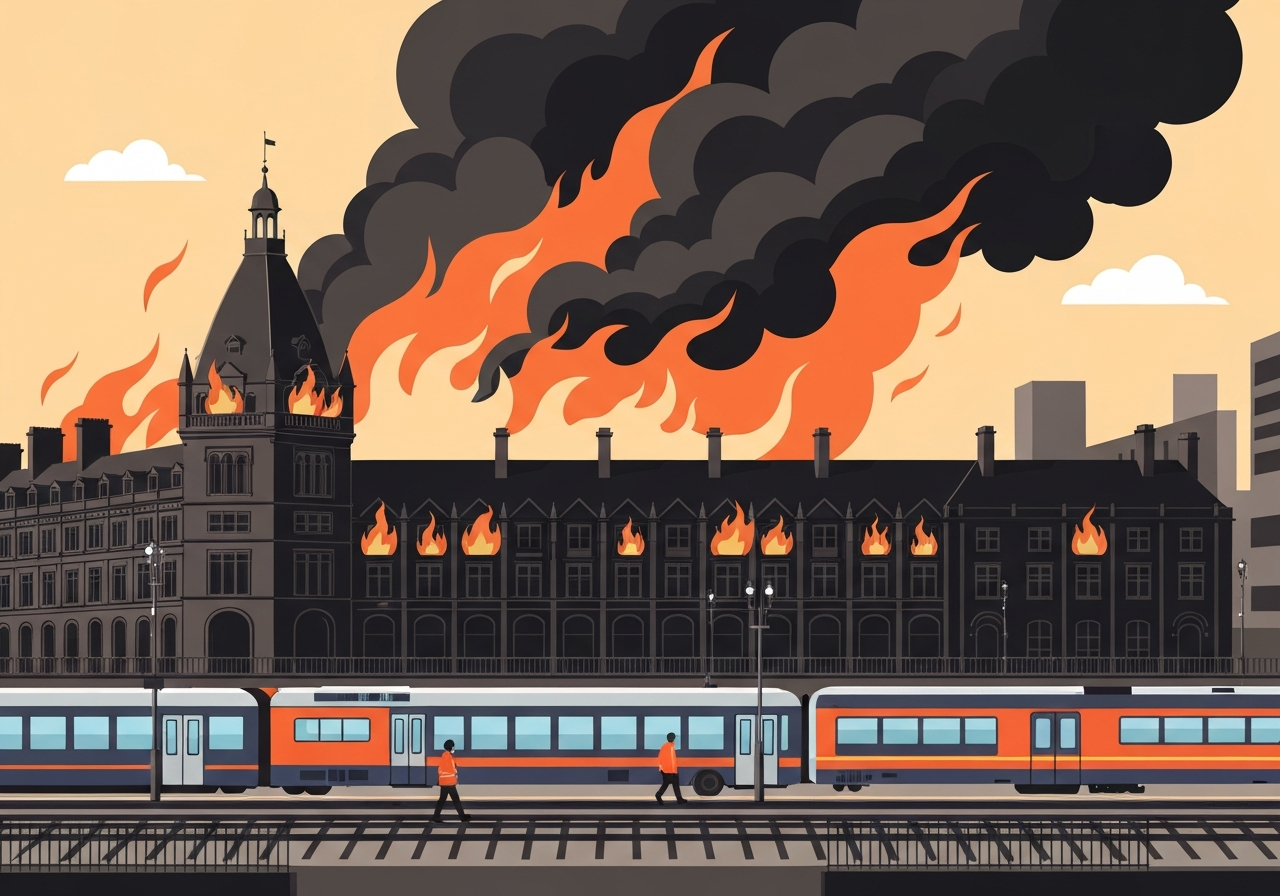
Lead: A large fire broke out just before 4 p.m. on Sunday on Union Street in Glasgow, engulfing the ground floor of a four‑storey commercial building and causing a partial collapse of the historic structure. The blaze prompted a prolonged emergency response that lasted more than 10 hours and forced the temporary closure of Glasgow Central station, disrupting services across the UK. Dozens of firefighters and specialist appliances were deployed and, as of early Monday, no casualties had been reported. Authorities urged the public to avoid the area while operations continued.
Key Takeaways
- The blaze began just before 16:00 BST on Sunday on Union Street and involved a four‑storey commercial building adjacent to Glasgow Central station.
- At its height, 18 appliances and specialist resources — including three high‑reach vehicles — were mobilised, according to the Scottish Fire and Rescue Service.
- The building suffered a partial collapse; dramatic imagery showed flames around a domed roof and large volumes of smoke visible at night.
- No casualties have been reported to date, but emergency services continued operations into the early hours, with the fire still burning after roughly 10 hours.
- Glasgow Central, opened in 1873 and described by Network Rail as the busiest station in Scotland, was closed and major rail disruptions were reported by National Rail.
- Video circulating on social media showed a bystander briefly using a small extinguisher before being pulled back; Police Scotland was contacted for comment.
Background
Glasgow Central station opened in 1873 as part of Victorian-era expansion to accommodate the city’s booming population and industry, including shipbuilding on the River Clyde. Network Rail and other operators have long described the station as a central transport hub with direct services across the UK, making any disruption there consequential for regional and long‑distance travel. Union Street sits close to the station complex and contains a mix of commercial premises in older masonry buildings that predate modern safety retrofits in some areas.
Large urban fires in historic districts present complex hazards: combustible interiors, aged structural elements and close proximity to major public infrastructure increase both firefighting difficulty and the potential for secondary disruption. Scotland’s emergency services have contingency plans for major fires near transport hubs, but the scale of response is determined by evolving conditions on scene. The partial collapse reported here underscores the structural vulnerability of some older buildings when subjected to intense, prolonged heat.
Main Event
Authorities say the fire started on the ground floor of the four‑storey commercial building on Union Street shortly before 4 p.m. Dozens of firefighters responded; at peak, 18 appliances plus specialist units, including three high‑reach vehicles, were in use. Crews used elevated monitors and specialist equipment to attack flames that were visible curling around a domed roof after dark.
Footage verified by CNN shows thick smoke pouring from a shop doorway and a bystander briefly attempting to apply a portable extinguisher before being pulled back by onlookers. Bystanders reported loud bangs and a sustained presence of sirens as police and fire services arrived. Emergency teams continued to work well into the night and early morning as hot spots were cooled and structural safety assessed.
Network Rail confirmed Glasgow Central remained closed while assessments were carried out; National Rail issued travel guidance and cancellations for routes serving the station. Scotland’s First Minister John Swinney posted on X (formerly Twitter) expressing concern and thanking emergency crews, urging people to avoid the area and follow official travel guidance.
Analysis & Implications
The immediate transport impact was substantial: closure of Glasgow Central affects regional commuter flows and long‑distance services to Edinburgh, London and other destinations. Disruption to one of Scotland’s busiest rail hubs can cascade across the national timetable, increasing cancellations and delays for thousands of passengers and complicating freight and logistics connections that use the network.
From a safety and infrastructure perspective, the partial collapse raises questions about the resilience of adjacent heritage structures and the adequacy of fire separation in older commercial buildings. Retrofitting heritage façades and interiors to modern fire safety standards is costly and complex, but incidents like this intensify pressure on local authorities and owners to accelerate mitigation measures for buildings close to critical transport assets.
Economically, the closure adds immediate costs for rail operators and businesses reliant on station footfall; longer disruptions could hit retail and hospitality nearby. Politically, high‑profile incidents near major public assets often prompt rapid reviews of preparedness and asset protection, and could lead to expedited inspections or funding for preventative works in the city centre.
Comparison & Data
| Item | Detail |
|---|---|
| Station opening | 1873 (Network Rail) |
| Resources mobilised | 18 appliances; 3 high‑reach vehicles (SFRS) |
| Building height | Four storeys; commercial with domed roof (on‑scene reports) |
The table summarizes verifiable, cited figures: the station’s opening year, and the number and type of firefighting resources reported by the Scottish Fire and Rescue Service. These data points illustrate both the historical character of the location and the scale of the operational response.
Reactions & Quotes
Officials and witnesses offered brief remarks as the incident unfolded; excerpts below encapsulate official updates, political response and on‑scene impressions.
At its height, 18 appliances and specialist resources, including three high‑reach vehicles, were mobilised to the scene.
Scottish Fire and Rescue Service (official statement)
The fire service’s update provided the clearest operational snapshot, listing apparatus and confirming sustained activity into the early hours. That statement formed the basis for resource-tracking by agencies coordinating road closures and travel advisories.
Please continue to follow travel guidance, avoid the area and stay safe.
John Swinney, First Minister of Scotland (social post)
The First Minister’s message underscored the government’s concern and encouraged public compliance with official advisories, a common step to reduce pressure on emergency responders and limit secondary incidents near the cordon.
Oh my God, it’s like an explosion.
Bystander in verified social video
Short clips captured by the public showed smoke and flames and were used by news outlets to corroborate the scale of the event; they also illustrate how public footage complements official briefings during fast‑moving incidents.
Unconfirmed
- The precise cause of the fire has not been publicly confirmed and remains under investigation by relevant authorities.
- The full extent of structural damage to adjacent parts of Glasgow Central and nearby buildings is still being assessed; long‑term effects on station fabric are unverified.
- While no casualties had been reported as of early Monday, casualty figures could change pending further checks and official updates.
Bottom Line
The incident on Union Street is a major urban fire with immediate transport and local economic consequences, given its proximity to Glasgow Central — the busiest station in Scotland. Large resource deployment and a partial building collapse highlight both the severity of the event and the risks posed by older commercial buildings near critical infrastructure.
Short term, travelers should expect continued disruption while authorities complete structural assessments and clear the scene. In the medium term, the event is likely to prompt renewed attention to fire safety upgrades in heritage and commercial properties near major transport hubs.