
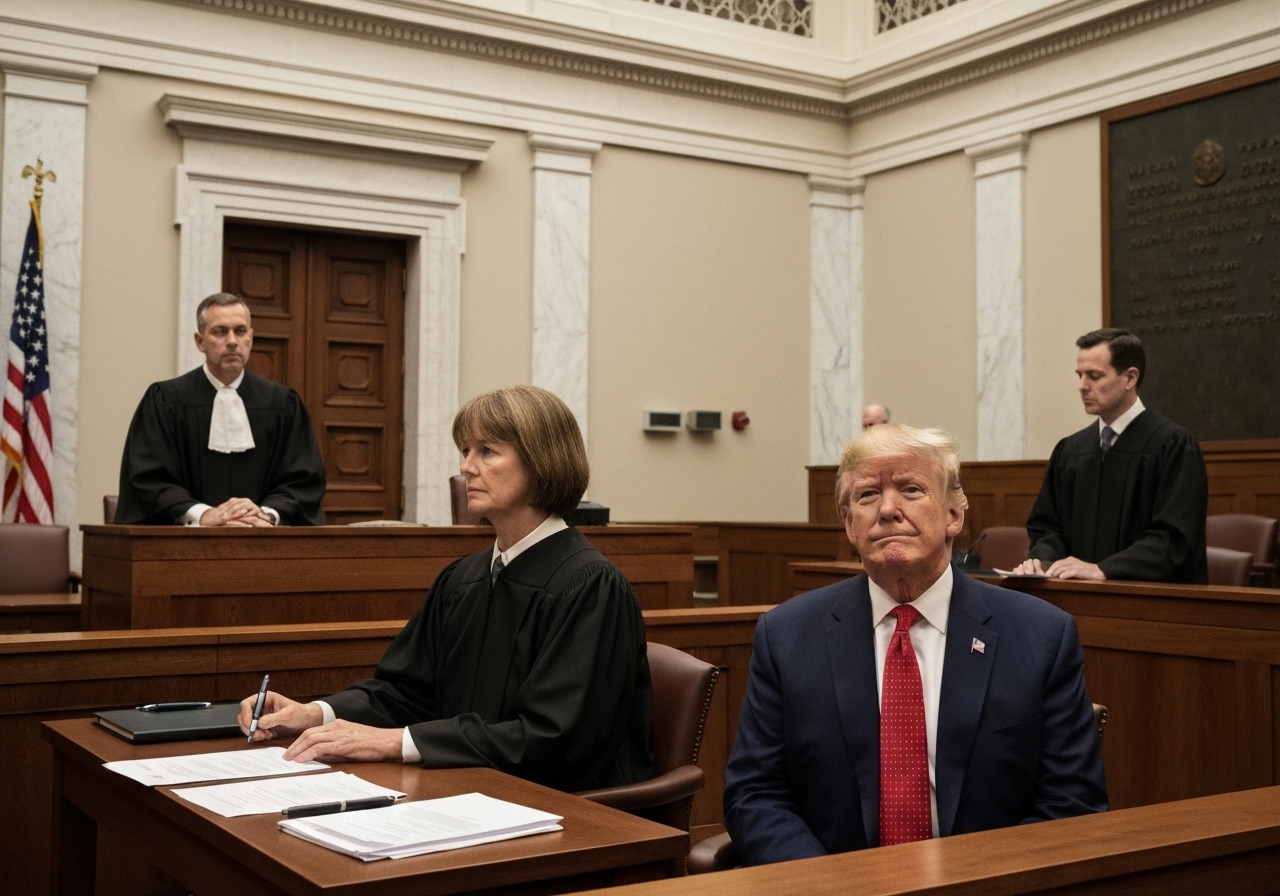
On Monday, Sept. 8, 2025, a three-judge panel of the U.S. Court of Appeals for the Second Circuit refused former President Donald Trump’s request to set aside an $83.3 million jury verdict ordering him to pay writer E. Jean Carroll for defamation. The judges found no legal basis to overturn their prior ruling on presidential immunity and said the lower court did not err in limiting relitigation of truth defenses. The decision preserves the substantial damages award tied to statements Trump made about Carroll, while separate appeals and a potential Supreme Court filing remain possible. The ruling follows a related $5 million verdict in Carroll’s second suit and comes amid continuing legal and political contention over immunity and civil liability for former presidents.
Key Takeaways
- The Second Circuit panel on Sept. 8, 2025, rejected Trump’s bid to vacate an $83.3 million defamation verdict in Carroll I.
- Judges said Trump failed to show grounds to revisit the court’s earlier holding on presidential immunity.
- The appellate opinion found no reversible errors in the district court’s rulings limiting relitigation of the truth of Trump’s statements.
- The decision noted material consistency between statements at issue in Carroll I (2019) and Carroll II (2022); a jury in Carroll II awarded Carroll $5 million after finding she had been sexually abused in 1996.
- Trump’s legal team signaled a near-term plan to ask the U.S. Supreme Court to review the Carroll II verdict; that step could raise fresh questions about immunity post-Trump v. United States (July 2024).
- The panel consisted of two Biden appointees and one Obama appointee and deemed the jury’s damages awards “fair and reasonable.”
Background
E. Jean Carroll, a longtime magazine writer, sued Donald Trump in two related civil actions alleging sexual assault in the mid-1990s and later defamation when Trump denied her account. Carroll I, filed first but tried second, focused on statements Trump made in 2019; Carroll II concerned later statements in 2022. In spring 2023, a jury in Carroll II found that Trump sexually abused Carroll in 1996 and awarded $5 million for defamation tied to his more recent comments.
The legal fights have intersected with a major constitutional question: how far presidential immunity shields a former president for unofficial conduct outside the scope of official acts. In July 2024, the U.S. Supreme Court issued a decision in Trump v. United States that clarified immunity for certain official acts, prompting renewed appeals by Trump in several civil cases. Carroll’s suits raise both factual disputes about the underlying allegations and legal disputes about whether immunity or other procedural rulings bar civil liability.
Main Event
On Sept. 8, 2025, the Second Circuit issued a short opinion denying Trump’s motion to overturn the Carroll I verdict. The panel wrote that Trump had not identified any intervening change in law that would justify revisiting the court’s prior immunity holding. The judges specifically rejected the argument that the July 2024 Supreme Court ruling required a different result on immunity in Carroll I.
The appeals court also addressed Trump’s claim that his attorneys were improperly barred from relitigating whether his 2019 statements about Carroll were true. The panel concluded that the statements in Carroll I and Carroll II were “identical in material respects” because both accused Carroll of fabricating her allegations for improper purposes, and that the Carroll II jury had resolved the factual dispute in Carroll’s favor.
In its brief ruling, the panel affirmed the district court’s evidentiary and procedural choices and characterized the $83.3 million damages award as fair and reasonable. The opinion noted the composition of the panel—two judges appointed by President Joe Biden and one by President Barack Obama—but based its conclusion on legal analysis rather than partisan factors.
Analysis & Implications
The decision preserves a large monetary judgment against a former president and reinforces the practical limits of presidential-immunity claims when a jury has already assessed underlying facts. For plaintiffs bringing similar suits, the ruling signals that appellate courts may be reluctant to upend jury findings absent clear legal error or a controlling intervening precedent. That lowers the bar for civil remedies in high-profile defamation and personal-injury claims when factual issues have been litigated.
For defendants who are former officials, the ruling underscores that Supreme Court guidance on immunity does not automatically erase civil judgments; the specific legal and factual posture of each case matters. Trump’s counsel argues that the Supreme Court’s July 2024 decision narrowed liability exposure for former presidents; the Second Circuit found that claim insufficient to warrant relief here. Whether the Supreme Court will accept further review of Carroll-related appeals could determine whether a national precedent reshapes civil exposure for future presidents.
Politically, the ruling may have consequences for public perception and campaign dynamics, as legal losses and outstanding liabilities remain salient in partisan discourse. Practically, enforcement of an $83.3 million judgment raises procedural questions—appeals, stays, and collection mechanisms—that could take months to resolve. Financially, large civil judgments can be insured, appealed, or stayed, and the eventual monetary outcome may hinge on further litigation rather than immediate payment.
Comparison & Data
| Case | Year of Statements | Jury Finding | Damages |
|---|---|---|---|
| Carroll I | 2019 | Defamation — jury awarded damages | $83.3 million |
| Carroll II | 2022 (related to 1996 conduct) | Sexual abuse found; defamation found | $5 million |
The table summarizes the two related lawsuits: Carroll I centered on 2019 statements and produced the $83.3 million award now affirmed on appeal; Carroll II resulted from a spring 2023 trial that included a finding the plaintiff was sexually abused in 1996 and a separate $5 million defamation award. These parallel proceedings influenced the appellate court’s view that relitigation of truth defenses was procedurally improper given the jury resolution in Carroll II.
Reactions & Quotes
Carroll’s counsel framed the ruling as a step toward finality and redress for her client. Before the panel’s written opinion, Roberta Kaplan told reporters she expected an end to prolonged appeals.
“We look forward to an end to the appellate process so that justice will finally be done.”
Roberta Kaplan, Carroll attorney (statement to CNBC)
The White House declined to comment directly, referring inquiries to Trump’s personal lawyers; those lawyers have indicated they may seek Supreme Court review of related verdicts. Legal observers emphasized that the next likely move is a petition for certiorari to the Supreme Court, which would raise the issue whether recent high-court immunity guidance requires a different result.
“The question now is whether the Supreme Court will take up the immunity issue and, if so, how it will reconcile its prior guidance with these factual rulings.”
Legal analyst (academic commentary)
Unconfirmed
- Whether the U.S. Supreme Court will grant review of Carroll-related appeals is not yet known and remains uncertain.
- The timing and practical mechanics of collecting on the $83.3 million judgment—whether payment will be stayed, bonded, or otherwise delayed—have not been confirmed.
- The extent to which insurance, appeals, or settlement negotiations might reduce the ultimate out-of-pocket exposure for the defendant is not publicly confirmed.
Bottom Line
The Second Circuit’s Sept. 8, 2025 ruling leaves intact a substantial defamation judgment against Donald Trump and underscores the limited relief appellate courts will grant when immunity arguments lack a clear, intervening legal basis. The decision preserves the jury’s factual resolutions from related trials and sets the stage for further high‑court litigation if Trump’s team pursues certiorari. Observers should watch for a Supreme Court filing and any procedural steps that could pause or alter enforcement of the $83.3 million award.
For plaintiffs and lawyers, the opinion signals that carefully litigated jury findings can be durable against immunity claims on appeal; for defendants, it highlights that legal strategies must account for both immediate appellate posture and the prospect of Supreme Court review. The next weeks and months will determine whether this stays a circuit-level resolution or becomes a new Supreme Court test of presidential immunity and civil accountability.
Sources
- Reuters (news report)
- CNBC (news report; includes counsel statements)
- U.S. Court of Appeals for the Second Circuit opinion (official court opinion)
- Trump v. United States, July 2024 (U.S. Supreme Court opinion)