
Lead
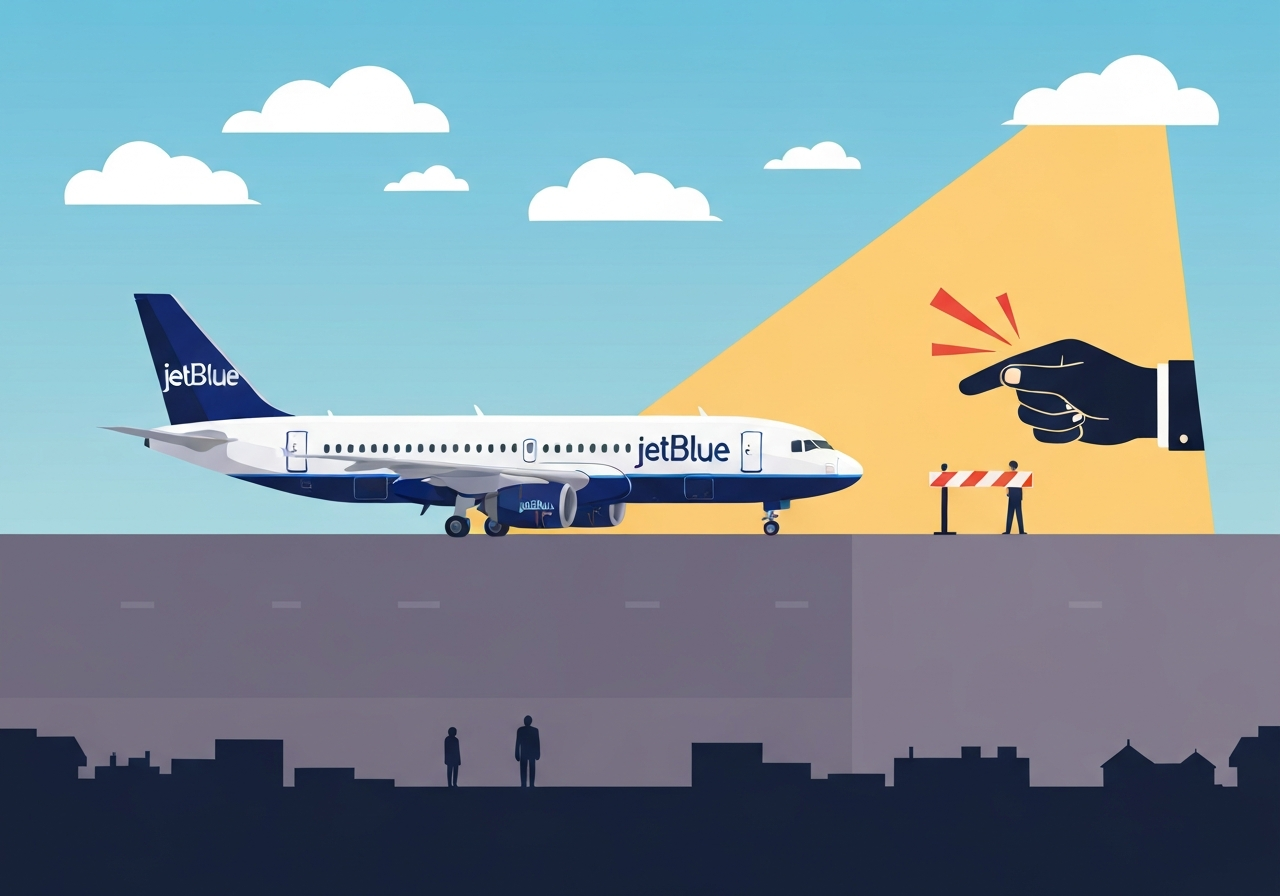
Shortly after the Federal Aviation Administration ordered all JetBlue flights to remain on the ground early Tuesday, March 10, 2026, the carrier said operations had resumed. The FAA said the directive followed a request from JetBlue and that it had been canceled after the airline reported the issue was resolved. Flight-tracking data showed two cancellations and 155 delays for Monday, with no delays recorded for Tuesday as of 2:40 a.m. EDT. The airline attributed the interruption to a brief system outage and said normal operations had resumed.
Key Takeaways
- The FAA briefly put a ground stop on all JetBlue flights after the carrier requested intervention; the stop was later canceled by the agency.
- JetBlue said a “brief system outage has been resolved” and that it resumed operations on March 10, 2026, according to its statement to CBS News.
- FlightAware reported two JetBlue cancellations and 155 delays on Monday; by 2:40 a.m. EDT Tuesday there were no reported delays for that day.
- JetBlue’s corporate headquarters are in New York City and its primary hub for many operations is John F. Kennedy International Airport (JFK).
- The FAA has previously issued ground stops in response to IT outages and security-related threats, making this measure a routine but consequential tool for managing national airspace safety.
- It was not publicly clear how many of Monday’s disruptions were directly caused by the brief ground stop versus other operational factors.
Background
Ground stops are an established instrument the FAA can use to freeze departures at one or more airports or for a specific carrier when conditions threaten safe, orderly traffic flow. They differ from broader airspace closures or ground delay programs, which manage arrival sequencing; ground stops halt departures at the origin. Airlines increasingly rely on complex IT systems to coordinate crew, aircraft, and gate assignments; when those systems fail, airlines sometimes ask the FAA for coordinated pauses to avoid cascading disruptions.
JetBlue operates a large domestic network with a major presence at JFK, where many arrivals and departures feed connecting flights across the carrier’s system. Even short interruptions at a hub can ripple through a carrier’s schedule, producing delays and cancellations on subsequent days. Regulators and carriers generally treat ground stops as an operational safety step, but they can also be a visible sign of technological or security stress for an airline.
Main Event
The sequence began late Monday when the FAA issued a ground stop that affected all JetBlue flights after receiving a request from the airline, the agency said. JetBlue notified news outlets early Tuesday that a short-lived system outage had been identified and fixed, and that flight operations had resumed. The FAA confirmed it had canceled the ground stop once the carrier reported the issue was cleared.
Flight-tracking service FlightAware recorded two JetBlue flight cancellations and 155 delays on Monday; by 2:40 a.m. EDT Tuesday flightaware.com showed no delays for Tuesday and indicated the ground stop no longer applied. CBS News and the Associated Press reported the timeline based on statements from the FAA and JetBlue and public tracking data. Officials did not provide a detailed technical post-mortem at the time of the update.
JetBlue’s statement to CBS News said in full that “a brief system outage has been resolved and we have resumed operations,” characterizing the incident as short-lived. The FAA’s public comment was limited to confirming that the ground stop had been issued at the carrier’s request and later canceled. There was no immediate indication of wider national airspace impact beyond JetBlue’s network.
Analysis & Implications
Operationally, a short ground stop requested by an airline is often a containment move to prevent aircraft from departing into potentially disordered airspace or into gaps in fleet and crew scheduling. For JetBlue, the quick resolution limited visible disruption: FlightAware’s snapshot showed a relatively small number of cancellations and delays compared with large-scale outages. Still, even brief interruptions can shift crews out of compliance windows, force aircraft to be repositioned, and complicate passenger connections.
From a regulatory perspective, the FAA’s readiness to accept a carrier request and later cancel the stop demonstrates the agency’s role as an air traffic manager that balances safety and traffic flow. The episode underscores the interdependence of airline IT systems and air traffic operations; when an airline flags a systems issue, the FAA may impose a ground hold to protect the broader network. That interplay can prompt additional scrutiny from regulators and industry observers about resilience and contingency procedures.
For travelers, the immediate risk was modest in this case, given the limited cancellations and the rapid rollback of the stop. However, the incident may prompt customers and consumer advocates to press airlines for faster, clearer communications when disruptions occur. Recurrent or prolonged system outages could have reputational and financial consequences, particularly during peak travel periods.
Comparison & Data
| Date | Cancellations (JetBlue) | Delays (JetBlue) |
|---|---|---|
| Monday, Mar 9, 2026 | 2 | 155 |
| Tuesday, Mar 10, 2026 (as of 2:40 a.m. EDT) | 0 | 0 |
The table above is based on FlightAware’s public tracking snapshot referenced by CBS News. It shows the immediate numerical footprint around the ground stop: a small number of cancellations on Monday and no continuing delays recorded early Tuesday. Those figures do not capture longer-term knock-on effects to connections occurring later the same day or on subsequent days.
Reactions & Quotes
JetBlue provided a concise statement to media outlining the carrier’s assessment and next steps, emphasizing restoration of service with limited delay to customers. The following are the primary public comments made by involved parties.
“A brief system outage has been resolved and we have resumed operations.”
JetBlue (statement to CBS News)
JetBlue framed the matter as quickly cleared, and the airline indicated it had returned to normal operations. The statement gave no further technical details about the outage or whether passengers would receive compensation for disrupted itineraries.
The FAA said the ground stop for JetBlue flights had been canceled following the airline’s notice that the issue was addressed.
Federal Aviation Administration (public statement)
The FAA’s comment confirmed the operational step and its reversal but did not elaborate on the root cause. Regulators typically wait for carrier-level technical reviews before releasing diagnostic information to the public.
Unconfirmed
- It remains unclear precisely which portion of the 155 delays on Monday were directly caused by the ground stop versus other operational factors such as crew availability or weather.
- Public reports did not include a technical root-cause analysis of the “system outage” JetBlue referenced; detailed findings had not been released at the time of reporting.
Bottom Line
The March 10, 2026 event was a brief, contained interruption in JetBlue operations that the carrier and FAA said was resolved quickly. Available tracking data show limited cancellations and delays confined to the day before the stop was lifted, and there was no immediate evidence of a broader national aviation impact.
Still, the incident highlights how dependent modern airline operations are on integrated IT systems and coordinated air traffic oversight. Regulators, carriers, and passengers will watch for a fuller technical explanation from JetBlue and any follow-up from the FAA to learn whether policy or procedural changes are needed to reduce the chance of repeat disruptions.
Sources
- CBS News — (media report; includes statements from JetBlue and the FAA)
- FlightAware — (flight-tracking data snapshot)
- Federal Aviation Administration — (official agency; air traffic control and regulatory role)
- JetBlue — (airline corporate site and public statements)