
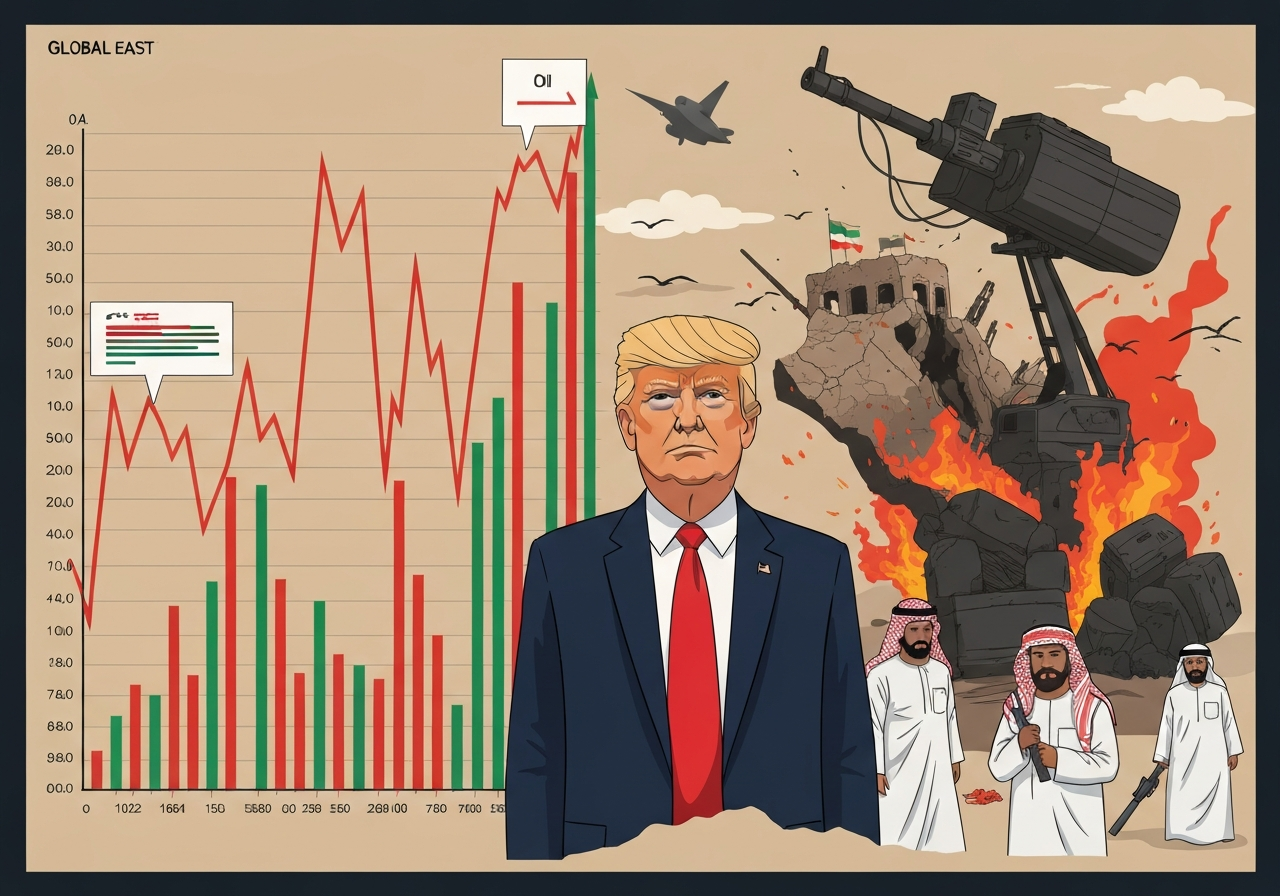
Lead: Former President Donald Trump said the Middle East war would end “very soon” in public remarks this week, comments that coincided with a fall in global oil prices. Traders interpreted the remark alongside fresh signals of diplomatic activity, prompting a retreat in risk premia on energy markets. The shift came amid continued fighting in the region and a wave of international responses. Markets and policymakers reacted to a mix of cautious optimism and persistent uncertainty about the conflict’s trajectory.
Key Takeaways
- Donald Trump publicly said the war in the Middle East would end “very soon,” a remark that moved market sentiment and media attention.
- Global oil benchmarks retreated following the comments as traders pared risk premiums tied to Middle East supply concerns.
- Energy markets remain sensitive to both battlefield developments and diplomatic signals from regional and global actors.
- Investors balanced hopes of de-escalation with reminders that front-line hostilities and logistical disruptions persist.
- Analysts noted that price swings reflect short-term risk re-pricing rather than a clear signal that supply fundamentals have changed.
- Policy responses from regional governments and external powers will be decisive for medium-term oil market direction.
Background
The recent conflict in the Middle East has repeatedly affected global oil markets because the region hosts key production and export infrastructure. Even localized disruptions, threats to shipping lanes or heightened military activity can lift the price of crude as traders build in a risk premium. Over the past months, periodic escalations have kept volatility elevated, drawing attention from governments and investors worldwide. The conflict’s geopolitical reach means that remarks by major political figures are quickly digested by markets for signals about likely de-escalation or escalation.
Donald Trump, as a high-profile former US president and current political figure, attracts outsized attention when he comments on foreign policy or conflict timelines. Markets tend to react to such commentary even when it is not an official policy statement from an incumbent government. That dynamic amplifies short-term price moves but does not automatically resolve underlying diplomatic, military or logistical uncertainties that determine supply over weeks and months.
Main Event
The immediate market move followed Mr. Trump’s public statement that the war would end “very soon,” which was reported widely across news outlets. Traders interpreted the comment together with reports of increased diplomatic activity involving regional and international actors, and they trimmed some of the premium that had been built into oil prices. The result was a visible slide in benchmark crude futures during the next trading sessions, reflecting a shift in market sentiment toward a reduced near-term supply risk.
On the ground, however, fighting and military operations have continued in several contested areas, and infrastructure risks have not been fully resolved. Shipping and insurance costs for vessels transiting sensitive routes remain elevated relative to pre-conflict levels, and some producers have signalled that operations are subject to disruption if hostilities spread. Those on-the-ground realities temper optimism that comments alone can usher in a faster resolution.
Market participants emphasised that the move was a repricing rather than a change in fundamentals: liquidity and positioning in futures markets amplified the price reaction, and short-term flows from hedge funds and index rebalancing contributed to the downward pressure. Energy firms and national exporters continue to monitor both security conditions and diplomatic channels for signs that supply disruptions will ease materially.
Analysis & Implications
The interaction between political messaging and commodity markets highlights how perceptions shape price formation as much as physical supply. A high-profile remark suggesting an imminent end to the conflict reduces uncertainty that underpinned recent risk premia — but it does not substitute for verifiable steps such as ceasefires, withdrawal of forces, or secure export routes. Persistent uncertainty means that any price relief can be fragile and reversible.
For importing economies, lower oil prices in the short run can ease inflationary pressure and improve trade balances. Central banks and fiscal authorities will evaluate whether the price move is durable before adjusting policy assumptions. Conversely, producing countries that rely on oil revenue may face renewed fiscal strain if lower prices persist without a matched recovery in demand or output.
Geopolitically, an early de-escalation would reduce incentives for certain states to deepen military involvement, but it could also trigger a reconfiguration of alliances and leverage. International diplomatic engagement, humanitarian access and reconstruction financing will determine the conflict’s aftermath and the speed at which markets regard the risk as resolved.
Comparison & Data
| Indicator | Short-term move | Structural drivers |
|---|---|---|
| Oil price direction | Down (risk premium trimmed) | Production capacity, shipping risk, inventories |
| Market sentiment | Less risk-averse briefly | Political statements, diplomatic signals |
| On-the-ground security | Still unstable | Active hostilities, infrastructure risk |
The table highlights the distinction between short-term market reactions and the underlying structural drivers that determine sustained price levels. Analysts say that unless there are concrete, verifiable improvements in security and logistics, price relief is likely to be intermittent.
Reactions & Quotes
“The conflict will end very soon,”
Donald Trump
Mr. Trump’s concise assertion was widely reported and helped trigger a near-term shift in market pricing as traders factored in a lower probability of prolonged disruption.
“Traders pared risk premia after the comment and related diplomatic reports,”
Energy trading desks (market participants)
Market participants described the move as driven by sentiment and positioning rather than immediate changes in physical supply flows.
“Diplomatic steps will ultimately determine whether markets can sustain this relief,”
Independent energy analyst
Analysts warned that durable easing of prices hinges on confirmed de-escalation and unhindered access to export routes, not just public remarks.
Unconfirmed
- That Mr. Trump’s statement reflects an agreed timeline among parties on the ground — there is no independent verification of coordinated ceasefire plans.
- That the oil price decline signals a sustained shift in supply fundamentals rather than a transient market re-pricing; longer-term confirmation is pending.
- That all transport and export corridors are secure — reports of localized disruption continue in some areas and have not been comprehensively resolved.
Bottom Line
Short-term market moves after high-profile political comments are common, especially when risk premia have been elevated by conflict. While Mr. Trump’s remark helped trigger a fall in oil prices, traders and analysts caution that fundamental risks remain until diplomatic and security conditions improve on the ground.
Investors and policymakers should watch for verifiable signs of de-escalation — such as agreed ceasefires, restored access to export infrastructure and lowered insurance costs for shipping — before treating the price decline as durable. For now, the market appears to be re-pricing sentiment rather than celebrating a definitive resolution.
Sources
- Financial Times — media (paywalled)