
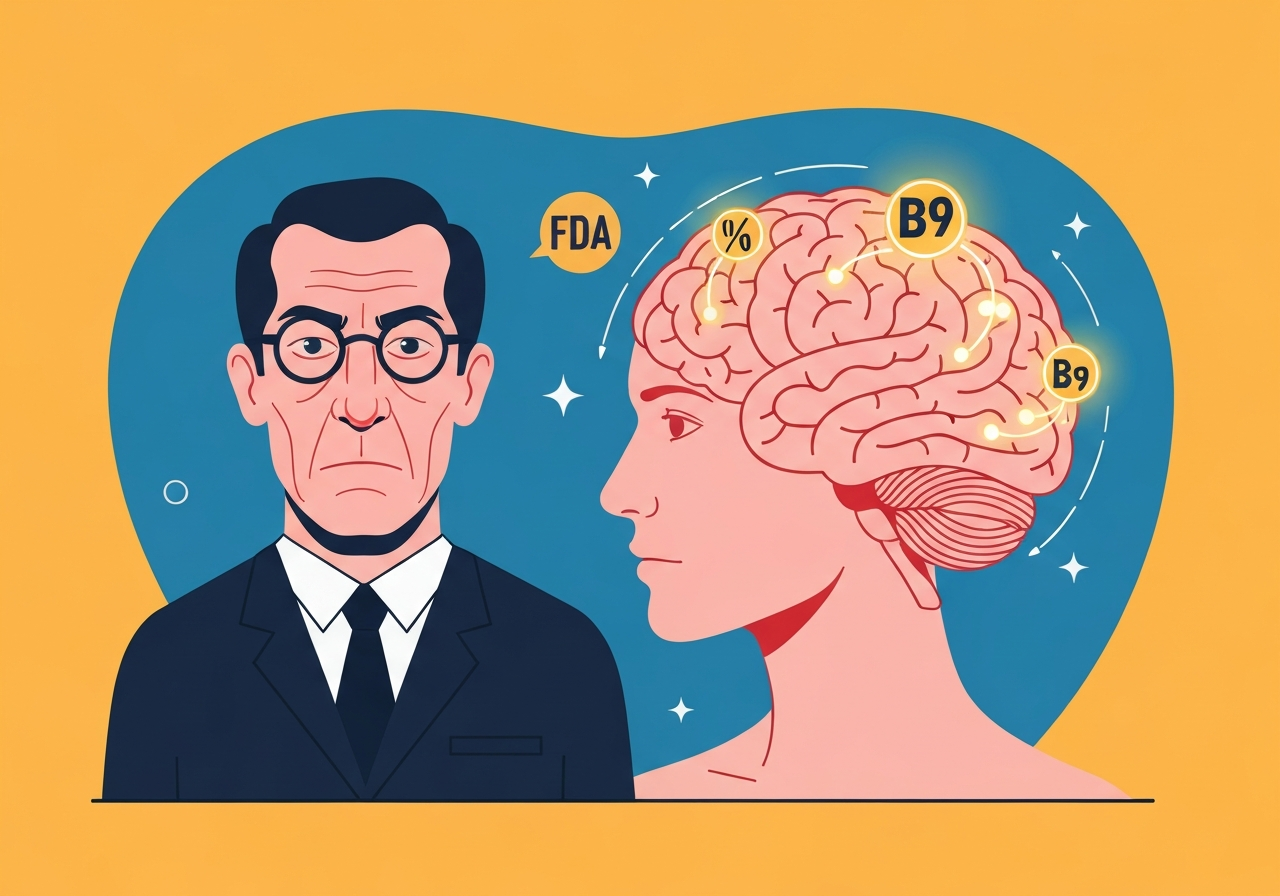
Lead: On Tuesday, the Food and Drug Administration announced an expanded approved use for leucovorin, a synthetic form of vitamin B9, authorizing it to treat cerebral folate deficiency rather than autism. The decision follows public statements in September by former President Donald Trump and then-FDA Commissioner Marty Makary suggesting the drug could help children with autism. The agency said there is insufficient evidence to establish efficacy for autism broadly, while permitting clinicians to prescribe leucovorin off-label where they deem appropriate. The move has heightened debate over communication, evidence and prescribing patterns for a medication already used in oncology care.
Key Takeaways
- The FDA approved leucovorin for cerebral folate deficiency, a rare neurological disorder characterized by low cerebral folate levels.
- Cerebral folate deficiency is estimated to affect about 1 in 1,000,000 people; researchers say it likely accounts for only a small fraction of autism cases.
- The agency explicitly did not authorize leucovorin as a treatment for autism; a senior FDA official said data are insufficient to establish broad efficacy for autism.
- After September remarks from Trump and Makary, leucovorin prescriptions for children rose 71% in the 2½ months that followed, according to data published in The Lancet.
- Some small trials outside the U.S. previously suggested benefits; one study in the European Journal of Pediatrics was retracted in January because of identified data errors.
- Leucovorin remains frequently used in oncology to reduce chemotherapy toxicity or boost effectiveness, and physicians may still prescribe it off-label for autism-related concerns.
Background
Leucovorin, also known as folinic acid, is a synthetic form of vitamin B9 with established uses in cancer care to mitigate side effects and, in some regimens, to potentiate chemotherapy. Clinical interest in leucovorin for neurodevelopmental disorders stems from observations that low cerebral folate can cause neurological symptoms that overlap with features seen in some autistic children, including social-communication difficulties, sensory differences and repetitive behaviors. Cerebral folate deficiency itself is rare, estimated at roughly one case per 1,000,000 people, and is typically diagnosed through specialized testing of cerebrospinal fluid folate levels.
In September, a high-profile White House briefing and related statements raised public expectations by describing changes to leucovorin labeling and suggesting benefits for autistic children. Those statements provoked rapid increases in demand and concern among autism clinicians and researchers about premature translation of weak or preliminary evidence into clinical practice. Prior clinical trials that explored leucovorin in autism were small and largely conducted outside the United States; one such randomized trial later had a publication retracted after data problems were found.
Main Event
The FDA’s formal action on Tuesday authorized leucovorin tablets specifically for patients with cerebral folate deficiency. Agency officials emphasized that the approval does not extend to autism as a general indication. A senior FDA official summarized the agency’s position succinctly, noting that evidence does not allow the agency to conclude that leucovorin is effective for autism broadly and that individual physician-patient decisions remain the route for off-label use.
The September briefing by then-Commissioner Makary and comments from President Trump had described an intention to change labeling in a way that would make leucovorin available to children with autism, with claims that many children could benefit. FDA staff said those public assertions overstated the scientific basis; agency materials and the newly approved wording focus on cerebral folate deficiency and the biological rationale linking folate transport disruption to neurological symptoms rather than asserting general benefit in autism.
Clinicians can and do prescribe medications off-label, and some had already been using leucovorin for autism-related indications before the September statements. The publication in The Lancet documenting a 71% rise in pediatric leucovorin prescriptions over 2½ months after the September announcements illustrates how public messaging can influence prescribing even when formal regulatory approvals are limited to a narrow indication.
Analysis & Implications
The FDA action highlights the tension between narrow regulatory approvals based on specific pathophysiology and broader public hopes for treatments of complex conditions like autism. Approving leucovorin for cerebral folate deficiency aligns with a standard regulatory model: authorize a drug for a defined, biologically plausible, diagnosable condition with measurable biomarkers. That approach preserves clinical options for the rare patients who meet those diagnostic criteria while avoiding an evidence-free expansion to a heterogenous neurodevelopmental population.
Public statements from high-level officials that imply a broader therapeutic endorsement can outpace the evidence base and produce rapid shifts in demand and prescribing. The 71% production surge documented after the September comments suggests physicians and families may act on signals from public leaders even when trials are limited and mixed. This dynamic raises questions about responsible communication of preliminary findings and the responsibilities of regulators, health officials and the press to frame uncertainty clearly.
From a research perspective, the current evidence for leucovorin in autism remains limited and inconsistent; existing trials are small, geographically varied and not uniformly robust. Several ongoing trials are expected to report results in coming months or years, but experts quoted by clinicians express low expectations that these will demonstrate broad benefit for autism as a whole. If future studies identify subgroups with definable biomarkers who benefit, that would support a precision-medicine approach rather than a blanket indication.
Comparison & Data
| Measure | Value |
|---|---|
| Estimated prevalence of cerebral folate deficiency | 1 in 1,000,000 |
| Increase in pediatric leucovorin prescriptions after Sept. statements | 71% over 2½ months |
Those figures illustrate scale: cerebral folate deficiency is exceedingly rare compared with the broader population diagnosed with autism spectrum disorder, so even if every patient with the deficiency benefited, the impact on the autism population would be limited. Conversely, the 71% prescription increase shows how public statements can generate measurable effects on prescribing behavior in a short timeframe, underscoring the need for clear public health communication.
Reactions & Quotes
Experts and advocates reacted strongly to the contrast between September rhetoric and Tuesday’s narrow approval, arguing for more careful communication about evidence and indications.
We don’t have sufficient data to say that we could establish efficacy for autism more broadly.
Senior FDA official
This comment was offered by an FDA official as part of internal briefings and reflects the agency’s emphasis on evidence-based indication rather than expansive claims.
This is 1,000% different from what was said in September.
Alycia Halladay, Autism Science Foundation
Halladay highlighted the gap between the administration’s earlier public statements and the FDA’s narrower approval, and she warned that earlier rhetoric had already driven prescribing behavior.
This back-and-forth about what treats autism and what doesn’t is terrible for families; they deserve more careful science and accurate information.
David Mandell, University of Pennsylvania
Mandell described how shifting messages complicate decision-making for families and clinicians, and welcomed the agency’s conservatism on broad autism claims given the weak current evidence.
Unconfirmed
- The extent to which cerebral folate deficiency contributes to autism in any significant proportion of patients remains unconfirmed and likely small.
- Whether ongoing clinical trials will identify autism subgroups that benefit from leucovorin is not yet established; current reports are insufficient to conclude broad efficacy.
- Claims that the September statements reflected an imminent label change explicitly for autism treatment were overstated compared with the FDA’s documented approval pathway.
Bottom Line
The FDA’s decision to approve leucovorin for cerebral folate deficiency preserves a treatment option for a defined, rare disorder while declining to endorse the drug as a general autism therapy. That distinction matters: regulatory approval rests on specific evidence tied to a diagnosable biological abnormality, not on broader symptomatic overlap or preliminary, small trials.
Families, clinicians and policymakers should expect ongoing research to clarify whether any autism subgroups benefit from leucovorin; until then, off-label prescribing remains a clinician-level decision with attendant uncertainty. The episode underscores the importance of accurate public communication about what regulators approve and why, and it highlights how statements by public figures can rapidly alter medical practice even when evidence is incomplete.
Sources
- NBC News (news)
- U.S. Food and Drug Administration (official)
- The Lancet (academic journal reporting prescription data)
- European Journal of Pediatrics (academic journal; publication and subsequent retraction noted)