
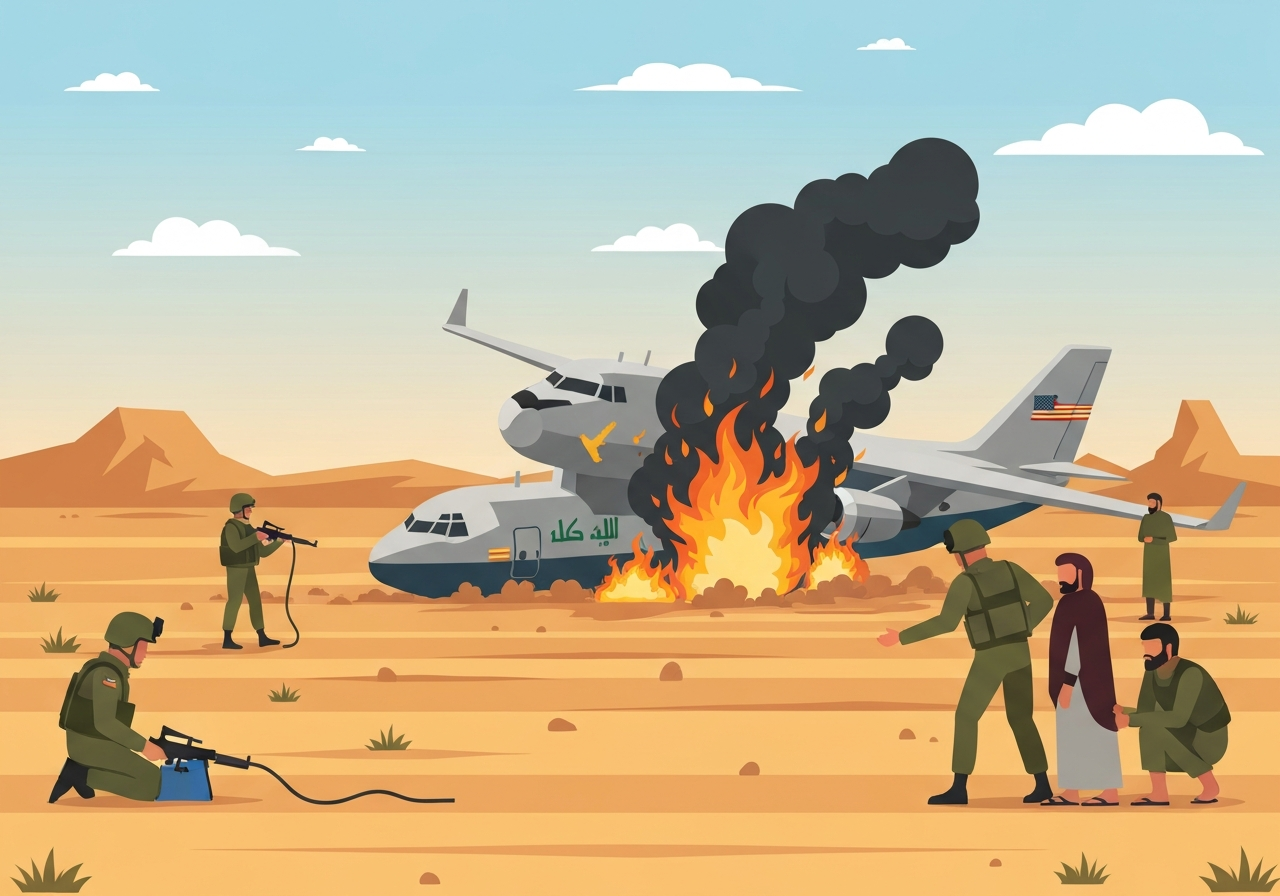
Lead: On Thursday, March 12, 2026, a U.S. KC-135 aerial refueling aircraft went down in western Iraq during Operation Epic Fury, U.S. Central Command said. CENTCOM said a second U.S. aircraft was involved and landed safely, and rescue operations were under way; the incident was reported as not the result of hostile or friendly fire. It was not immediately clear whether there were casualties. The crash comes amid a U.S. surge of aircraft into the region tied to strikes that began on February 28, 2026.
Key takeaways
- The aircraft was a U.S. KC-135 refueling plane that crashed in western Iraq on Thursday, March 12, 2026; CENTCOM said rescue efforts are ongoing.
- CENTCOM reported a second U.S. aircraft was involved in the incident but that it landed safely and the crash did not result from hostile or friendly fire, per the statement.
- This is the fourth U.S. aircraft downed since U.S. and Israeli strikes against Iran began on February 28, 2026.
- Earlier in March 2026, three U.S. fighter jets were mistakenly shot down by Kuwaiti air defenses in a friendly-fire episode; all crew members ejected safely.
Background
Since February 28, 2026, the United States and Israel have carried out strikes linked to tensions with Iran, prompting Washington to move additional aircraft and support assets into the Middle East. Those deployments include tankers, surveillance platforms and strike aircraft intended to sustain extended operations and provide flexibility across the theater. Aerial refueling is central to that posture: tankers like the KC-135 extend flight time and range for fighters and surveillance planes operating far from home bases.
The operational name cited by CENTCOM for the campaign is Operation Epic Fury. The intensification of air activity has increased demands on airspace coordination, logistics and force protection measures among U.S. forces and partner nations. Earlier in March, an incident in which Kuwaiti air defenses downed three U.S. jets highlighted the risks of misidentification and the fragile margin for error when many aircraft operate in contested or congested airspace.
Main event
U.S. Central Command said the KC-135 went down in western Iraq on Thursday, and that a second U.S. aircraft involved in the event landed safely. CENTCOM described the area as friendly airspace and emphasized that its initial assessment did not identify hostile or friendly fire as the cause. Rescue teams were dispatched immediately to recover crew and determine the circumstances of the crash.
Local Iraqi authorities and Coalition search-and-rescue units coordinated at the scene, according to the U.S. statement, while investigators from military aviation safety units prepared to begin an on-site inquiry once safety conditions allowed. CENTCOM has not released a crew manifest or casualty figures pending notification of next of kin and completion of initial rescue actions.
The incident is the most recent in a string of aircraft losses since strikes began on February 28, 2026. Military officials have repeatedly warned that the tempo of operations, combined with expanded sorties and contested airspace, raises the likelihood of accidents even absent enemy action.
Analysis & implications
The loss of a KC-135 has operational consequences beyond the immediate rescue and investigation. Aerial refueling capacity is a force multiplier for long-range missions; each tanker lost strains sortie generation and may force adjustments to mission planning, time on station and aircraft rotation. The U.S. military keeps redundancies in place, but replacing a tanker’s capability in a theater is neither instant nor cost-free.
Politically, the crash will add pressure on U.S. commanders and policymakers to demonstrate control of the operational environment and to accelerate measures that reduce the risk of additional non-combat losses. The earlier friendly-fire shootdown in Kuwait already prompted calls for improved deconfliction protocols between Coalition and host-nation air defenses. Expect renewed diplomatic engagement with partner air-defense authorities and possibly tighter centralized airspace management.
Strategically, repeated aircraft losses—whether from accident, misidentification or enemy action—can erode public and allied support for prolonged campaigns. They also complicate deterrence messaging: adversaries may interpret such incidents as vulnerabilities to exploit, while domestic audiences may press for clearer objectives and risk mitigation. For commanders, the near-term priority will be sustaining operational tempo while minimizing exposure to further incidents.
Comparison & data
| Date | Aircraft | Circumstance | Crew outcome |
|---|---|---|---|
| March 12, 2026 | KC-135 (tanker) | Crash during Operation Epic Fury; CENTCOM said another U.S. aircraft involved | Rescue ongoing; casualties unconfirmed |
| Early March 2026 | 3 U.S. fighter jets | Shot down by Kuwaiti air defenses (friendly fire) | All crew ejected safely |
The table above places the KC-135 loss in the context of operations that began February 28, 2026. Combined, these incidents highlight both the operational strain of a high sortie rate and the importance of robust airspace coordination. Official casualty and damage figures remain limited pending investigations and formal notifications.
Reactions & quotes
U.S. Central Command released an initial operational statement describing the response and situating the event within ongoing operations.
“Rescue efforts are ongoing,”
U.S. Central Command (official statement)
Observers and analysts noted the broader implications for aerial logistics and deconfliction regimes. A regional security analyst highlighted that losses of support aircraft directly affect mission endurance and raise the stakes for coalition planning.
“Tankers are the invisible backbone; losing one degrades reach and complicates mission scheduling,”
Regional security analyst
Iran’s UN envoy has provided casualty figures for Iran’s side of the broader campaign, which officials and independent counts may vary from; those figures have been cited in international reporting.
“More than 1,300 have been killed,”
Iran’s UN ambassador (as reported)
Unconfirmed
- Precise casualty numbers from the KC-135 crash remain unconfirmed; CENTCOM had not released a crew manifest at the time of reporting.
- While CENTCOM said the incident did not result from hostile or friendly fire in its initial statement, a full investigation is pending and causes remain under review.
- Reports of total wounded among U.S. forces (up to 150) come from Reuters reporting and may be revised as military accounting continues.
Bottom line
The KC-135 crash in western Iraq on March 12, 2026, underscores the operational hazards that accompany an intensified air campaign. Even when not caused by enemy action, aircraft losses disrupt logistics, complicate mission planning and heighten political pressure for clearer operational risk management.
In the coming days, investigators will seek to determine the technical and procedural causes of the crash while commanders balance the need to sustain operations with the imperative to prevent further incidents. Diplomatic and military deconfliction with regional partners will be a near-term priority to reduce the chance of additional friendly-fire or accidental losses.
Sources
- The Guardian (international news report)
- Reuters (international news organization; reporting on U.S. casualties and wounded)
- U.S. Central Command (official statement/press releases)
- United Nations (forum where Iran’s UN ambassador reported casualty figures)