
Lead
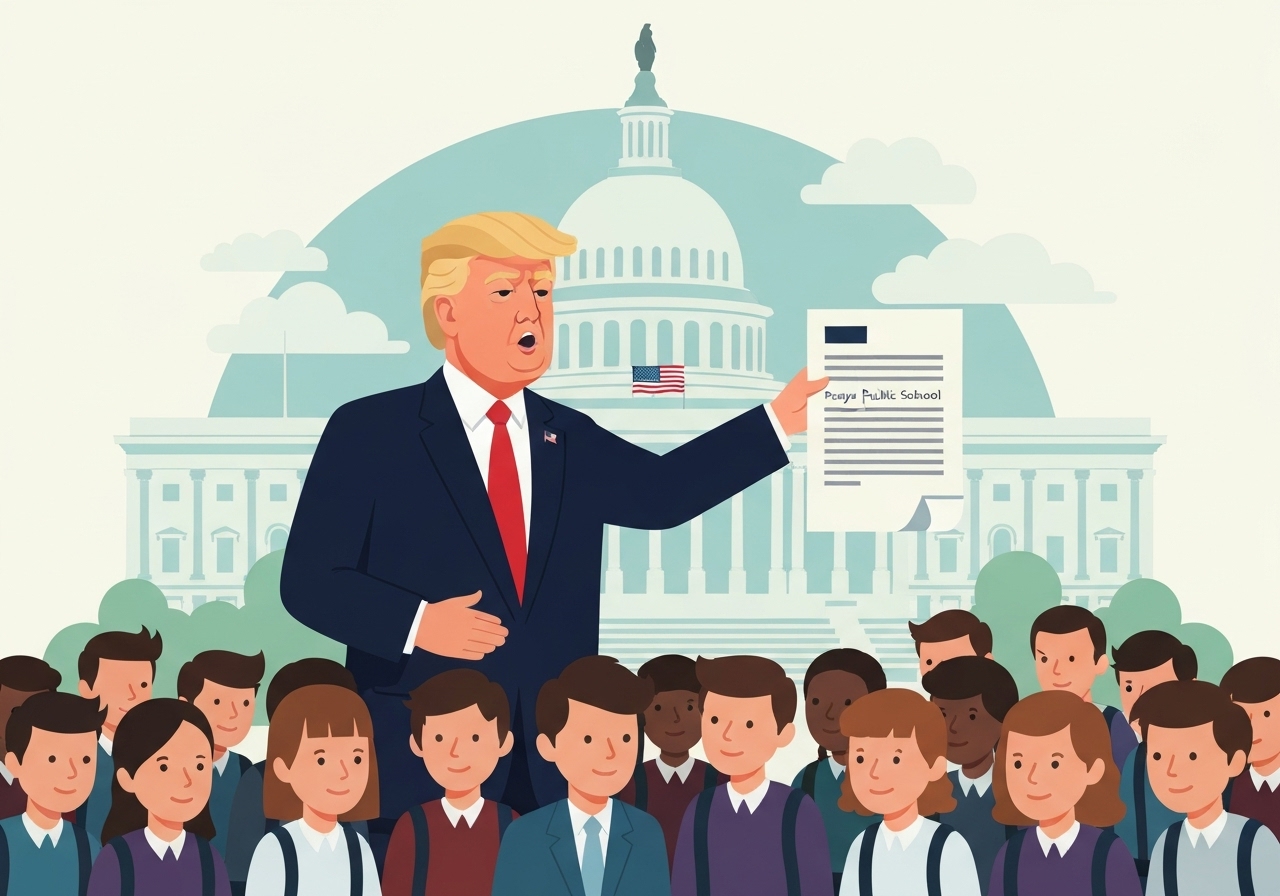
On September 8, 2025, at the Museum of the Bible in Washington, President Donald Trump said the U.S. Department of Education will soon publish guidance aimed at protecting prayer in public schools. He made the announcement ahead of a meeting of the Justice Department’s Religious Liberty Commission and described the guidance as offering “total protection” for student prayer, without providing text or a timetable. The president linked the initiative to broader priorities including school-choice tax credits and restrictions on transgender student participation in sports. The remarks highlighted a continuing effort by his administration and allied groups to expand religious-liberty protections in K–12 settings.
Key Takeaways
- President Trump announced on September 8, 2025, that the Department of Education will issue guidance intended to protect prayer in public schools.
- The announcement came at the Museum of the Bible before a meeting of the Justice Department’s Religious Liberty Commission.
- The president described the forthcoming guidance as offering “total protection,” but did not release specific language or a timeline.
- The remarks referenced a 2018 incident in Honey Grove, Texas, involving student Hannah Allen; First Liberty Institute represented her in that matter.
- The Honey Grove Texas Independent School District ultimately reversed its initial restrictions after pressure from religious-liberty groups.
- Trump tied the guidance to other priorities, including tax credits for school-choice scholarships and policies on transgender student athletics.
- The Museum of the Bible display will include a Trump family Bible used at his inaugurations, which he donated the same day.
Background
For decades, courts have drawn a line between student-initiated religious expression and school-sponsored endorsement of religion. Landmark Supreme Court rulings such as Engel v. Vitale (1962) and Santa Fe Independent School Dist. v. Doe (2000) limit government-led prayer in public schools, while protecting private, voluntary prayer by students. Federal agencies and watchdog groups have periodically issued guidance and complaints to clarify those boundaries, and administrations from both parties have, at times, shifted emphasis toward either broader accommodation or stricter separation.
In recent years, advocacy groups representing religious conservatives have pressed for expanded protections for student prayer and other religious activities, and several state legislatures have enacted laws intended to shield religious expression in schools. At the same time, civil-rights organizations warn that overly expansive policies could risk endorsing religion in ways courts have found unconstitutional or could collide with protections for other students, including LGBTQ+ youth. The Honey Grove case in Texas has become a touchstone for religious-liberty advocates who say schools sometimes improperly restrict private prayer.
Main Event
Speaking at the Museum of the Bible on September 8, 2025, the president announced that the Department of Education will issue guidance to protect prayer in public schools. He said the guidance would be issued “soon” and framed it as a corrective to practices he described as punitive toward religious students. He did not provide draft language, a release date, or detail how the guidance would address distinctions between teacher- or school-led prayer and private student prayer.
The president used the platform to reference a 2018 cafeteria incident at Honey Grove Middle School in Honey Grove, Texas, where, according to First Liberty Institute, a student named Hannah Allen was praying for an injured classmate and was directed by school staff to pray in a curtained area, an empty gym or outside. First Liberty has said the local district later reversed the rule after pressure from religious-liberty groups; the administration cited that outcome as an example of the guidance’s purpose.
Trump also reiterated other policy priorities in the same speech, including expanding tax-credit scholarship programs and measures to limit transgender students’ participation in school sports. He framed those items as part of a broader effort to strengthen faith-based values in public life, saying that the nation’s moral and civic vitality is connected to religious practice.
Analysis & Implications
How the Department of Education defines “protection” will determine the guidance’s practical effect. If the document strictly reaffirms existing Supreme Court precedent, its legal footprint may be limited to interpretation and best practices. If it signals a broader interpretation that encourages schools to permit or even facilitate prayer activities, legal challenges could follow from civil-rights groups who contend such policies risk state endorsement of religion in violation of the Establishment Clause.
The guidance could affect district policies nationwide, either by nudging local school systems to revise their procedures for handling student prayer or by prompting state legislatures to adopt parallel statutes. School administrators will face operational questions about where and when prayer may occur, how to treat school officials’ involvement, and how to balance competing students’ rights. Ambiguity in the text would likely produce a varied patchwork of local responses and invite litigation in jurisdictions where parties test the limits.
Politically, the announcement reinforces the administration’s outreach to religious-conservative constituencies ahead of the 2026 cycle. Supporters may view formal federal guidance as validation of longstanding complaints about local school practices, while critics may see it as a federal intrusion into local education policy or as messaging that sidelines other student protections. The interplay between federal guidance and state law will be a focal point for legal advocacy and potential court cases.
Comparison & Data
| Year | Case/Action | Significance |
|---|---|---|
| 1962 | Engel v. Vitale | Ruled school-sponsored prayer unconstitutional |
| 2000 | Santa Fe ISD v. Doe | Struck down student-led prayer at football games when school-controlled |
The two Supreme Court decisions above remain central reference points for any federal guidance on prayer. Agencies historically have steered between clarifying students’ rights to private religious expression and cautioning against school endorsement. Any new Department of Education document will be evaluated against this jurisprudential backdrop.
Reactions & Quotes
The president’s remarks drew applause from attendees at the Museum of the Bible and immediate attention from advocacy groups on both sides of the issue. Legal observers and civil-rights organizations signaled they would closely scrutinize the guidance once it is released.
“I am pleased to announce this morning that the Department of Education will soon issue new guidance protecting the right to prayer in our public schools, and it’s total protection.”
President Donald J. Trump, Sept. 8, 2025
“When faith gets weaker, our country seems to get weaker. When faith gets stronger, as it is right now, we’re having a very good period of time after some rough years.”
President Donald J. Trump, Sept. 8, 2025
Unconfirmed
- The precise wording, scope and legal rationale of the promised Department of Education guidance remain unspecified by the administration.
- No publication date or implementation timeline has been provided for when the guidance will be released or become effective.
- It is unclear whether the guidance will address distinctions between school-sponsored prayer and private, student-initiated prayer in concrete operational terms.
Bottom Line
The administration’s announcement signals an intention to prioritize religious-liberty concerns in K–12 schools and to provide federal direction on prayer issues. The immediate effect is primarily political and symbolic; the substantive impact will depend on the text of the forthcoming Department of Education guidance, its legal framing, and how courts and local school districts respond.
Observers should watch for the guidance’s publication, any accompanying enforcement memoranda from the Department or Justice Department, and rapid responses from civil-rights and religious-advocacy groups. Those reactions will shape whether the document leads to modest administrative clarification or ignites broader legal battles over religion in public schools.