
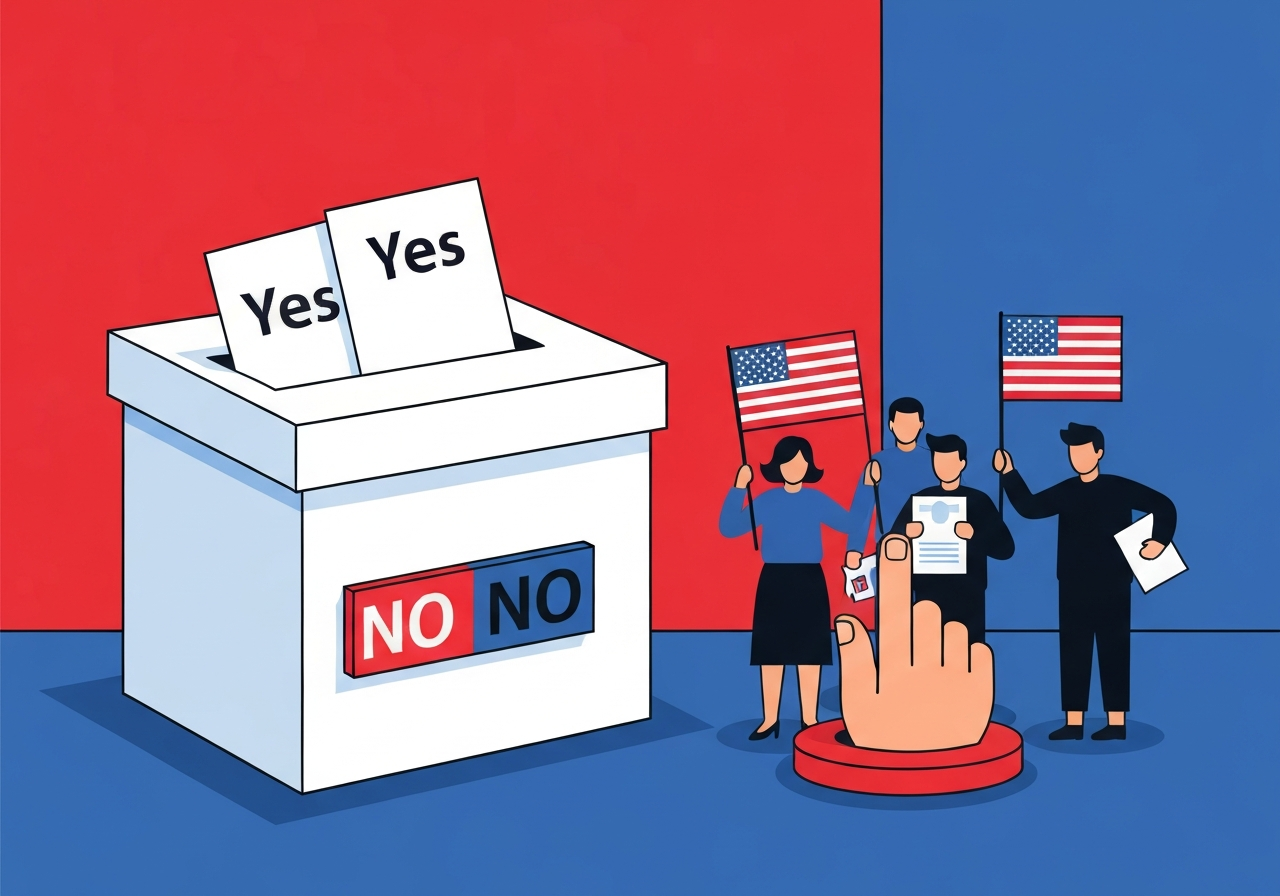
Lead: On March 12, 2026, Florida’s Republican-controlled legislature approved a bill that would require voters to prove U.S. citizenship when registering and narrow acceptable IDs at the polls. The measure cleared the State House by a 77–28 vote after passing the State Senate, and Gov. Ron DeSantis signaled support on social media. Lawmakers and supporters framed the bill as an integrity measure; critics warn it could remove thousands from voter rolls and disproportionately affect younger and marginalized voters. The provisions are not slated to take effect before this year’s midterm elections and, according to sponsors, would be implemented next year.
Key Takeaways
- Legislative passage: The Florida House approved the bill 77–28 on March 12, 2026, following earlier Senate approval; votes were strictly along party lines.
- Proof requirement: New registrants would have to supply documents such as a birth certificate or passport to verify citizenship; existing registrants would be checked against government databases.
- Implementation timing: Sponsors say the new validation process would not be in force before the 2026 midterm elections and would begin the following year.
- Administrative process: If a database check fails to show a citizenship document, county supervisors would mail a notice; voters must present proof in person at the county office to remain registered.
- Population impact: If enacted, Florida would become the most populous state to impose a proof-of-citizenship requirement, advancing a priority long voiced by national Republican leaders.
- Partisan split: All House and Senate opposition came from Democrats, who argue the bill risks disenfranchisement, especially among young and minority voters.
- Enforcement tools: The bill ties verification to government databases such as Real ID systems and mandates procedural steps for removal and notification.
Background
Debates over voter identification and registration requirements have been a recurring feature of U.S. state politics for more than a decade, with Republican officials typically arguing tighter rules prevent fraud and Democrats emphasizing broader access. Florida has enacted several election-related changes in recent cycles, including tight deadlines and signature-verification rules; this bill builds on that trend by adding a citizenship-verification element. Nationally, proof-of-citizenship proposals have been advanced by federal and state Republicans and were cited by President Trump as a legislative priority, which lawmakers in Florida acknowledged as partly inspirational for the measure.
Opponents of proof-of-citizenship laws point to administrative challenges: mismatches in databases, lost or hard-to-obtain documents, and burdens on voters who may lack easy access to county offices. Advocates counter that government records and modern IDs make verification feasible without widespread disruption. Legal challenges are common when states change voting rules; courts have previously blocked or limited similar measures elsewhere, making litigation a foreseeable next phase if the bill becomes law. County elections supervisors — charged with implementing the new checks — vary in staffing and resources, a factor that could affect the speed and uniformity of enforcement.
Main Event
The bill advanced through committee stages before reaching the full chambers, culminating in the March 12 House vote of 77–28. The vote followed hours earlier approval in the State Senate; both chambers recorded strict party-line divisions, with no Democrats supporting the measure. Sponsor statements on the floor emphasized election integrity and database cross-checks as central justifications for the change.
Under the enacted text, new registrants must present a government document indicating U.S. citizenship — for example, a birth certificate or passport — at registration. For existing registrants, state agencies would run citizenship status checks against government records such as those tied to Real ID. Where no matching document appears, county elections supervisors would send a mailed notice requiring the registrant to produce proof in person at the county elections office to remain on the rolls.
Officials said the bill would narrow the types of identification acceptable at polling places, although exact limits vary by provision and will be specified in the implementing rules. Advocates for the law argued this reduces ambiguity at the polls; opponents warned practical obstacles — from document retrieval to office hours and transportation — could suppress turnout among particular demographic groups. Gov. Ron DeSantis publicly expressed support on social media the day the House voted, aligning the state-level move with broader Republican calls for verification measures.
Analysis & Implications
Politically, the bill advances a national Republican priority by putting a high-population state on record requiring proof of citizenship for registration. For Republicans, the change is presented as strengthening confidence in election outcomes; for Democrats and voting-rights groups, the measure represents a tactical shift that could shape turnout patterns in critical races. Because the law is scheduled to take effect after the 2026 midterms, its immediate impact on the upcoming federal contests is limited, but it could influence candidate strategies and voter outreach for future cycles.
Administratively, the reliance on database matching poses practical risks. Government records are not uniformly complete, and mismatches are a known cause of wrongful removal from rolls. Counties with fewer resources may struggle to process notices and in-person verifications quickly, potentially creating backlogs before key primaries or general elections. The mail-notice-plus-in-person-proof pathway benefits voters with stable housing and flexible schedules, and it disadvantages those with mobility, work-hour, or transportation constraints.
Legally, the measure is likely to face scrutiny. Past courts have examined whether similar laws impose undue burdens relative to the state’s interest in preventing fraud. Plaintiffs could challenge the implementation details — especially how database matches are conducted, the notice period, and remedial mechanisms. If litigation delays enforcement, that could shift when and how the verification regime is applied and may prompt interim guidance from state or federal judges.
Comparison & Data
| Measure | Key detail |
|---|---|
| House vote | 77–28 (March 12, 2026) |
| Effect timing | Not before 2026 midterms; sponsors say effective next year |
| Verification tool | Government databases (e.g., Real ID) and documentary proof (birth certificate, passport) |
The table summarizes the bill’s legislative margin, its stated implementation window and primary mechanics. While the vote tally is precise, the scope of disenfranchisement — how many registrants might be flagged and removed — depends on database matches, county processing and subsequent legal rulings, all variables that are not settled.
Reactions & Quotes
“This is about the integrity of our elections,”
Sen. Erin Grall (R-Vero Beach)
Senator Grall framed the law as a trust-building measure for the electorate, emphasizing database checks and documentary proof as safeguards.
“I support this legislation,”
Gov. Ron DeSantis (social media)
The governor’s brief public endorsement aligned state executive posture with the Republican legislative majority, signaling likely swift enactment pending signature and implementation steps.
“We are deeply concerned this will lead to unnecessary removals and barriers for young and marginalized voters,”
Democratic caucus and voting-rights advocates
Opponents warned the bill’s mechanics — especially mail notices and in-person documentation requirements — create practical hurdles that could suppress participation among certain groups.
Unconfirmed
- Estimates that the bill could remove “perhaps thousands” from the rolls are projections that depend on database match rates and county follow-through and remain unverified.
- The bill is described as modeled in part on a federal priority advocated by President Trump; the precise legislative or technical lineage of provisions has not been fully documented in public legislative records.
Bottom Line
The March 12, 2026 vote marks a significant policy shift in Florida: if signed and implemented, the state would require documentary proof of citizenship at registration and would be the most populous state to do so. Proponents argue the change bolsters election integrity; opponents see added barriers that could disproportionately affect younger, lower-income and minority voters. Because the law is not scheduled to take effect before the 2026 midterms and because legal challenges are likely, its practical consequences will unfold over the coming year.
Key questions for observers are procedural: how accurately state databases identify citizenship, how quickly county offices handle notices and verifications, and whether courts uphold the law’s mechanics. Those factors — rather than the legislative vote alone — will determine whether the measure meaningfully reshapes voter rolls and turnout in future Florida elections.
Sources
- The New York Times (news)