
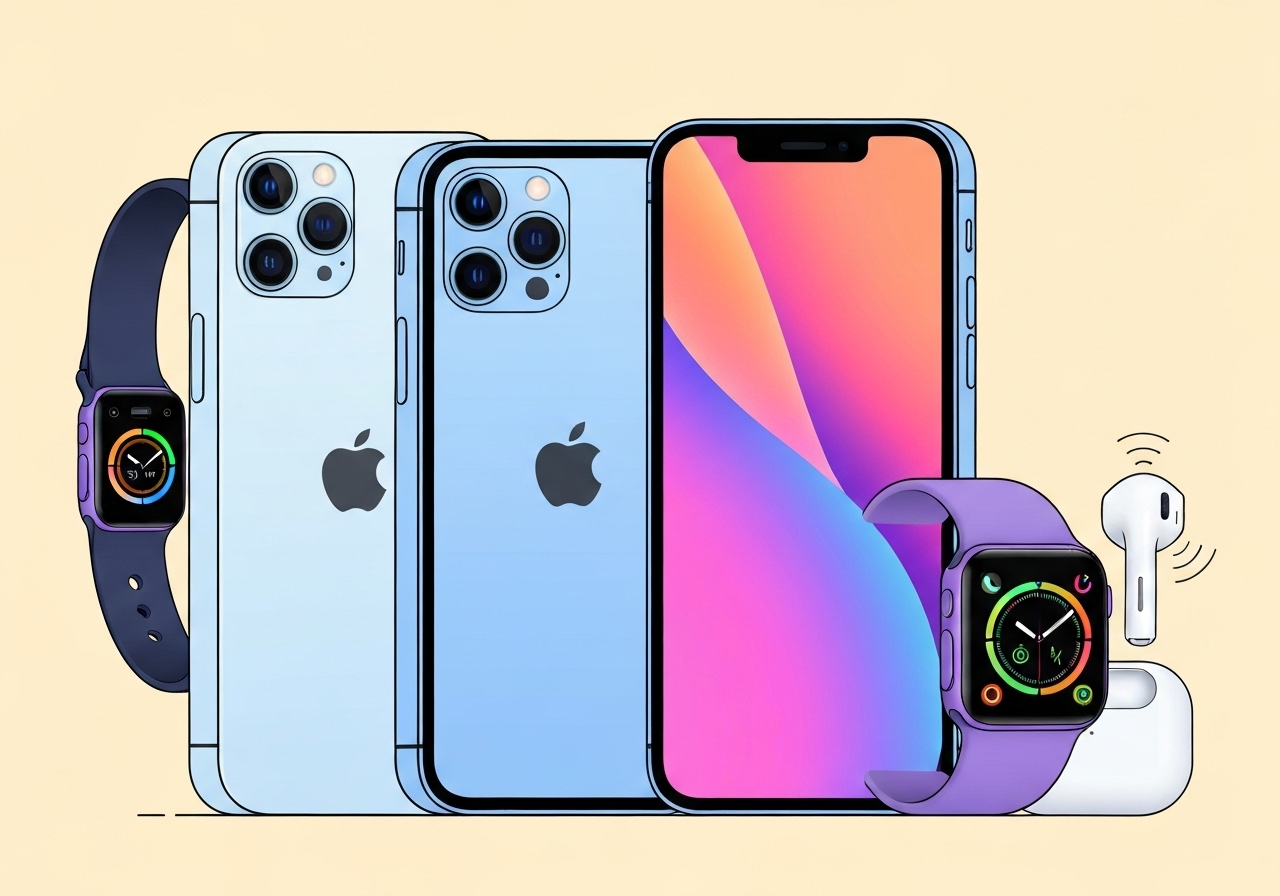
Apple will hold its hardware keynote on September 9, 2025, at 10 a.m. PT, where the company is widely expected to unveil the iPhone 17 family alongside new Apple Watch and AirPods models. Leaks and analyst reports point to a larger, higher-refresh iPhone 17, a new ultra-thin iPhone Air that may replace the Plus line, and incremental but meaningful updates to the Watch lineup and AirPods. Reporters and industry analysts say the iPhone 17 Pro may adopt cost-saving material changes, while a foldable iPhone is still forecast for 2026 under a multi-year redesign plan. Early pricing leaks suggest the iPhone 17 could start near $800, with Pro and Pro Max models commanding higher price points.
Key takeaways
- The iPhone 17 lineup is expected to include iPhone 17, 17 Pro and 17 Pro Max; the standard model may gain a 6.3-inch display and 120 Hz refresh, plus a 24 MP front camera.
- Apple may introduce an iPhone Air with a 6.6-inch screen and a 5.5 mm profile, marketed as the thinnest iPhone ever, potentially replacing the Plus variant.
- Material changes on Pro models are reported: the 17 Pro may swap a titanium frame for aluminum to reduce weight and cost; the Pro Max could be slightly thicker to host a larger battery.
- Price estimates in leaks: iPhone 17 around $800, 17 Pro about $1,100, and 17 Pro Max near $1,250; iPhone Air estimates vary between $899 and $950 in different reports.
- Apple Watch updates expected include Series 11 and Ultra 3 with possible blood-pressure and sleep-apnea monitoring (features that may be delayed), plus an SE 3 with modest changes and a possible plastic variant.
- AirPods Pro 3 rumors point to a slimmer design, touch-sensitive controls, smaller buds, a new H3 chip and the removal of a visible pairing button.
Background
Apple’s September hardware events have for years been the company’s primary stage for iPhone refreshes and incremental upgrades across its product family. The 2025 keynote follows a development cycle in which Apple has alternated between major redesigns and refinement years; multiple industry reports now say Apple plans a three-year sequence of substantial iPhone design changes. That narrative has fueled expectations not only for revised glass and chassis layouts but for a roadmap that includes a foldable iPhone in 2026.
The smartphone market has trended toward thinner, lighter devices over recent product cycles, driven by consumer taste and competition from Android makers. Samsung and Huawei have recently introduced devices with exceptionally slim profiles, and Apple’s rumored iPhone Air appears to be a direct response to that segment. However, the push for thinness traditionally forces trade-offs in battery capacity, thermal design and component packaging, which will shape how consumers evaluate the new model.
Parallel to handset changes, wearable and audio product lines are in transitional phases. Apple has invested in health-sensor capabilities for several years; blood-oxygen monitoring and advanced heart metrics are already in-market. Moving to blood-pressure estimates or sleep-apnea detection would require new sensors or algorithms plus regulatory and clinical validation—factors that can delay rollouts even after internal testing.
Main event (expected announcements and rumored details)
iPhone 17: The standard iPhone 17 is widely reported to approach Pro-class design cues, gaining a 6.3-inch OLED panel (up 0.2 inches from the iPhone 16) and a 120 Hz refresh rate versus the current 60 Hz. A higher-resolution 24-megapixel front camera is also in rumor circulation, and color trials reportedly include purple and green finishes. Price guidance from leaks places the base model around $800, making it a potentially more mainstream offering with upgraded display tech.
iPhone 17 Pro and Pro Max: The Pro is expected to show a notable rear redesign—concept images and leaks depict the three lenses arranged in a single rectangular bar across the back with the flash and sensors skewed to one side and a centered Apple logo for symmetry. Reports say Apple may replace the titanium band on the Pro with aluminum in 2025 to cut costs and weight. The Pro Max appears to get fewer cosmetic tweaks but may adopt a slightly thicker chassis to accommodate a larger battery, improving real-world endurance.
iPhone Air: The most-talked-about rumor is the launch of an ultra-thin iPhone Air at about 5.5 mm thickness and a 6.6-inch display, marketed as the thinnest iPhone yet. Early renders suggest a single rear lens rather than the dual-camera setup used by the Plus, and there are circulation reports that bottom-firing speaker space may be constrained, relying more on the top earpiece for audio output. Analysts warn battery life may be compromised by the svelte profile, and Apple could offer an optional battery case to mitigate user concerns.
Watches and audio: Apple Watch Series 11 and Ultra 3 are both expected to receive updates—rumors include faster charging, 5G and satellite functions, plus larger screens. The Ultra 3 is also linked to potential blood-pressure estimation and sleep-apnea detection features, though sources indicate those capabilities could be delayed. The Watch SE 3 is likely to be a modest refresh; price leaks put the SE 3 at about $250, Series 11 at $400, and Ultra 3 around $800. For audio, AirPods Pro 3 rumors describe a slimmer case, smaller earbuds, touch-sensitive surfaces and an upgraded H3 chip for improved ANC and adaptive audio.
Analysis & implications
Product positioning: If Apple ships an iPhone 17 that brings 120 Hz to the non‑Pro model and standardizes a larger display, it narrows the differentiation between base and Pro lines—potentially simplifying purchase decisions but compressing upgrade incentives. A thinner iPhone Air would create a new mid‑range design tier that contrasts battery-oriented Max models with style-oriented Air buyers. That strategy allows Apple to address multiple consumer priorities without changing flagship performance goals.
Supply-chain and cost signals: The reported switch from titanium to aluminum for the 17 Pro’s frame would reduce material costs and may ease manufacturing complexity, but it risks diluting the premium feel associated with higher-end models. Conversely, making the Pro Max thicker to fit a larger battery signals Apple responding to persistent user demand for extended endurance—an engineering trade-off that favors practicality over aesthetics for the largest model.
Health and regulation: Moving toward blood-pressure and sleep-apnea detection would represent a meaningful expansion of Apple’s health ambitions, but these capabilities carry regulatory and clinical-validation burdens. Even with promising internal results, Apple has historically staged phased rollouts for health features to address safety, accuracy and liability concerns. A delayed or region-limited release is therefore plausible even if watch hardware supports the features at launch.
Market impact and competition: An iPhone Air that undercuts premium pricing while emphasizing thinness could pressure competitors in the mid-to-high range, especially if Apple prices the Air near $899 as some analysts suggest. Meanwhile, retention of higher-capacity battery options in the Pro Max retains appeal for power users. Together these moves help Apple bookend different buyer segments—style-conscious, price-sensitive, and endurance-focused—without major platform changes.
Comparison & data
| Model | Screen | Thickness | Notable specs | Leak price |
|---|---|---|---|---|
| iPhone 16 (baseline) | 6.1″ | ~5.9 mm | 60 Hz (standard) | — |
| iPhone 17 (rumor) | 6.3″ | ~5.9 mm | 120 Hz, 24 MP front | ~$800 |
| iPhone 17 Pro | Pro-size | ~5.9 mm | New rear bar camera, possible aluminum frame | ~$1,100 |
| iPhone 17 Pro Max | Largest | slightly thicker | larger battery | ~$1,250 |
| iPhone Air | 6.6″ | 5.5 mm | single rear lens, thin profile | $899–$950 (est.) |
The table summarizes reported screen sizes, thickness targets and tentative pricing ranges from leaks and analyst notes. These values reflect public reporting and should be treated as provisional until Apple’s keynote or official specs are published. The biggest trade-offs implied by the data are between thinness and battery capacity for the Air, and between material choices and perceived premium quality for the Pro models.
Reactions & quotes
Industry reporting has framed the 2025 event as the opening move in a multi-year design cycle. Contextualizing that claim helps readers weigh near-term changes against a longer product roadmap.
“This will be the first of three planned years of major iPhone redesigns,”
Mark Gurman, Bloomberg (report)
Independent leakers who test colorways and hardware samples have publicized early findings on finishes and aesthetics—information that often precedes official announcements but can change. The following tweet, circulated in June, highlighted two color shades under testing.
“iPhone 17: Purple and Green Colors in Testing as Potential New Shade for 2025,”
Majin Bu (leak via tweet)
Financial analysts tracking price sensitivity and product mix have also weighed in; some banking research suggests Apple may set an aggressive price for a thin Air model to attract buyers from rival Android devices.
“Our channel checks point to an $899 price target for the iPhone Air to offset hardware compromises,”
JPMorgan (research note)
Unconfirmed (claims still awaiting verification)
- Precise pricing: leaked $800/$1,100/$1,250 figures are unverified until Apple publishes official pricing at the event.
- iPhone Air battery life: claims of reduced endurance due to a 5.5 mm profile are plausible but not confirmed by hardware tests.
- Blood-pressure and sleep-apnea features on Apple Watch: regulatory clearance and software readiness have not been publicly confirmed by Apple.
- Material change from titanium to aluminum on 17 Pro: this is reported by some sources but lacks an Apple confirmation.
Bottom line
Apple’s September 9 event looks set to be evolutionary in scope but strategically broad: upgrades that democratize premium features (120 Hz on standard models, larger displays) alongside a new design experiment in the iPhone Air. The company appears to be balancing aesthetic innovation with practical concessions—thinner form factors at the potential cost of battery life, and material changes that lower manufacturing cost but could alter premium perceptions.
If the leaks hold, Apple’s product mix for late 2025 will aim to cover three distinct buyer priorities—style (iPhone Air), performance and camera capability (Pro), and endurance (Pro Max). Health and audio advancements add longer-term strategic value, but several of those features remain contingent on regulatory review and further engineering validation. Readers should treat the reported specifications and prices as provisional until Apple’s official announcement and hands-on testing are available.
Sources
- TechCrunch — news report on expected product lineup and rumors
- Bloomberg / Mark Gurman — reporting on multi-year iPhone redesigns (analysis)
- Majin Bu tweet — leak showing color testing (social media / leak)
- Apple — official events page (company announcement)
- JPMorgan — research note cited for iPhone Air pricing (financial analysis)