
Lead
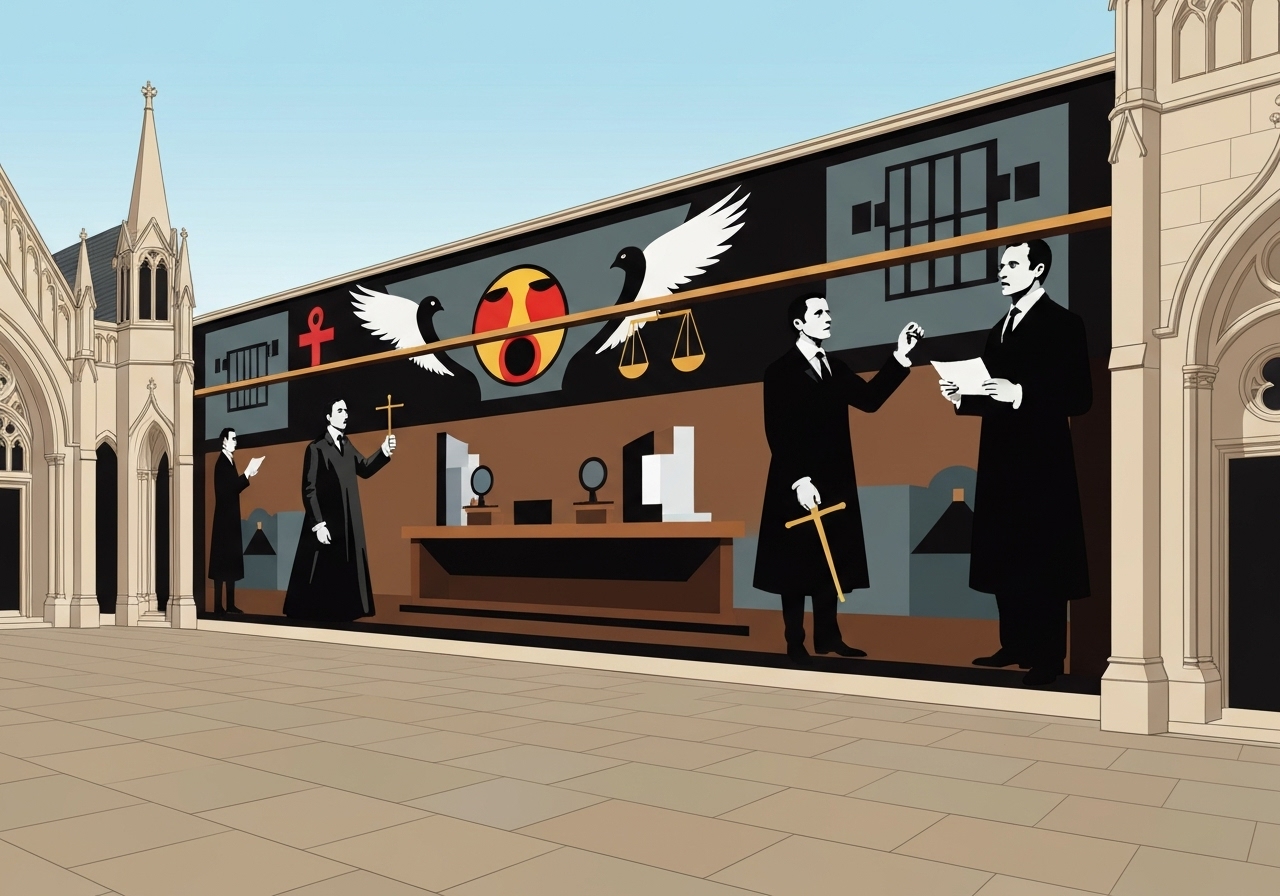
A new mural attributed to the anonymous street artist Banksy appeared on the exterior of the Royal Courts of Justice in central London on 8 September 2025. The image shows a judge in a traditional wig and gown striking a protester on the ground, with blood splattering the protester’s placard. Within hours the artwork was covered with plastic sheeting and metal barriers and court officials said it would be removed. The Metropolitan Police said it had received a report of criminal damage and that enquiries would continue.
Key Takeaways
- The mural appeared on an external wall of the Queen’s Building, part of the Royal Courts of Justice complex on Carey Street in central London.
- The image depicts a judge hitting a protester; it was posted on Banksy’s Instagram with the caption “Royal Courts Of Justice. London.”
- The work was covered by large sheets of plastic and metal barriers and is being guarded while officials consider removal to protect a listed building.
- The Metropolitan Police confirmed they have received a report of criminal damage and are conducting enquiries.
- The mural’s arrival followed mass arrests: almost 900 people were arrested two days earlier at a London protest against the ban on Palestine Action.
- HM Courts & Tribunals said the Royal Courts of Justice is a listed building and that it is obliged to maintain its original character.
- Banksy’s recent London activity included an animal-themed sequence of nine works the previous summer, demonstrating a pattern of high-profile public interventions.
Background
Banksy is a Bristol-based artist known for stencilled street art that often critiques government policy, war and social issues. The artist typically claims new works by posting images on an official Instagram account, a practice widely used by commentators to validate authenticity when an artwork appears in public.
The Royal Courts of Justice is a Grade II* listed complex on the Strand, of which the Queen’s Building on Carey Street is a visible component facing pedestrian routes and courtyards. Listed status imposes legal duties on custodians to preserve the historic fabric and to seek permissions before any alteration or conservation work.
The mural appeared amid heightened public attention to large-scale protests in London. Two days before the work appeared, police arrested almost 900 people at a demonstration protesting the ban on Palestine Action. That timing has invited public interpretation, although the mural itself does not name a specific campaign.
Main Event
On the morning of 8 September 2025 a figure matching Banksy’s known style was photographed on the Queen’s Building exterior on Carey Street. The image portrays a robed judge striking a prone protester; the protester’s placard appears to be splattered with blood. Passers-by gathered to photograph the new piece before stewards and security covered the wall.
Court officials moved quickly to shield the area with sheets of plastic and temporary metal barriers, citing the building’s listed status and the need to preserve its condition. A court spokesperson said removal would follow established conservation and legal procedures for listed sites.
The Metropolitan Police confirmed receipt of a criminal damage report and said enquiries were ongoing; no arrests had been publicly reported in connection with the mural itself at the time of publication. Two security officers stationed outside the covered section described a steady flow of onlookers taking photos of the hidden patch.
Banksy’s Instagram account published an image of the wall and captioned it with the site name, a move consistent with the artist’s past confirmations of new work. Media and social platforms quickly circulated photographs and commentary, prompting discussions across political and cultural communities.
Analysis & Implications
The mural’s subject — a judge striking a protester — is a charged visual that intersects with current debates about protest policing and judicial roles. Its appearance shortly after mass arrests at a London protest has amplified interpretations that the work is a direct critique of how the justice system engages with dissent, though the piece itself does not explicitly identify a target.
Legally, the location complicates responses. The Royal Courts of Justice’s listed status means any intervention to remove or conserve the work must respect heritage-protection protocols; that can slow the process and create a trade-off between rapid removal of alleged criminal damage and careful preservation of historic fabric.
From a policing perspective, the Metropolitan Police’s classification of the incident as a report of criminal damage puts the matter squarely within criminal-enforcement procedures rather than administrative or civil heritage routes. That could lead to enquiries about who applied the paint and whether the act was planned or opportunistic.
Culturally, Banksy’s interventions routinely generate public debate, fundraising, and legal disputes over ownership and conservation. If authenticated, the mural will likely attract calls from different quarters — some urging preservation for artistic or documentary value, others stressing the need to enforce property protections and to avoid tacitly endorsing criminal damage.
Comparison & Data
| Item | Count / Note |
|---|---|
| Banksy animal-themed campaign (previous summer) | 9 works in London (publicly recorded) |
| Royal Courts mural (this incident) | 1 work; covered and under investigation |
The table places this single high-profile mural in the context of the artist’s recent London activity. The animal-themed sequence of nine works last summer and this new legal-themed image illustrate Banksy’s continued use of public sites to stage narrative sequences that invite political reading.
Reactions & Quotes
Officials, politicians and onlookers gave immediate but measured responses. Labour peer Baroness Harriet Harman interpreted the mural as a critique of law and judicial power while warning against overreading judicial intent, emphasizing the separation between Parliament’s law-making role and judges’ interpretive role.
“I believe this is a protest about the law,”
Baroness Harriet Harman (Labour peer)
Two security officers guarding the covered area spoke to media and passers-by about the practicalities of protection and public interest; their remarks underlined the routine challenges of policing a high-profile site when a new artwork appears.
“At least it’s not raining,”
Security officer outside Royal Courts of Justice
Banksy’s Instagram post served as the artist’s customary public claim; the short caption provided location confirmation without elaborating motive, a familiar pattern for the artist that leaves interpretation open to public debate.
“Royal Courts Of Justice. London.”
Banksy (Instagram)
Unconfirmed
- Whether the mural was intended specifically to comment on the arrests at the London protest against the ban on Palestine Action is unconfirmed.
- There is no public confirmation of who physically painted the mural; attribution rests on Banksy’s Instagram claim and stylistic markers.
- The precise time the artwork was created has not been independently verified beyond photographic and social-media timestamps.
Bottom Line
The new Banksy mural on the Royal Courts of Justice is a provocative public image that arrived at a politically sensitive moment and has already prompted official action: the work is covered, guarded and the police have opened enquiries. Because the site is a listed building, decisions over removal will need to balance heritage protections with legal and operational considerations.
Watch for updates from the Metropolitan Police on any investigatory findings, statements from HM Courts & Tribunals about conservation or removal steps, and any further commentary from the artist’s Instagram channel. The incident is likely to sharpen public debate about protest, the judiciary and the role of street art as a form of political expression.
Sources
- BBC News (news report on the mural and context)
- Banksy Instagram (artist’s social media post) — social media / artist
- Metropolitan Police (official) — police statement regarding criminal damage enquiries
- HM Courts & Tribunals Service (official) — statement on listed-building obligations