
Lead
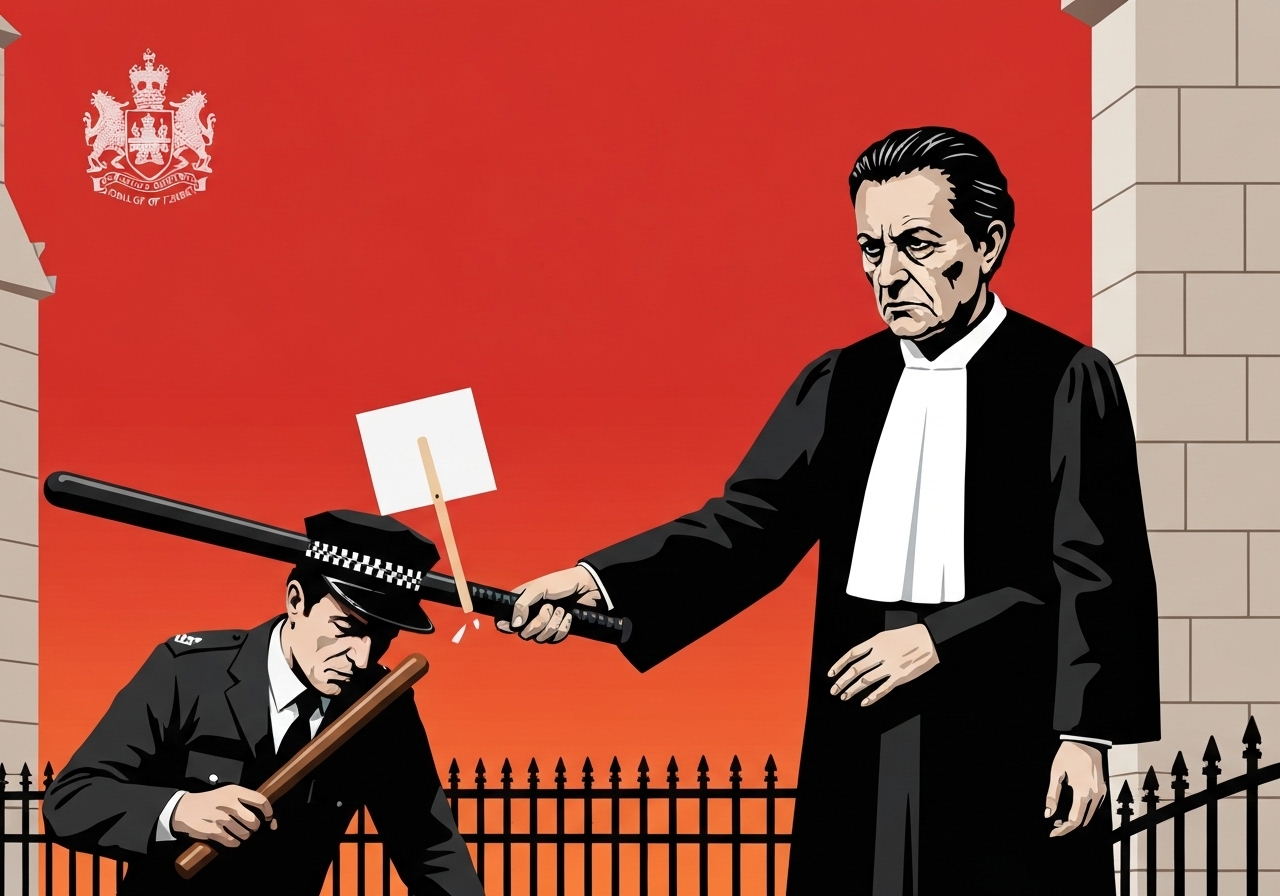
On September 8, 2025, a new mural attributed to Banksy appeared on the exterior of the Royal Courts of Justice in central London depicting a judge striking a prone protester with a gavel. Security teams covered the image with black plastic and erected metal barriers while two officers and a surveillance camera guarded the site; HM Courts & Tribunals said the listed, 143‑year‑old building will have the work removed with care. The artist posted a photograph on Instagram captioned “Royal Courts Of Justice. London,” his customary method of claiming new pieces. Activists quickly read the image as a comment on the government’s recent ban on Palestine Action, a dispute that has already produced large-scale arrests and ongoing legal challenges.
Key Takeaways
- The mural appeared on September 8, 2025, at the Royal Courts of Justice in London and was posted on Banksy’s Instagram account with the caption “Royal Courts Of Justice. London.”
- Site security covered the artwork on Monday with black plastic, placed two metal barriers, and had two officers plus a security camera guarding the area.
- HM Courts & Tribunals said the building is 143 years old and listed, and that removal will proceed with attention to the site’s historic character.
- Activists connected the image to the U.K. government’s ban on Palestine Action; nearly 900 people were arrested at a London protest on the preceding Saturday.
- Defend Our Juries, which organised the protest, framed the mural as depicting state brutality; the courts have already been engaged in parallel legal challenges about Palestine Action’s ban.
- Banksy is widely known for politically charged street works and for posting images on Instagram as a form of attribution; his identity remains publicly unconfirmed.
Background
Banksy emerged spray‑painting public walls in Bristol and has since become one of the world’s best‑known anonymous artists, with works selling for millions at auction and attracting both legitimate buyers and thieves. The artist’s anonymity began as a shield against legal trouble; speculation about his identity has named Bristol figures such as Robin Gunningham and Robert Del Naja among others. A lost BBC interview recorded in 2003 and disclosed in 2023 included Banksy giving the name “Robbie,” a detail widely reported but not definitive.
The Royal Courts of Justice sits on the Strand in central London and is a Victorian Gothic revival building completed roughly 143 years ago; as a listed structure it is legally protected and subject to rules intended to preserve its character. HM Courts & Tribunals Service (HMCTS) has emphasised that any intervention on the façade must consider historic fabric. The political backdrop includes recent escalations over enforcement actions against protesters and the government’s decision to ban the direct‑action group Palestine Action, which has prompted arrests and litigation.
Main Event
On the afternoon of September 8, 2025, a stencilled mural appeared on a visible wall of the Royal Courts of Justice showing a robed judge raising a gavel over a protester lying on the ground, who clutches a blank placard stained with red paint interpreted as blood. Photographs of the work were posted to Banksy’s verified Instagram account, the artist’s usual channel for announcing new pieces. Within hours, courthouse security covered the mural with black sheeting, installed two metal barriers, and stationed two officers; a nearby surveillance camera was also monitoring the location.
HMCTS issued a short statement noting the building’s listed status and saying removal would be handled with care to preserve historic features. The service did not confirm the timing or precise method of removal but stressed legal obligations to maintain the site’s original character. Local officials have not announced any enforcement action against the artist; prosecutions in street‑art cases historically hinge on establishing who applied paint to protected property.
Activist groups quickly framed the mural as commentary on the government response to Palestine Action after a London protest the previous Saturday led to almost 900 arrests. Organisers of that demonstration—identified in statements as Defend Our Juries—said they saw the image as a visual summary of what they describe as the criminalisation of dissent. Separately, the courts are already hearing litigation about the ban: judges initially rejected Palestine Action’s request to appeal the ban, but a High Court judge subsequently allowed an appeal to proceed; the government is challenging that decision.
Analysis & Implications
The appearance of a politically charged image on a high‑profile judicial building raises several immediate tensions: freedom of expression, protection of heritage assets, and the appearance of judicial independence. A mural on a court façade is symbolically potent because it visually links criticism of legal institutions with the institutions themselves, potentially influencing public perceptions of impartiality even where no judicial conduct is at issue. Authorities will need to balance heritage conservation rules with public‑order and anti‑graffiti policy when deciding removal methods and timing.
From a legal standpoint, removing paint from a listed façade often requires specialist conservators to avoid damaging original stone or lead to irreversible loss. Those technical constraints can delay removal, creating a public and political optics problem for officials who wish to limit the image’s circulation. If the mural is confirmed as Banksy’s, his established practice of publicly claiming works via Instagram complicates any prosecution: proving the identity of an anonymous artist remains the central evidentiary hurdle in criminal cases.
Politically, activists’ quick association of the image with the Palestine Action ban shows how street art functions as rapid visual commentary that can shift debate dynamics. The mural may intensify attention on the protests, the scale of recent arrests, and the pending High Court processes; conversely, a heavy‑handed, rapid removal could become a new focal point for critics who say the state is suppressing dissent. For courts and ministers, the episode underscores how symbolic spaces become arenas in contemporary political conflict.
Comparison & Data
| Item | Year / Date | Detail |
|---|---|---|
| Royal Courts building age | c. 1882 (143 years old) | Victorian Gothic revival; listed status |
| London protest arrests | Weekend before Sept 8, 2025 | Almost 900 people arrested at a protest linked to Palestine Action |
| Recent Banksy projects | 2018–2024 | Works in Paris (2018), Venice (2019), West Bank/Gaza, Walled Off Hotel (closed Oct 2023), London animal series (summer 2024) |
The table puts the mural in three contexts: the legal/heritage status of the site, the scale of recent protests, and Banksy’s recent publicly claimed works. These datapoints show why officials emphasise careful removal (heritage risk) while activists stress political meaning (large arrests and ongoing litigation). Technical conservation needs and legal disputes over protest regulation are likely to shape next steps.
Reactions & Quotes
Short statements from institutions and organisers framed the immediate dispute. HMCTS pointed to statutory duties on listed buildings when explaining the decision to remove the work carefully.
The Royal Courts of Justice is a listed building and HMCTS are obliged to maintain its original character.
HM Courts & Tribunals Service (official statement)
Defend Our Juries, the group linked to the recent demonstration, described the image as a stark representation of their view that the state is using legal power to curb dissent.
It powerfully depicts the brutality unleashed by the ban; when the law is used to crush civil liberties, it strengthens dissent.
Defend Our Juries (organiser statement)
Banksy’s Instagram post—his typical public claim—was limited to a location caption rather than an explicit message, a form that has in the past been taken as de facto attribution.
Royal Courts Of Justice. London.
Banksy (Instagram post)
Unconfirmed
- While Banksy posted the image on Instagram, definitive proof that he personally painted the mural on the courthouse façade has not been publicly established.
- The mural’s explicit intent—whether it was created specifically to comment on the Palestine Action ban or more broadly on state power—has not been confirmed by the artist.
- Specific timing, contractor choice and technical method for removal have not been announced; details on conservation approach remain pending.
Bottom Line
The mural’s placement on a prominent judicial building turned a street‑art intervention into a legal and heritage issue almost immediately. Officials are obliged to protect a listed 143‑year‑old structure, which means removal will be conducted with conservation safeguards even as the political conversation around the image intensifies.
Beyond the immediate logistics of removal, the episode is likely to feed the larger dispute over protest regulation and the Palestine Action ban: it amplifies activist messages while forcing officials to manage both symbolic and technical risks. Watch for further court filings in the pending appeal and for public statements from heritage professionals once a removal plan is announced.