
Lead
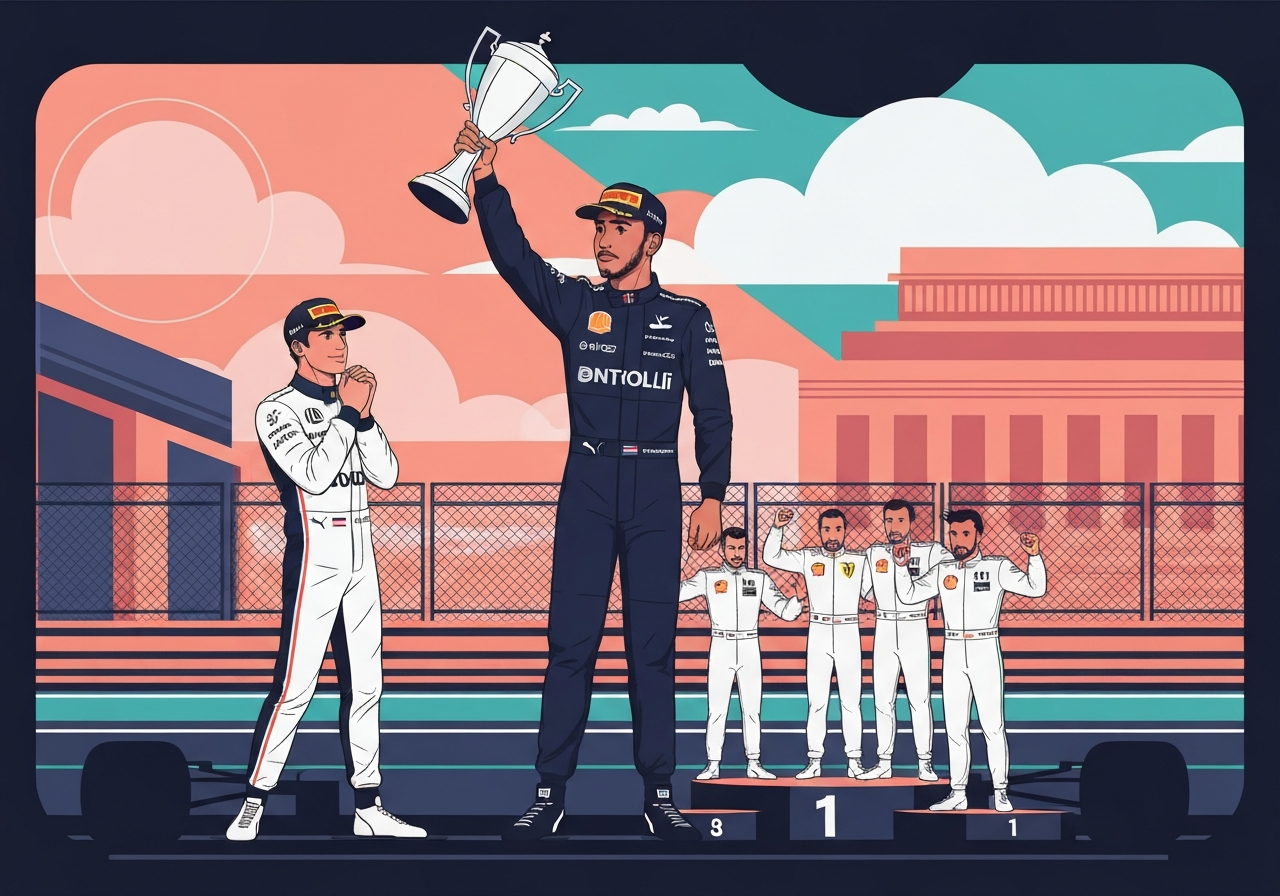
Kimi Antonelli claimed his first Formula 1 victory at the 2026 Chinese Grand Prix in Shanghai, holding off Mercedes team mate George Russell to win by 5.515 seconds. The 19-year-old Italian — who had become the youngest polesitter on Saturday — briefly ceded the lead at the start before retaking it on lap two and never relinquishing it. Lewis Hamilton delivered his first Grand Prix podium for Ferrari in third after a fierce intra-team duel with Charles Leclerc. The result came amid a chaotic weekend that featured multiple non-starts and retirements, including both McLarens and Max Verstappen.
Key takeaways
- Kimi Antonelli won the 56-lap Chinese Grand Prix in Shanghai in 1:33:15.607, finishing 5.515s clear of George Russell and earning 25 championship points.
- Antonelli, 19, was the youngest polesitter from Saturday and became the second youngest driver ever to win a Formula 1 race.
- Lewis Hamilton achieved his first Grand Prix podium for Ferrari in P3, 25.267s behind the winner, after an intense on-track battle with team mate Charles Leclerc.
- George Russell, who had taken victory in Saturday’s Sprint, preserved his lead in the Drivers’ Championship despite finishing P2.
- Race interruptions and mechanical issues were significant: a Safety Car was deployed following Lance Stroll’s stoppage, Max Verstappen retired with a car issue 10 laps from the end, and both McLarens (Lando Norris, Oscar Piastri) failed to start because of separate electrical problems.
- Points scorers included Oliver Bearman (P5), Pierre Gasly (P6), Liam Lawson (P7), Isack Hadjar (P8), Carlos Sainz (P9) and Franco Colapinto (P10), with several midfield incidents and penalties shaping the final order.
Background
The Shanghai International Circuit returned to the calendar as the Chinese Grand Prix staged a dramatic 2026 event that spotlighted a new generation of talent and persistent reliability concerns. Antonelli’s rapid rise through junior categories culminated in a historic weekend: youngest polesitter on Saturday and a breakthrough race win on Sunday. Mercedes entered the weekend with strong pace, demonstrated by Russell’s Sprint victory, while Ferrari fielded a highly charged intra-team pairing of Hamilton and Leclerc that produced one of the day’s most entertaining battles.
Off-track storylines amplified the sporting narrative. McLaren suffered a rare double non-start, with Norris unable to reach the grid and Piastri returned to the garage before the formation lap; the team cited separate electrical issues on each car. Red Bull also endured a blow when Max Verstappen, running in the top ten, retired with an unspecified mechanical problem late in the race. Those reliability problems contrasted with Antonelli’s team’s effective race execution and strategic timing.
Main event
The race began with high drama as Antonelli, starting from pole, moved across to cover George Russell and opened a gap that allowed Lewis Hamilton to sweep around the outside from P3 into the lead. Hamilton’s advantage lasted less than two laps: Antonelli regained first place at the Turn 14 hairpin on lap two and immediately extended a one-second buffer. Russell recovered from the opening shuffles to reassert himself in the top three by lap five and later chased down the Ferraris during the middle stints.
An early Safety Car was triggered when Lance Stroll’s Aston Martin stopped at Turn 1, prompting almost the entire lead group to pit and change from medium to hard Pirelli tyres. Antonelli pitted under the Safety Car and rejoined still in the lead because a handful of cars, including Franco Colapinto and Esteban Ocon, had elected to remain on their starting compound. The restart exposed Russell’s difficulty in generating tyre temperature, costing him grip and track position briefly.
The middle phase featured a compelling intra-Ferrari duel: Hamilton and Leclerc repeatedly ran wheel-to-wheel, swapping places on several occasions and producing some of the race’s closest on-track exchanges. Leclerc briefly reclaimed P3 on lap 24, but Hamilton fought back for the final podium spot around lap 39 after decisive moves into Turn 1. As Antonelli pulled clear, Russell managed his pace and tyre wear to hold second despite pressure late in the race.
Further back, the race was shaped by incidents and penalties: Ocon received a 10-second penalty for contact with Colapinto, Colapinto later recovered to take the final point, and several drivers suffered spins or tyre-related errors at Turn 14. Verstappen retired with a mechanical issue 10 laps from the end while both Aston Martins also failed to finish. The final laps saw Antonelli manage a tense flat-spot scare at Turn 14 but still cross the line comfortably ahead of Russell.
Analysis & implications
Antonelli’s win is significant on several fronts. Sporting-wise, it signals the arrival of a young front-runner capable of handling qualifying pressure and race management across mixed conditions, including Safety Car periods and tyre management. Being the second youngest race winner elevates him into a select group of early achievers, creating commercial and sporting momentum for his team and for talent pipelines across F1.
For the championship, the result is a mixed bag. Russell’s P2 sustains his lead in the Drivers’ standings, but Mercedes will take note of the team dynamics: Russell’s Sprint win and Sunday podium demonstrate consistent performance, while Ferrari’s midfield fight between Hamilton and Leclerc underlines both the strength and potential friction within the Scuderia. Red Bull’s retirement of Verstappen represents a non-negligible lost opportunity in the constructors’ and drivers’ battles and underscores that mechanical reliability remains a deciding factor even among the top squads.
McLaren’s double non-start raises urgent reliability questions that could alter the championship calculus if not resolved quickly. Two separate electrical failures on two cars suggest either homologation fragility or systemic integration issues with the power unit that the team must isolate before Suzuka. Conversely, teams that managed to avoid strategic missteps — making timely pit calls under the Safety Car, for example — reaped outsized benefits.
Comparison & data
| Pos | Driver | Team | Gap/Time | Points |
|---|---|---|---|---|
| 1 | Kimi Antonelli | ANT | 1:33:15.607 | 25 |
| 2 | George Russell | RUS | +5.515s | 18 |
| 3 | Lewis Hamilton | HAM | +25.267s | 15 |
| 4 | Charles Leclerc | LEC | +28.894s | 12 |
| 5 | Oliver Bearman | BEA | +57.268s | 10 |
The table highlights how Antonelli was able to build a decisive margin early and then manage tyre wear and race pace to the flag. Pit strategy under the Safety Car played a pivotal role: most frontrunners swapped to hard tyres during the interruption, while a small number of rivals who stayed out briefly reshaped the restart order and the tyre-management battle across the middle stints.
Reactions & quotes
I’m speechless. I’m about to cry — thank you so much to my team, because they helped me to achieve this dream.
Kimi Antonelli
Antonelli expressed raw emotion on the radio and afterwards, praising his team for the weekend’s execution and acknowledging a late flat-spot scare.
It was actually quite fun, to be honest.
Charles Leclerc (radio)
Leclerc’s brief on-radio comment captured the competitive, high-stakes nature of his fight with Hamilton, who in turn praised the team for allowing fair racing between team mates.
Unconfirmed
- The precise technical root cause for Max Verstappen’s late retirement has not been publicly confirmed by Red Bull as of race close; team statements remain pending.
- While McLaren reported two separate electrical issues on Norris and Piastri, it is not confirmed whether the failures share a common supplier or software source; a full forensic report is awaited.
Bottom line
Kimi Antonelli’s maiden victory in Shanghai is both a personal milestone and a reminder that Formula 1 remains unpredictable: young talent, split-second strategy choices and reliability still decide outcomes. The result elevates Antonelli into championship and commercial conversations and gives his team a major boost heading into the next rounds.
For title contenders, the event is a cautionary tale about margins: Russell’s championship lead remains intact thanks to strong recovery drives, Ferrari proved it can produce both excitement and podium returns with Hamilton, while Red Bull and McLaren must address reliability to avoid losing ground. The paddock now turns its attention to Suzuka for the Japanese Grand Prix on March 27-29, where strategy, reliability and track-specific setups will all be tested anew.