
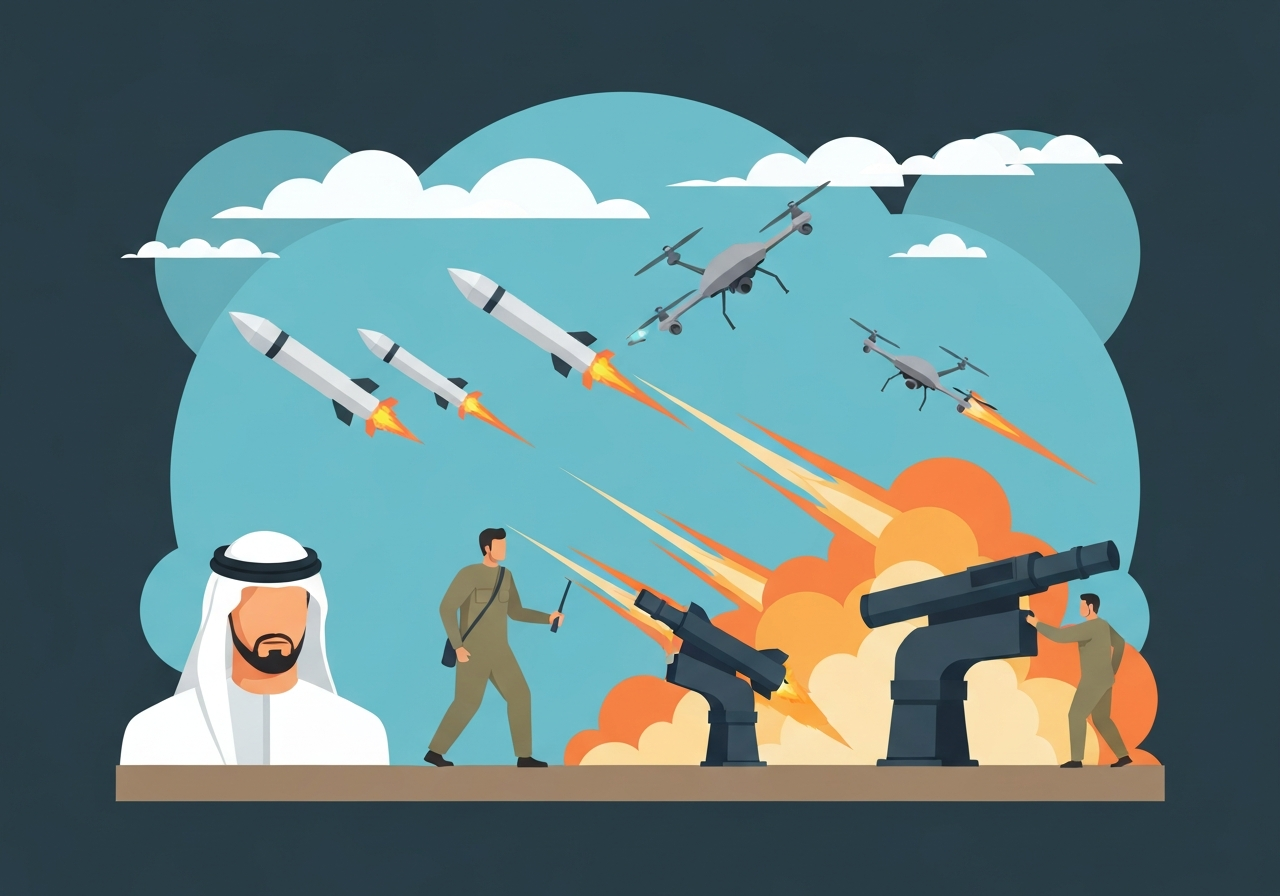
Gulf Arab states reported new missile and drone interceptions on March 15, 2026, as Iran warned it could broaden the conflict, while international efforts to secure the Strait of Hormuz produced no immediate naval commitments. Governments from the United Kingdom to South Korea said they were consulting with allies about protecting shipping, and the International Energy Agency announced a near-412 million barrel release of emergency oil stocks to calm markets. Attacks and counterstrikes since Feb. 28 have driven up regional civilian casualties and disrupted energy infrastructure, and Tehran’s foreign minister said some foreign vessels have been allowed passage at Iran’s discretion. The flurry of strikes, denials and strategic signaling underscored the risk of further escalation across the Gulf and Levant.
Key Takeaways
- Gulf states — including Bahrain, Saudi Arabia and the UAE — reported intercepting missile and drone attacks on March 15, 2026, after Iran urged evacuation of three major UAE ports.
- Iran’s foreign minister Abbas Araghchi said Tehran has allowed some foreign vessels to pass the Strait of Hormuz; Iran says the strait is open to all except the U.S. and its allies.
- U.S. President Donald Trump urged several countries to send warships to keep the Strait of Hormuz safe; no formal commitments were announced as of March 15.
- The International Energy Agency updated its emergency release to nearly 412 million barrels, with Asian members to release stocks immediately and European/American releases from late March.
- Casualties across the conflict include more than 1,300 fatalities in Iran (ICRC figure), at least 820 in Lebanon, 12 in Israel and at least 13 U.S. service members killed, including six in a recent plane crash.
- Iran has fired hundreds of missiles and drones across the Gulf at UAE, Bahrain, Saudi Arabia, Qatar and Oman; many have been intercepted but some struck civilian infrastructure.
- Claims that the U.S. launched strikes on Kharg Island from UAE territory were made by Iran and rejected by Gulf officials; U.S. Central Command did not confirm the allegation.
Background
The current series of exchanges traces to coordinated strikes by Israel and the United States on Feb. 28, 2026, set against stalled indirect U.S.-Iran talks about Tehran’s nuclear program. Those strikes damaged Iranian facilities and, according to Iranian officials, left enriched uranium under rubble that Tehran says it cannot recover. Iran has framed subsequent operations as retaliation for attacks on its infrastructure and as responses aimed primarily at U.S. military assets in the region.
The Strait of Hormuz is a strategic choke point: roughly one-fifth of global oil exports normally transit the waterway. That dependence has pushed multiple governments to weigh escort or patrol options, but divergent strategic calculations, political sensitivities and the risk of direct confrontation have limited immediate multilateral naval commitments. France has discussed a possible escort mission with partners but conditions must be right, while other countries have signaled caution and are coordinating with allies.
Main Event
On March 15, Gulf Arab governments reported fresh missile and drone activity targeting their territories a day after Iran warned neighboring countries to evacuate three UAE ports — a novel escalation aimed at non-U.S. assets. Bahrain, Saudi Arabia and the UAE said their forces were working to intercept incoming projectiles; officials emphasized air defenses and allied coordination. Tehran has maintained that it is focusing strikes on U.S.-linked infrastructure, but several Iranian-launched strikes have hit civilian sites such as airports and oil facilities.
Iran accused the United States of launching recent strikes on Kharg Island, the country’s main oil terminal, allegedly from UAE territory; Gulf governments hosting U.S. bases denied allowing their airspace or soil to be used for such operations, and a UAE presidential adviser contested Tehran’s claim. U.S. Central Command said it had no immediate confirmation of Iran’s allegation. The competing claims have increased mistrust and complicated diplomacy in the region.
Diplomatic consultations intensified after President Trump asked China, France, Japan, South Korea, Britain and others to dispatch warships to keep the Strait of Hormuz ‘open and safe.’ U.S. Energy Secretary Chris Wright said he was ‘in dialogue’ with some of those countries and expected China to be constructive in reopening passage, while Britain’s Energy Secretary Ed Miliband said allies are ‘intensively’ examining options to reopen the strait.
Market and humanitarian effects widened the stakes: the IEA said nearly 412 million barrels of emergency oil stocks will be released — the largest collective release on record — with Asian members acting immediately and other regions following from late March. Meanwhile, the humanitarian toll grew: the ICRC reported more than 1,300 dead in Iran, and national ministries and agencies reported hundreds more killed across Israel, Lebanon and Gulf countries, many among migrant workers.
Analysis & Implications
The intercepts and warnings highlight a phase of calibrated escalation in which Tehran seeks to signal vulnerability to strike while limiting full-scale confrontation. By threatening non-U.S. regional assets and ordering port evacuations, Iran appears to be broadening the psychological and economic pressure on Gulf states and global markets, raising the cost for countries that might directly support U.S.-led maritime patrols.
For outside powers, the calculus is fraught. Committing naval assets to protect shipping through Hormuz risks clashes with Iranian forces or drawing patrol ships into kinetic exchanges. Conversely, failing to act leaves commercial traffic exposed and markets jittery; the IEA’s unusually large coordinated release underscores how serious members view the disruption risk to global energy supplies.
Regionally, the pattern of strikes at both military and civilian infrastructure complicates norms and raises questions about proportionality and discrimination in targeting. Repeated Iranian missile and drone salvos have shown both reach and the potential to produce civilian casualties even when many intercepts succeed. That dynamic increases pressure on Gulf states to improve air defenses and on global actors to press for de-escalation and humanitarian protections.
Comparison & Data
| Location | Reported Fatalities |
|---|---|
| Iran (ICRC) | More than 1,300 |
| Lebanon (Health Ministry) | At least 820 |
| Israel | 12 |
| U.S. service members | At least 13 (including 6 in Iraq plane crash) |
| Gulf civilian fatalities | At least a dozen |
These figures reflect official counts and agency tallies released through March 15, 2026. Differences in reporting standards, verification challenges in active combat zones and delays in counting civilian deaths — particularly among migrant communities — mean totals are likely to be revised as investigators gain access and records are consolidated.
Reactions & Quotes
Governments and agencies responded with a mix of caution and calls for coordinated action. Britain emphasized allied planning; South Korea said it would ‘closely coordinate’ with the United States. The IEA framed its oil release as a stabilizing measure for global markets.
“We are intensively looking with our allies at what can be done… because it’s so important that we get the strait reopened.”
Ed Miliband, U.K. Energy Secretary (Sky News)
Context: Miliband’s comment underlines European concern over shipping disruptions and preference for de-escalation before a large-scale naval mission. Several countries, including France, say escorts should occur only when hostilities subside.
“We don’t see any reason why we should talk with Americans”
Abbas Araghchi, Iran foreign minister (CBS)
Context: Araghchi framed Tehran’s posture as rejecting direct negotiation with the United States while asserting Iran’s military retains discretion over passage through Hormuz. His remarks also corrected an earlier reporting attribution: he spoke to CBS.
“Asian member countries plan to release stocks immediately… reserves from Europe and the Americas will be released from the end of March.”
International Energy Agency (official statement)
Context: The IEA’s coordinated release aims to blunt price spikes, but markets may remain volatile if attacks on energy infrastructure continue or transit through Hormuz is intermittently disrupted.
Unconfirmed
- Iran’s claim that U.S. strikes on Kharg Island were launched from UAE territory has been denied by Gulf officials and not confirmed by U.S. Central Command.
- Details about which foreign vessels were allowed to pass the Strait of Hormuz were not specified by Iranian officials and remain unclear.
- Specific weapon types (for example, use of cluster munitions) cited in some field reports require further verification from munitions analysis teams and independent investigators.
Bottom Line
The episode on March 15 marks a continuation of a dangerous tit-for-tat dynamic that has broadened beyond direct U.S.-Iran exchanges to involve Gulf states, regional militia actors and global markets. Interceptions demonstrate functioning air defenses in parts of the Gulf, but they have not eliminated the risk of strikes reaching civilian infrastructure or shipping lanes.
Policy options now fall between two difficult choices: bolstering multinational naval protection of shipping — with attendant escalation risks — or relying on market measures and diplomatic pressure while accepting ongoing disruptions. The near-term trajectory will depend on whether major powers commit to visible naval escorts, the effectiveness of regional de-escalation diplomacy, and how quickly emergency oil stock releases calm markets.
Sources
- Associated Press — news report of events and official statements (journalism)
- International Energy Agency — official statement on emergency oil stock release (international organization)
- International Committee of the Red Cross — casualty reporting and humanitarian updates (international organization)
- Mizan (Iranian Judiciary news agency) — report on Iran Health Ministry casualty figures (state-affiliated media)
- U.S. Central Command — statements regarding U.S. operations and assessments (official military)
- Sky News — reporting and quote from U.K. Energy Secretary Ed Miliband (news media)