
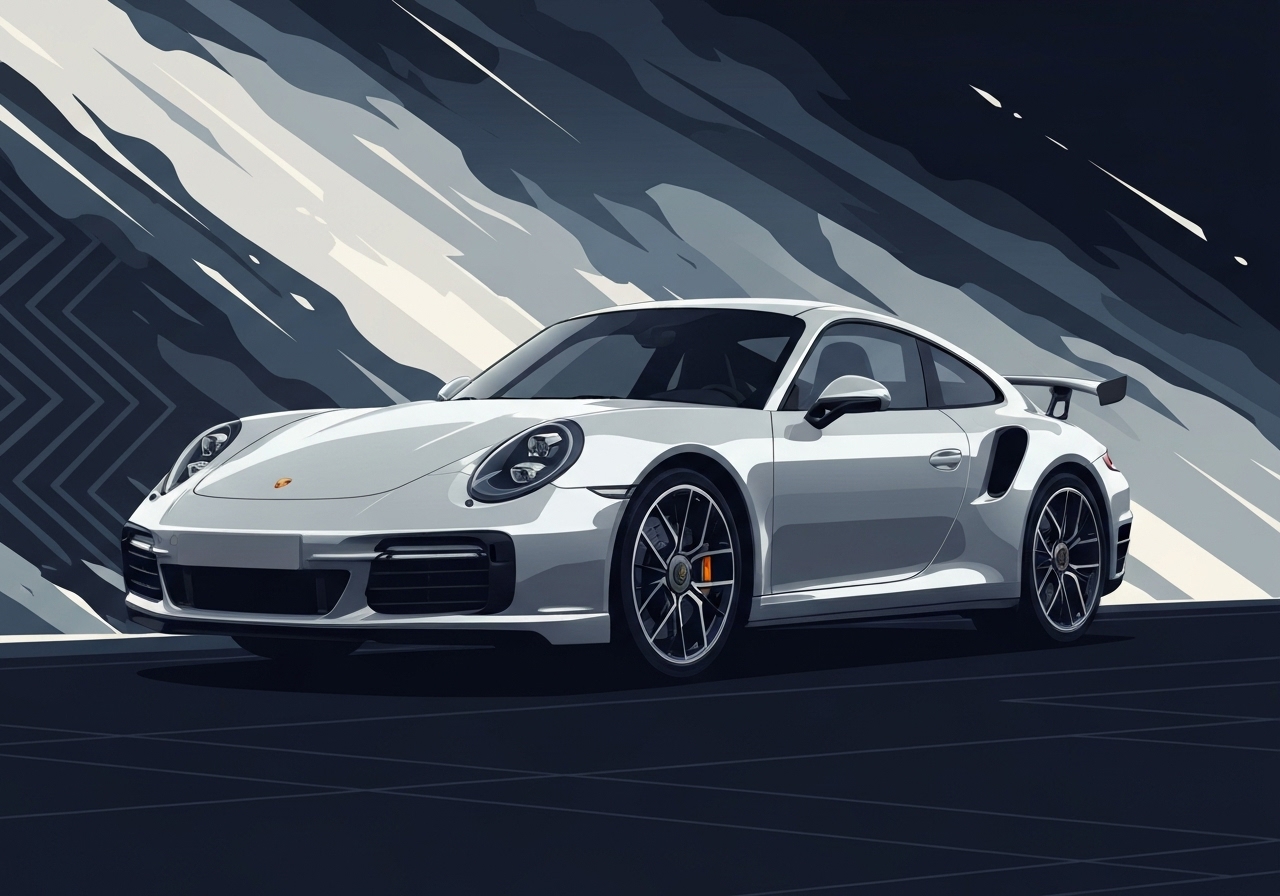
— Porsche unveiled the 2026 911 Turbo S at the Munich Motor Show on 7 September 2025. The car pairs a twin-turbo flat-six with an electrified assist to produce a combined 701 hp, accelerate from 0–60 mph in 2.4 seconds and post a Nürburgring Nordschleife lap of 7:03.92, roughly 14 seconds quicker than the previous Turbo S. Porsche positions the model as the most powerful road-going 911 to date, while standard all-wheel drive, advanced chassis control and carbon-ceramic brakes aim to keep the package driveable despite a 180-lb weight increase over its predecessor.
- Total system output is 701 hp and 590 lb-ft of torque (available 2,300–6,000 rpm); peak power is held between 6,750 and 7,000 rpm.
- Acceleration is rated at 0–60 mph in 2.4 seconds and a Nürburgring Nordschleife time of 7:03.92, 14 seconds faster than the outgoing Turbo S.
- Hybrid hardware includes a 1.9 kWh, 400-volt lithium-ion trunk battery and an electric motor placed between the engine and eight-speed PDK transmission.
- Unique twin electric turbochargers spin the turbine/compressor shafts with shaft-mounted motors, removing the need for a traditional wastegate and harvesting energy back to the battery or traction motor.
- Kerb weight is 3,829 lb for the coupe—about 180 lb heavier than the previous Turbo S—while the coupe starts at $272,650; the Cabriolet begins at $286,650.
- Chassis and aero upgrades include Porsche Dynamic Chassis Control (PDCC) with adjustable anti-roll bars, active grille shutters, an active front diffuser, deployable splitter and a rear wing; Porsche cites a 10% drag reduction in its most efficient aero setting.
- Standard hardware: carbon-ceramic brakes, a titanium sports exhaust, wider rear tires (325/30R21) and new Turbonite trim inside and out.
Background
Porsche has been steadily electrifying its 911 range to meet emissions targets while maintaining or improving performance. Last year the Carrera GTS adopted a “T-Hybrid” architecture that combined a small lithium-ion battery, an in-line electric traction motor and an electric-assisted turbocharger; the Turbo S now adopts and expands that approach. The move follows broader industry trends that use electrification to eliminate turbo lag, recover energy and broaden the usable powerband without simply increasing fuel consumption.
The 911 Turbo nameplate traditionally represents the pinnacle of Porsche’s road-going 911s, balancing extreme performance with daily usability. Prior Turbo S models relied purely on internal combustion; this generation marks the most extensive hybrid integration into the Turbo family to date. Stakeholders include Porsche AG as the manufacturer, European regulators and customers willing to pay a substantial premium for top-trim performance and technology.
Main Event
Porsche showed the new 992.2 Turbo S at the Munich Motor Show on 7 September 2025, emphasizing a twin-electric-turbo setup rather than the single electrically assisted turbo used in the GTS. The hybrid system places a 1.9-kWh, 400-volt battery in the trunk and locates an electric motor between the flat-six and the eight-speed dual-clutch (PDK) transmission. The Turbo S differs from the GTS chiefly by incorporating two electric turbochargers with shaft-mounted motors that can spool compressors almost instantly.
Those electric motors act both to accelerate the turbocharger and to brake it, harvesting kinetic energy that can recharge the trunk battery or feed the traction motor. Porsche says the turbine and compressor wheels are slightly smaller on the Turbo S compared with the GTS component, tuned to the Turbo S’s performance envelope. The system yields 701 hp total and preserves 590 lb-ft of torque across a broad midrange, with peak power held near the redline.
Chassis updates include the latest PDCC with adjustable anti-roll bars driven by the 400-volt system for faster actuation, plus wider rear tires—325/30R21 versus the previous 315/30R21—to address the greater rear weight bias and higher output. Standard carbon-ceramic brakes and a titanium sports exhaust are part of the base equipment list; Porsche also offers extensive personalization, including Turbonite interior and exterior accents and optional carbon-fiber wiper arms.
Analysis & Implications
Porsche’s application of electric turbochargers illustrates a pattern: electrification used to enhance responsiveness and power delivery rather than merely to add range. By putting motorized assistance directly on the turbo shafts and integrating energy recovery, Porsche reduces lag, recovers what was previously wasted, and widens the useful torque band—advantages that directly translate to quicker acceleration and faster lap times without simply increasing fuel consumption.
The Turbo S’s 701 hp figure makes it numerically the most powerful street 911, surpassing both the previous Turbo S and even earlier high-output variants such as the GT2 RS. That headline number helps justify the model’s steep pricing: the coupe starts at $272,650 and the Cabriolet at $286,650, each more than $30,000 above the outgoing Turbo S. For buyers, the trade-off is clear—higher cost and modest weight gain in exchange for a measurable step forward in real-world and track performance.
From an engineering and market perspective, the model underlines tensions automakers face: adding hybrid hardware increases mass and complexity, requiring changes to tires, cooling, brakes and chassis electronics. Porsche’s use of a small 1.9 kWh battery is notable because it prioritizes performance boosts and regenerative capability over electric range, distinguishing this approach from full hybrid or plug-in strategies aimed at emissions-only benefits.
Comparison & Data
| Spec | 2026 Turbo S | Previous Turbo S |
|---|---|---|
| Power (hp) | 701 | 640* |
| Torque (lb-ft) | 590 | 590 |
| 0–60 mph | 2.4 s | ~2.6–2.8 s |
| Nürburgring | 7:03.92 | ~7:17.92 (14 s slower) |
| Curb weight (lb) | 3,829 | 3,649 |
| Starting price (coupe) | $272,650 | ~$242,000 (outgoing) |
The table puts the Turbo S’s gains in context: the hybrid assistance produces a notable power increase with a relatively small battery, and the Nürburgring result demonstrates the net effect on track pace despite added mass. Customers will see the consequences in tire choice, brake hardware and optional equipment pricing.
Reactions & Quotes
Porsche’s official materials framed the car as a performance leap enabled by electrification and aerodynamic refinements.
“This makes the new Turbo S the most powerful road-going 911 yet.”
Porsche AG (official press release)
On aero and efficiency, Porsche emphasized reduced drag when systems are in their most efficient configuration.
“Improvements amount to a 10-percent reduction of the drag coefficient with the aero in its most efficient setting.”
Porsche AG (official specification sheet)
Early public reaction at the Munich show mixed admiration for the technology with questions about price and weight—common themes when combustion-era icons adopt hybrid systems. Journalists and enthusiasts noted the Nürburgring figure and 0–60 time as evidence that Porsche retained the 911’s performance halo even as the architecture changes.
Unconfirmed
- Reported brake-disc dimensions appear inconsistent in published materials (16.5-inch front vs. “larger” 16.1-inch rear); the precise rotor sizing should be verified with Porsche technical documentation.
- Exact impact of tariffs on final U.S. pricing is not detailed publicly; Porsche has warned tariffs could raise prices further, but specific increases are unannounced.
- The previous Turbo S Nürburgring baseline time used to compute the 14-second delta is inferred from Porsche’s stated difference; an exact prior official lap time should be confirmed from Porsche’s timing records.
Bottom Line
The 2026 Porsche 911 Turbo S represents a deliberate pivot: electrification used to refine and amplify performance rather than to replace combustion propulsion. With 701 hp, a sub-2.5-second 0–60 and a sub-7:05 Nordschleife time, Porsche has pushed the 911 envelope while keeping the car recognizably a Turbo S in character and capability.
Those performance gains come with trade-offs: additional weight, complexity and a significantly higher price—coupe starting at $272,650. For buyers and the market, the Turbo S is an early indicator of how high-performance sports cars will combine electrical systems with traditional engines to chase both lap times and emissions targets.