
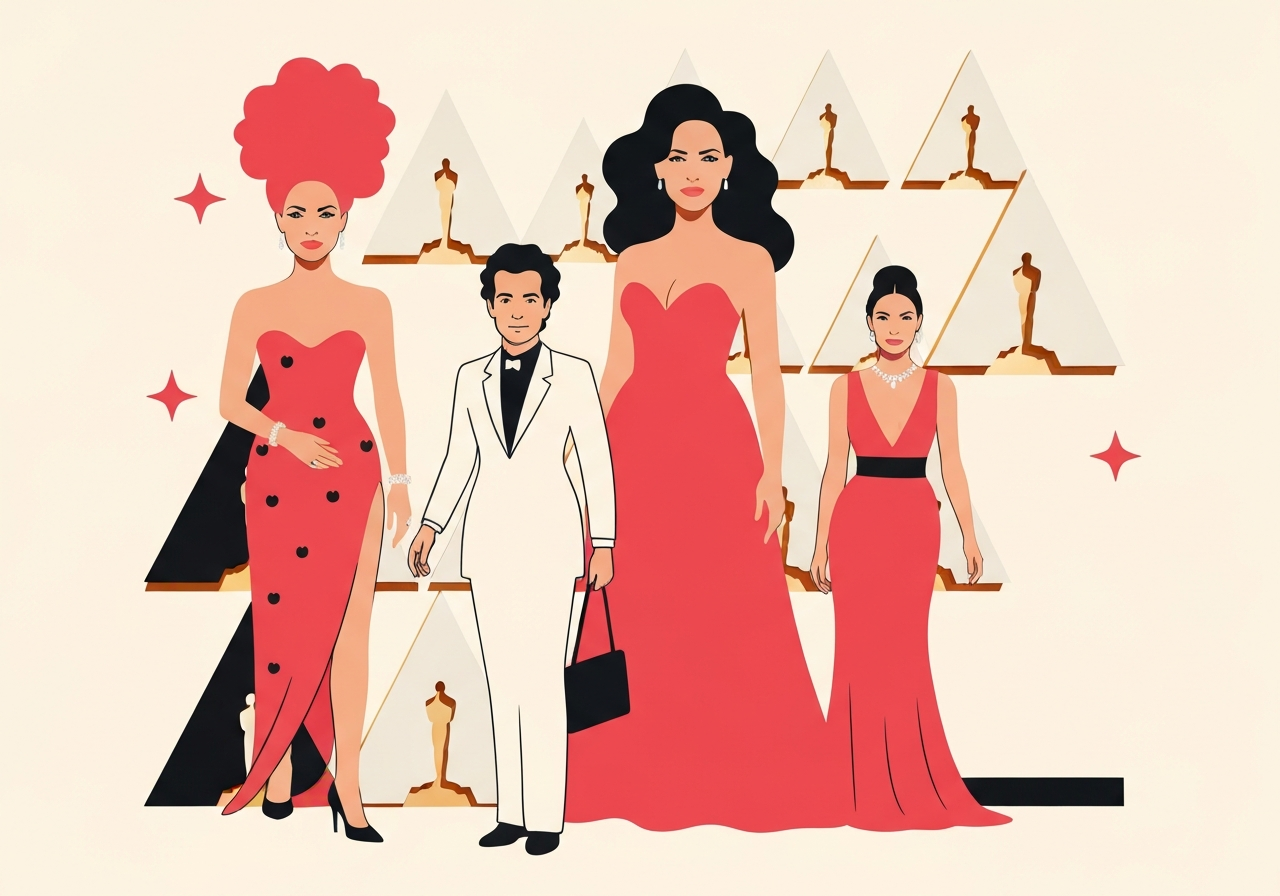
Lead: Hollywood’s biggest night arrived with an equally colossal red carpet — a 25,000-square-foot runway assembled over roughly 2,400 hours by more than 400 workers — and a fashion moment that leaned heavily on Old Hollywood references. Stars leaned into glamour that echoed the Golden Globes and recent awards-season themes, with nominees and presenters delivering memorable gowns, feathers, fringe and inventive menswear. Designers from Givenchy to Chanel framed the evening’s most-talked-about silhouettes while several films, including the 16‑nomination frontrunner Sinners, brought notable creative teams to the carpet.
Key takeaways
- The Oscars red carpet measured about 25,000 square feet, extending roughly 900 feet long and 60 feet wide; its installation required about 2,400 work hours and over 400 crew members.
- Old Hollywood glamour dominated trends, following January’s Golden Globes and the Actor Awards’ “Reimagining Hollywood Glamour from the ’20s and ’30s” theme.
- Acting nominees Jessie Buckley, Kate Hudson, Emma Stone, Elle Fanning, Wunmi Mosaku and Teyana Taylor were widely praised for their red-carpet looks.
- Standout menswear included brooches and nontraditional ties on stars such as Pedro Pascal, Michael B. Jordan, Timothée Chalamet, Delroy Lindo and Jacob Elordi.
- Givenchy by Sarah Burton dressed Elle Fanning; Chanel was worn by Teyana Taylor; several celebrities opted for dramatic ball gowns and feathered or fringed frocks.
- Producers Natalie Qasabian and Sev Ohanian attended together; Ohanian’s film Sinners carried a record 16 nominations at this ceremony.
- Industry figures of note on the carpet included Ruth E. Carter (nominated for a fifth Oscar) and Autumn Durald Arkapaw (a potential first female winner in cinematography).
- Activism appeared on the carpet: producer Nadim Cheikhrouha wore an Artists4Ceasefire pin, designed by Shepard Fairey, to call for a Gaza ceasefire.
Background
The Oscars red carpet has long been the industry’s most visible stage for fashion, where designers, stylists and publicists converge to shape seasonal trends. This year’s carpet was notable not only for its physical scale — 25,000 square feet and a 900‑foot run — but for how awards-season programming has foregrounded vintage glamour, encouraging looks that consciously reference the 1920s and 1930s. The Golden Globes earlier this year and the Actor Awards’ curated theme helped set expectations for ornate tailoring, structured ball gowns and period-inflected embellishment.
Beyond aesthetics, the carpet functions as a platform for studios and filmmakers to spotlight talent and collaborators: nominees, costume designers, cinematographers and production teams often appear together, leveraging visibility ahead of the ceremony. For example, Sinners’ creative contingent — including producers Natalie Qasabian and Sev Ohanian, production designer Hannah Beachler and performers like Miles Caton — used the evening to cement the film’s presence while the broader industry showcased both established names and rising stars.
Main event
Arrivals emphasized theatricality. Elle Fanning appeared in a Givenchy gown by Sarah Burton that read like a modern fairytale, while several contemporaries opted for large-scale ball gowns that prioritized volume and drama. Teyana Taylor chose Chanel and, along with Nicole Kidman, Demi Moore and Maya Rudolph, embraced textures such as feathers and fringe that moved on camera and in person.
Menswear presented its own moments: Pedro Pascal elevated formalwear with a prominent brooch, Joe Alwyn experimented with a nontraditional necktie, and Wagner Moura abandoned a tie for a more relaxed tuxedo silhouette. These choices underscored a continuing trend toward personalized accessories and subtle subversion of black‑tie codes.
Notable arrivals threaded industry milestones into the fashion narrative. Ruth E. Carter, up for her fifth Oscar, posed in a look that acknowledged her stature in costume design, while Autumn Durald Arkapaw arrived amid discussion that she could become the first woman to win in cinematography. The carpet also featured cultural crossovers: stars from Netflix’s KPop Demon Hunters, such as Audrey Nuna, Ji‑young Yoo and Rei Ami, brought coordinated gold and multitone looks that referenced their series’ stylistic palette.
Analysis & implications
The scale and stylistic choices at the 2026 Oscars underscore how awards-season red carpets have shifted from spontaneous celebrity moments to highly staged cultural productions. The 25,000‑square‑foot installation and multiweek leadups reflect an industry that treats fashion as both an artistic statement and a strategic publicity vehicle. Designers and stylists now factor in broadcast angles, choreography, and media coverage when scripting a celebrity’s arrival.
Stylistically, the triumph of Old Hollywood touches suggests cyclical taste patterns: after years of minimalist and athleisure-inflected red carpets, there is renewed appetite for maximalism — embroidery, feathers, full skirts and period tailoring. That pivot will likely inform couture orders and atelier commissions for the coming seasons, benefiting heritage houses and designers who specialize in structured, high‑work garments.
For the film industry, these sartorial moments carry commercial weight. A buzzworthy look can amplify a film’s visibility on social platforms and entertainment media, sometimes translating into measurable box‑office or streaming interest. The presence of multiple Sinners creatives on the carpet, alongside performances like Miles Caton’s scheduled rendition of the film’s nominated song “I Lied to You,” illustrates how the Oscars remain a concentrated publicity engine that blends awards campaigning with cultural spectacle.
Comparison & data
| Metric | 2026 Oscars Red Carpet |
|---|---|
| Area | 25,000 square feet |
| Length | 900 feet |
| Width | 60 feet |
| Assembly time | ~2,400 hours |
| Workers involved | More than 400 |
Those figures make the Oscars carpet one of the most logistically intensive staging efforts in awards‑season history. The resources applied to a single night — from carpentry and lighting to wardrobe and hair — point to an industry willing to invest heavily in optics. For designers, the operational scale can justify extended fittings, bespoke embellishment and complex fabric engineering that would be impractical for smaller events.
Reactions & quotes
The photo team captured a wide range of looks, from sculpted ball gowns to inventive menswear accessories, illustrating the evening’s stylistic breadth.
Los Angeles Times photo team (caption summary)
Observers noted that the carpet felt like a deliberate nod to past decades, with many attendees channeling 1920s and 1930s silhouettes while updating them for contemporary cameras.
Los Angeles Times fashion roundup (summary)
Attendees and industry members treated the carpet as an extension of awards campaigning, with films like Sinners using fashion-facing moments to reinforce nomination narratives.
Los Angeles Times coverage (paraphrase)
Unconfirmed
- Whether any single look from this carpet will trigger a sustained mainstream trend beyond awards season remains uncertain and will depend on retail adoption and editorial momentum.
- Claims that Autumn Durald Arkapaw’s presence guarantees a historic win should be treated as speculative until official results are announced.
Bottom line
The 2026 Oscars red carpet combined logistical ambition with a clear stylistic throughline: a return to elaborate, Old Hollywood–inspired fashion that rewarded craftsmanship and theatrical presentation. With heavyweights from Givenchy and Chanel alongside statement menswear and politically resonant accessories, the evening functioned as both a cultural showcase and an industry marketplace for ideas.
For audiences and industry observers alike, the lasting impacts will play out over months: which silhouettes make the jump to retail, which designers see follow‑on commissions, and whether the awards-season emphasis on vintage glamour endures. In the meantime, the carpet offered a concentrated tableau of contemporary celebrity style — photographed and debated from every angle.
Sources
- Los Angeles Times — Oscars 2026 red carpet fashion: best looks (U.S. newspaper: event coverage and photo captions)