
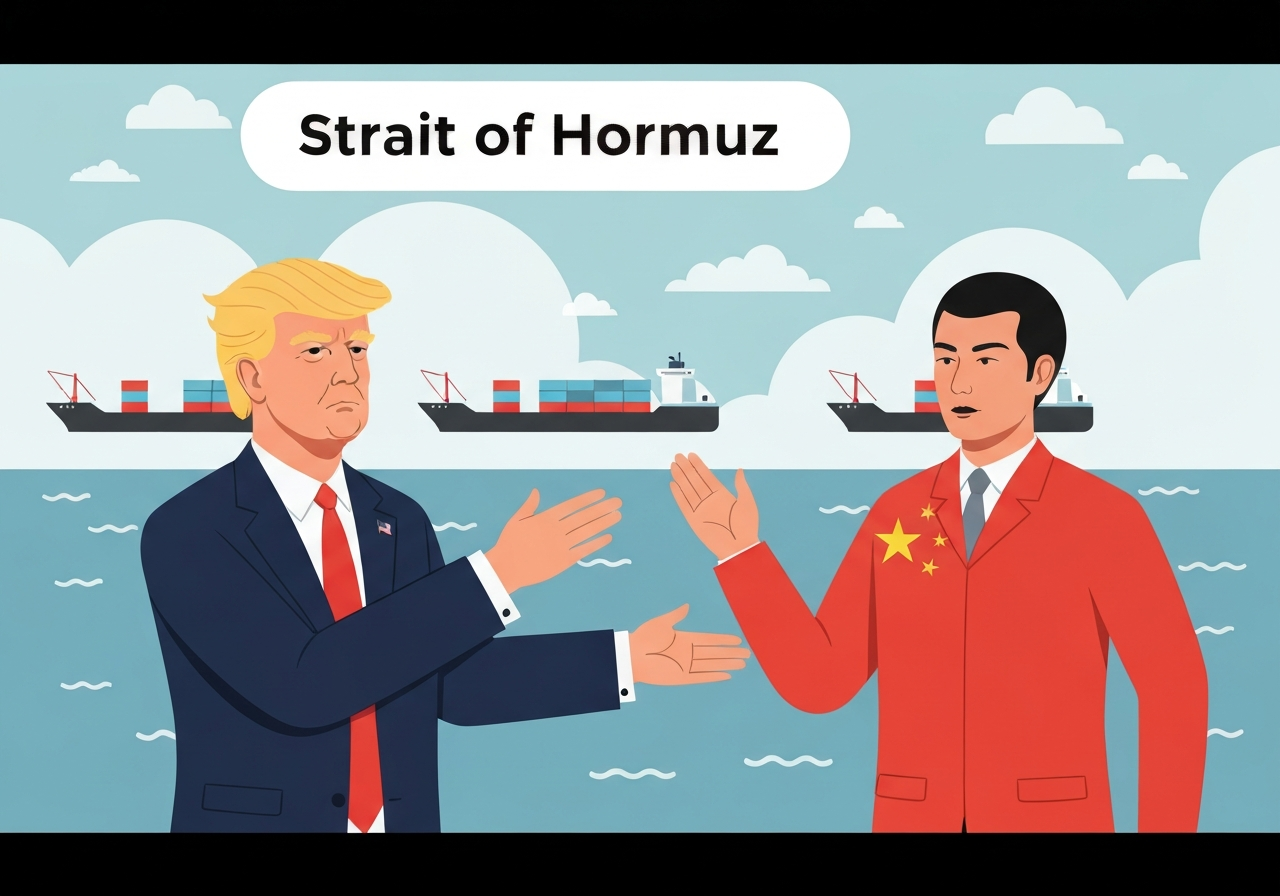
Lead: President Donald Trump on Sunday called on China and other nations to help secure the Strait of Hormuz after weeks of escalation between the US, Israel and Iran that have effectively halted tanker traffic and sent oil prices above $100 a barrel. The request came as Dubai International Airport briefly suspended flights following a nearby fuel-tank fire linked to a reported drone incident, and as maritime authorities warn the Gulf remains a high-risk area. US and Israeli officials say military operations will continue in the near term while some allies decline to commit naval forces. The disruptions have immediate economic effects and raise questions about how long shipping and energy markets will be impaired.
Key Takeaways
- The Strait of Hormuz has been effectively closed to oil tankers since the war began; roughly 20% of global oil supply normally transits the chokepoint.
- Brent crude jumped above $105 per barrel on Sunday; US oil (WTI) traded around $100–101 per barrel, its highest since July 2022.
- UK Maritime Trade Operations reports at least 20 vessels were attacked in the Persian Gulf, Strait of Hormuz and Gulf of Oman since the conflict began three weeks ago.
- Dubai International Airport briefly suspended operations after a fuel tank fire early Monday; authorities say the blaze was contained and no injuries were reported.
- President Trump said he has received ‘some positive response’ from countries contacted about helping secure the strait but declined to name them; Australia has said it will not send a ship.
- Iran’s Islamic Revolutionary Guard Corps (IRGC) claimed about 700 missiles and 3,600 drones were launched at US and Israeli targets; that figure has not been independently verified.
- Tasnim, a semi-official Iranian outlet, reported more than 54,000 damaged civilian units and casualties to medical workers; CNN and independent sources have not verified those totals.
Background
The current crisis stems from a sharp escalation after US-Israeli strikes and reciprocal Iranian and proxy attacks since late February. The conflict entered its third week as of mid-March, producing repeated strikes on infrastructure, shipping, and regional ports. Iran has asserted control over the Strait of Hormuz, a narrow waterway through which about a fifth of the world’s oil normally flows, and has at times impeded normal tanker transits.
International response has varied. Washington has announced naval deployments and has asked allies to contribute ships and specialized vessels such as minesweepers to escort commercial traffic. Some partners, including Australia and senior Japanese officials, have publicly signaled reluctance or high thresholds for sending warships, citing political and operational constraints. European leaders have expressed concern and emphasized defensive postures to protect their national interests and freedom of navigation.
Main Event
On Sunday, President Trump told reporters aboard Air Force One that he had contacted multiple countries about protecting the Strait of Hormuz and had received ‘some positive response’ while noting that some countries prefer not to become involved. He suggested China could play a role and warned that NATO could face long-term consequences if members do not assist. The president also indicated the possibility of delaying a planned summit with Chinese leader Xi Jinping to assess Beijing’s stance.
Operationally, the region remains tense. UK Maritime Trade Operations categorized the maritime threat as ‘critical’ after a pattern of attacks, navigation interference and port disruptions. At least 20 vessels have reportedly come under attack across the Persian Gulf, Strait of Hormuz and Gulf of Oman since the war began three weeks ago. National militaries have continued strikes on both sides; Israel said it struck more than 200 targets in Iran in one recent day, while Iran’s forces claimed large-scale missile and drone launches.
In the United Arab Emirates, Dubai International Airport temporarily halted flights and evacuated passengers after a fuel tank caught fire early Monday during what local authorities called a ‘drone-related incident.’ The Dubai Media Office and Civil Defence said the fire was contained and no injuries were reported. Airline operators advised travelers not to come to the airport while staff processed evacuations and rebookings.
Analysis & Implications
Short term, the primary consequence is elevated energy prices and increased volatility in shipping and insurance costs for vessels operating near the Gulf. Brent crude rising above $105 per barrel and US crude trading near $100 pushes immediate costs onto consumers and businesses; AAA reported US pump prices averaging about $3.70 per gallon, a roughly 24% rise since the war began February 28. Higher fuel costs will ripple through airline fares, freight rates and food logistics.
Strategically, the United States is seeking burden-sharing from global consumers of Persian Gulf oil, framing protection of the strait as a shared interest. That request places allied capitals in a diplomatic bind: committing naval assets risks escalation and domestic political cost, while non-participation risks diplomatic friction with Washington. Australia’s public refusal to send a ship highlights how allied responses may diverge, and Japan has signaled ‘high hurdles’ for any dispatch of vessels.
Militarily, mines, small-boat harassment and drone strikes complicate safe passage even if large naval formations are present. Minesweepers and escort vessels reduce some risks but cannot immediately reopen chokepoints when infrastructure is damaged and commercial crews are reluctant to transit. Analysts project that even after hostilities subside it could take weeks to clear shipping lanes and months to restore full throughput if terminals and pipelines were damaged.
Economically, prolonged disruption would likely sustain higher oil and commodity prices, prompt upward pressure on Treasury yields and consequently lift mortgage rates and borrowing costs. Policymakers face trade-offs between strategic objectives—such as degrading Iran’s military capacity—and limiting economic fallout at home and among partners dependent on Gulf energy.
Comparison & Data
| Metric | Before conflict (late Feb) | Recent (mid-March) |
|---|---|---|
| Brent crude | ~$80–90 per barrel | ~$105–106 per barrel |
| US crude (WTI) | ~$75–85 per barrel | ~$100–101 per barrel |
| Reported vessel attacks | Few incidents | At least 20 vessels (UKMTO) |
| US average gas price | ~$2.98/gal | ~$3.70/gal (AAA) |
The table above shows the scale of market and security shifts since the outbreak of direct hostilities. Even modest percentage moves in oil prices can translate to significant consumer and industrial cost increases globally. Clearing marine channels and repairing damaged facilities could stretch from several weeks to months depending on the intensity and duration of operations.
Reactions & Quotes
“We have had some positive response, but a few would rather not get involved,”
President Donald Trump, White House (reported remarks aboard Air Force One)
Trump framed his outreach as both pragmatic and political, urging nations that benefit from Gulf energy to contribute to security efforts. He also connected allied participation to future NATO dynamics, warning of consequences for non-cooperation.
“The overall maritime threat environment remains at a critical level,”
UK Maritime Trade Operations (official advisory)
UKMTO’s advisory reflects the pattern of attacks and threats to navigation, citing attacks, navigation interference and port facility disruption as elements elevating risk for commercial shipping in the region.
“We will not be sending a ship to the Strait of Hormuz,”
Catherine King, Australian Transport Minister (interview with ABC)
Australia described its current contributions as focused on regional defense with aircraft support to the UAE and declined the specific commitment of a naval vessel. The response highlights political and operational limits among partners despite shared concerns about energy flow and regional stability.
Unconfirmed
- The IRGC’s claim of firing about 700 missiles and 3,600 drones has not been independently verified and lacks detailed supporting timelines or damage assessments.
- Tasnim’s reported figure of more than 54,000 damaged civilian units and associated casualty counts have not been corroborated by independent international monitors.
- Whether China or other named states will ultimately commit naval assets to escort duties in the Strait of Hormuz remains unclear and unconfirmed as of this report.
Bottom Line
The immediate picture is one of heightened maritime risk and economic cost. The Trump administration is pressing allies and major energy consumers, including China, to share security responsibilities for the Strait of Hormuz, but several key partners have signaled reluctance or set high thresholds for involvement. That split complicates efforts to restore normal tanker traffic quickly.
Even if a diplomatic or military pause occurs, market and logistical fallout will linger: insurance and fuel costs, port repairs, and the time needed to clear shipping lanes mean energy markets and supply chains could feel pressure for weeks to months. Policymakers must weigh the tactical benefits of continued operations against the long-term economic and diplomatic consequences of an extended Gulf confrontation.
Sources
- CNN (live updates) — news outlet (live blog)
- Downing Street readout — official government statement (UK government)
- UK Maritime Trade Operations (UKMTO) — official maritime advisory (UK maritime security)
- Dubai Media Office — official local government communication (UAE)
- Tasnim News Agency — semi-official Iranian media outlet (reported damage figures)
- Fars News Agency — semi-official Iranian media (IRGC statements)
- Kpler — commercial energy analytics (market and shipping data)
- AAA — consumer fuel price averages (industry association)