
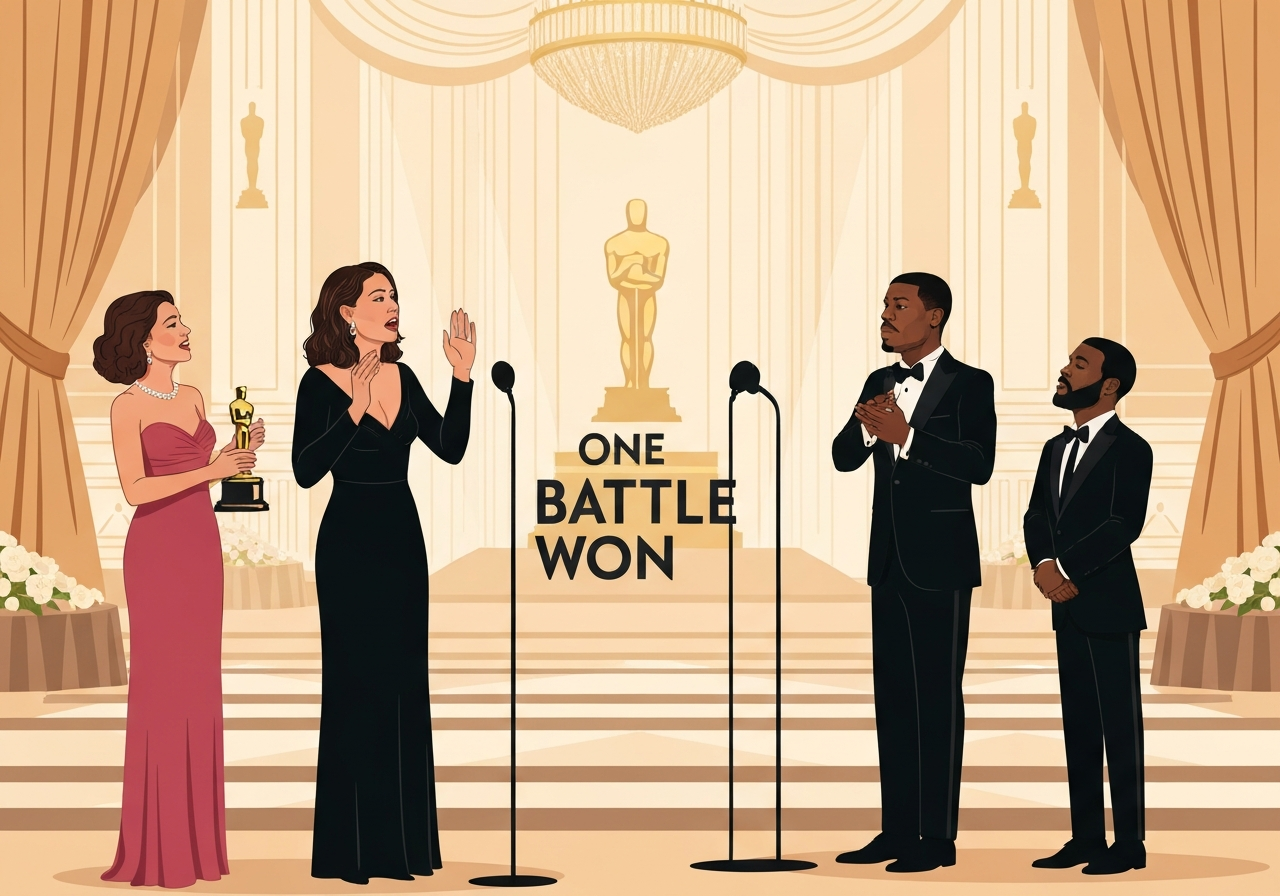
At the 98th Academy Awards on Sunday, Paul Thomas Anderson’s One Battle After Another dominated the ceremony, taking home six Oscars including Best Picture and Best Directing. The show, hosted by Conan O’Brien in Los Angeles, also honored Jessie Buckley and Michael B. Jordan with major acting awards. Sinners won four statuettes, and Frankenstein and KPop Demon Hunters picked up multiple wins as well. The broadcast included a tribute to entertainers and filmmakers who died in 2025, led by Billy Crystal.
Key takeaways
- One Battle After Another won six awards, including Best Picture, Best Directing and Best Supporting Actor.
- The film also earned Oscars for Best Editing, Best Adapted Screenplay and the first-ever Best Casting award.
- Sinners won four Oscars, with Michael B. Jordan named Best Actor for his dual role as Smoke and Stack.
- Autumn Durald Arkapaw became the first woman to win Best Cinematography for Sinners.
- Frankenstein received three Oscars; KPop Demon Hunters won two, including Best Original Song.
- Two People Exchanging Saliva and The Singers tied for Best Live Action Short Film.
- Billy Crystal led a tribute to industry figures who died in 2025, including Rob Reiner and his wife, Michelle Reiner.
Background
The 98th Academy Awards returned to Los Angeles as the film industry continued to recover from pandemic-era disruptions and box-office shifts toward streaming and franchise releases. This year’s nominations reflected a mix of established auteurs and genre pieces that crossed conventional awards lines: big-budget thrillers, auteur-driven dramas and films with strong technical showings. The Academy added a new competitive focus on categories that highlight previously underrecognized crafts — most notably the introduction and awarding of Best Casting at this ceremony. Industry observers had tracked momentum for films like One Battle After Another and Sinners throughout awards season, where both accrued guild recognition that foreshadowed Sunday’s results.
Studios and talent campaigns this year leaned heavily into diversity and technical achievement messaging; several contenders marketed distinct visual styles and casting strategies as central selling points. The Academy’s membership, which has been undergoing multi-year diversification efforts, appeared to reward both traditional prestige markers (direction, screenplay) and landmark firsts (female cinematography winner, first casting award). For many attendees, the ceremony served as both an artistic showcase and an industry checkpoint assessing where major creative and commercial trends will head next.
Main event
One Battle After Another’s night was the ceremony’s dominant narrative. The Paul Thomas Anderson–directed action-thriller collected six Oscars: Best Picture, Best Directing, Best Supporting Actor, Best Editing and Best Adapted Screenplay, along with the inaugural award for Best Casting. Onstage, Anderson — a long-time awards-season presence with 14 prior nominations — accepted with wry gratitude, noting the long arc of recognition that led to the night’s wins.
Sinners emerged as the other major winner, taking four prizes and delivering several historic moments. Michael B. Jordan won Best Actor for a dual performance as twins Smoke and Stack, and cinematographer Autumn Durald Arkapaw was awarded Best Cinematography, marking the first time a woman won that category at the Academy Awards. Jordan used his acceptance speech to acknowledge the Black performers who paved the way for him.
Frankenstein claimed three trophies across technical and creative categories, while KPop Demon Hunters secured two wins, including Best Original Song — evidence of the Academy’s continued attention to global and genre work. The shorts program produced a rare tie: Two People Exchanging Saliva and The Singers split the Best Live Action Short Film award, an uncommon result that underscored the close voting in short-form categories.
The ceremony also paused for remembrance. A segment honoring actors, writers and filmmakers who died in 2025 featured a tribute led by Billy Crystal to Rob Reiner — described by presenters as among those lost in December — and others in the community. The moment was framed as a collective acknowledgement of cultural loss amid celebration.
Analysis & Implications
One Battle After Another’s sweep illustrates how a single film can bridge critical acclaim and Academy tastes when it delivers across both auteurial direction and technical execution. Winning Best Picture and Best Directing together reinforces the Academy’s continued tendency to align its top prizes when a film offers a cohesive artistic vision. The added awards for editing and adapted screenplay suggest voters rewarded narrative craft and pacing as much as performance and spectacle.
Sinners’ success — particularly Jordan’s Best Actor win and Arkapaw’s historic cinematography win — signals the Academy’s increasing openness to performances rooted in genre or unconventional storytelling forms. Jordan’s public recognition of Black predecessors in his speech aligns with wider industry conversations about legacy, representation and mentorship, and Arkapaw’s prize could prompt renewed focus on supporting women in major cinematography roles.
The first presentation of Best Casting may have shored up attention on hiring practices and ensemble construction as central creative decisions, potentially elevating casting directors’ visibility in future awards and industry negotiations. Studios that emphasize inclusive or innovative casting strategies could use this moment to argue for casting as a measurable contributor to a film’s artistic and commercial success.
| Film | Oscar wins |
|---|---|
| One Battle After Another | 6 |
| Sinners | 4 |
| Frankenstein | 3 |
| KPop Demon Hunters | 2 |
The table above summarizes the leading winners by total statuettes. While One Battle After Another led in raw count, Sinners’ key wins in acting and cinematography carry symbolic weight that may influence future festival placements and studio marketing. For awards strategists, the split between headline wins and historic firsts offers multiple takeaways about how to position films across guilds and Academy voting blocs.
Reactions & Quotes
Winners, presenters and viewers offered immediate responses inside and outside the Dolby Theatre. Acceptance remarks and onstage exchanges framed much of the evening’s emotional tone, balancing humor and gratitude with references to industry lineage and craft.
“You make a guy work hard for one of these, I really appreciate it.”
Paul Thomas Anderson, Best Directing winner
Anderson’s quip came after a long awards-season run and multiple Academy nominations; his remark was delivered with self-deprecating humor and followed a moment of pointed thanks to collaborators. The line underscored the narrative of perseverance that many media outlets highlighted in post-ceremony coverage.
“I want to thank the Black actors who came before me.”
Michael B. Jordan, Best Actor winner
Jordan’s brief acceptance comment tied his personal victory to a broader lineage of performers and was widely cited in commentary about representation. Observers noted that his win and Arkapaw’s historic cinematography prize were framed together as part of the night’s milestones for inclusion in key creative categories.
Unconfirmed
- Details about the circumstances surrounding Rob Reiner and Michelle Reiner’s deaths were reported in the ceremony coverage; at the time of the broadcast, motives and investigative findings had not been exhaustively detailed in public reports.
- Tie results in short-film voting are rare; the reporting confirms the tie for Best Live Action Short Film but does not provide the Academy’s full ballot breakdown or vote counts.
Bottom line
The 98th Academy Awards blended headline makers and historic firsts: One Battle After Another’s six wins cemented it as the night’s dominant film, while individual milestones — Michael B. Jordan’s Best Actor prize and Autumn Durald Arkapaw’s breakthrough in cinematography — signaled notable shifts in recognition. The introduction and awarding of Best Casting further expanded the Academy’s acknowledgment of behind-the-scenes crafts, potentially reshaping future awards strategies and industry valuation of key creative roles.
Looking ahead, studios and awards campaigns will likely analyze both the raw tally of Oscars and the symbolic weight of specific wins to guide promotion and project development. For audiences and industry members alike, the ceremony underscored that prestige and historic moments can coexist: a single film can dominate counts, while other wins mark meaningful progress in representation and craft recognition.
Sources
- Yahoo Entertainment — news (media)