
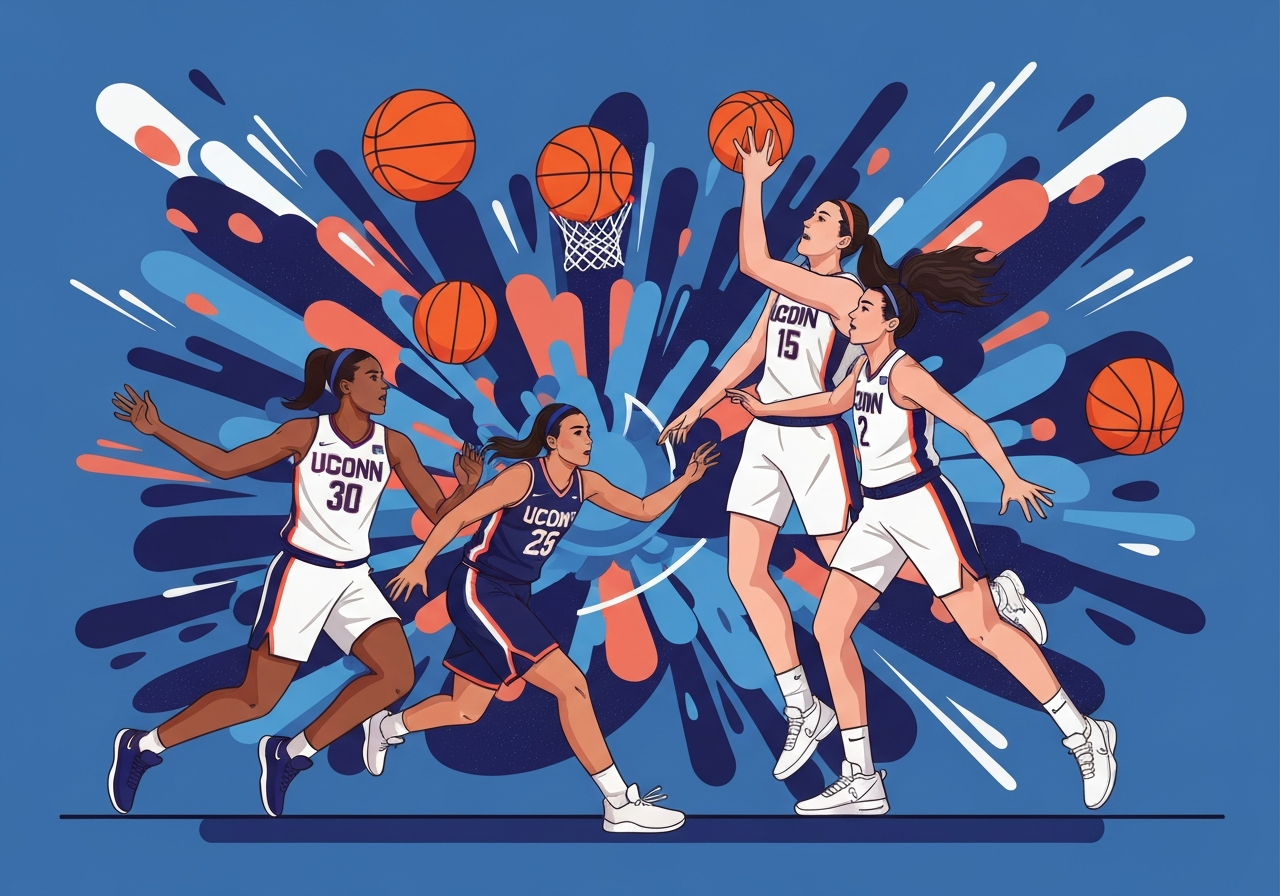
Lead: The UConn Huskies arrived at the 2026 NCAA women’s basketball tournament as the clear odds-on favorite on March 16, 2026, with sportsbooks installing them at -265 to win a record-extending 13th national title. The line marks the shortest pre-tournament favorite price since 2018, reflecting a season in which UConn frequently dominated opponents. UCLA sits a distant second at +550, and several SEC teams occupy the next tier of contenders. Early public betting and bracket submissions show heavy concentration on a few programs rather than a wide-open field.
Key Takeaways
- UConn is listed at -265 by DraftKings to win the national championship, implying roughly a 72.6% probability on a straight-conversion basis.
- UCLA is the next-shortest at +550 (≈15.4% implied), followed by Texas +700 (≈12.5%) and South Carolina +800 (≈11.1%).
- LSU (16-1, ≈5.9%) and Vanderbilt (50-1, ≈2.0%) fill out the next set of notable short prices; Duke and Michigan are 75-1 and 80-1, respectively.
- Bookmakers and market data show concentration: UConn, UCLA and South Carolina accounted for about 57.4% of BetMGM’s futures handle this season.
- UConn began the season around +225, later shortening to -265 as the team won consistently, including a noted run of 29 straight double-digit victories cited by Caesars.
- Early ESPN Tournament Challenge entries favored UConn strongly—about 46% of submitted brackets picked the Huskies to win.
- Most of the tournament field is priced at 100-1 or longer, highlighting how top-heavy the market is; Texas Tech (200-1) drew notable action with 2.4% of BetMGM’s handle despite long odds.
Background
The Huskies entered 2026 with the program’s legacy of 12 national championships and the expectation of contending for a 13th. After several seasons outside the clear pre-tournament favorite position, UConn returned to that role for the first time since 2018, driven by a stretch of decisive victories and consistent margins. The team’s regular-season form influenced sportsbook lines and public perception, compressing futures prices toward the Huskies.
The betting market’s structure reflects both on-court results and historical brand weight: programs with deep tournament pedigrees tend to attract money early, which compounds line movement. Conferences matter in the market too; the SEC supplied multiple teams in the short-odds group, reinforcing narratives about league strength. At the same time, most of the bracket sits at long prices, signaling a substantial gap between the few top teams and the rest.
Main Event
Bookmakers set UConn at -265 in DraftKings’ pre-tournament futures, the shortest pre-tournament favorite line in eight years. That level of favoritism is notable given the single-elimination format and the history of upsets in March. UCLA’s +550 price places the Bruins as the primary challenger in market terms, but sportsbooks see other potential threats across the SEC and in a handful of midrange contenders.
Market commentary from Caesars emphasized UConn’s run of dominant wins—specifically a streak of 29 straight games decided by double digits—as justification for the short price. Market handles reported by BetMGM reveal concentrated public money: UConn, UCLA and South Carolina together made up roughly 57.4% of futures action on that platform this season, a skew that reduces line diversity and increases liability on a few teams.
There are isolated pockets of heavy backing for longshots. BetMGM data showed Texas Tech at 200-1 capturing 2.4% of the book’s futures handle, making it, paradoxically, one of the site’s largest liabilities despite its long price. Conversely, BetMGM identified liabilities on Michigan and Vanderbilt at shorter prices, indicating uneven exposure across books depending on customer preferences.
Analysis & Implications
From a betting-market standpoint, UConn’s -265 implies a high degree of confidence that the Huskies will navigate the bracket without an early exit. That confidence is rooted in both recent results and roster quality, but it elevates the cost for bettors who wish to back UConn at scale. Heavy favoritism can dampen market efficiency: a single team attracting most handle makes sportsbook risk management more delicate and could amplify line movement if injuries or other news emerge.
Competitive balance in the tournament is a separate concern. When one program is priced so short, it increases the impact of variance—an upset in a single elimination contest becomes a larger story both on-field and for markets. Teams like UCLA and South Carolina, priced as second-tier threats, will be watched as matchup-based challengers; if tactical matchups favor them in tournament play, the market could re-evaluate quickly.
For the sport more broadly, concentrated futures money signals where public interest and narratives are focused. That benefits the top programs through media attention and potentially greater television ratings, but it also underscores a structural gap between a few elite teams and the majority of the field. For sportsbooks, the immediate implication is liability management: balanced books are rare in such a skewed market, so hedging and limit-setting become important tools.
Comparison & Data
| Team | Odds | Approx. Implied Probability |
|---|---|---|
| UConn | -265 | 72.6% |
| UCLA | +550 | 15.4% |
| Texas | +700 | 12.5% |
| South Carolina | +800 | 11.1% |
| LSU | 16-1 | 5.9% |
| Vanderbilt | 50-1 | 2.0% |
These implied probabilities are direct conversions from the listed odds and do not include bookmaker margin (vig) or cross-market adjustments. The sharp gap between UConn and the next teams highlights the top-heavy nature of market risk: a single upset would materially alter implied expectations and could create significant payout exposure for books that took heavy UConn money.
Reactions & Quotes
Market operators and public bettors reacted predictably to the Huskies’ season-long dominance and the concentration of futures wagers. Below are representative statements and data points that capture the tone of commentary around the lines and handle.
“UConn has been incredibly dominant, winning 29-straight games by double digits. It’s one of the more remarkable runs we’ve seen in recent memory.”
Patrick Berbert, Caesars Sportsbook (college basketball trader)
Caesars framed UConn’s game-level margins as the rationale for the short line and the low perceived probability of a deep upset.
“46% of ESPN Tournament Challenge brackets have UConn selected to win the national championship.”
ESPN Tournament Challenge data (public bracket submissions)
ESPN’s bracket submissions reflected early public sentiment and helped explain why futures action skewed heavily toward a few teams.
“Texas Tech, at 200-1, accounted for 2.4% of BetMGM’s futures handle, making it one of the site’s largest liabilities despite long odds.”
BetMGM handle reporting (operator data)
BetMGM’s internal handle numbers illustrated how even longshots can create disproportionate exposure when backed by concentrated bets.
Unconfirmed
- Whether UConn’s short line fully reflects on-court superiority rather than an outsized public-betting bias—current evidence is consistent with both explanations and requires deeper market modeling to separate.
- Late injuries, lineup changes or off-court developments that could materially shift lines before the tournament begin are possible but not reported at the time of publication.
- Internal hedging strategies and the precise liability positions at individual books beyond the public snippets (BetMGM, DraftKings, Caesars) remain proprietary and unverified.
Bottom Line
UConn’s placement as a heavy pre-tournament favorite is grounded in a dominant season and strong public backing; sportsbooks and bracket entrants have priced and bet accordingly. That concentration carries both narrative clarity—one clear favorite—and structural risk for books and bettors alike, because single-game variance in a knockout format can quickly overturn market expectations.
For bettors, the market poses a choice: accept a low payout backing a short-price favorite with a high implied probability, or seek value in underpriced challengers and longshots whose outcomes would generate larger returns. For the tournament’s storytelling, the Huskies’ status shapes media focus and raises the stakes of every matchup they play.
Sources
- ESPN — News report and Tournament Challenge data (media)
- DraftKings — Futures odds (sportsbook odds board)
- Caesars Sportsbook — Trader comment via email (sportsbook/operator)
- BetMGM — Handle and liability reporting (sportsbook/operator)