
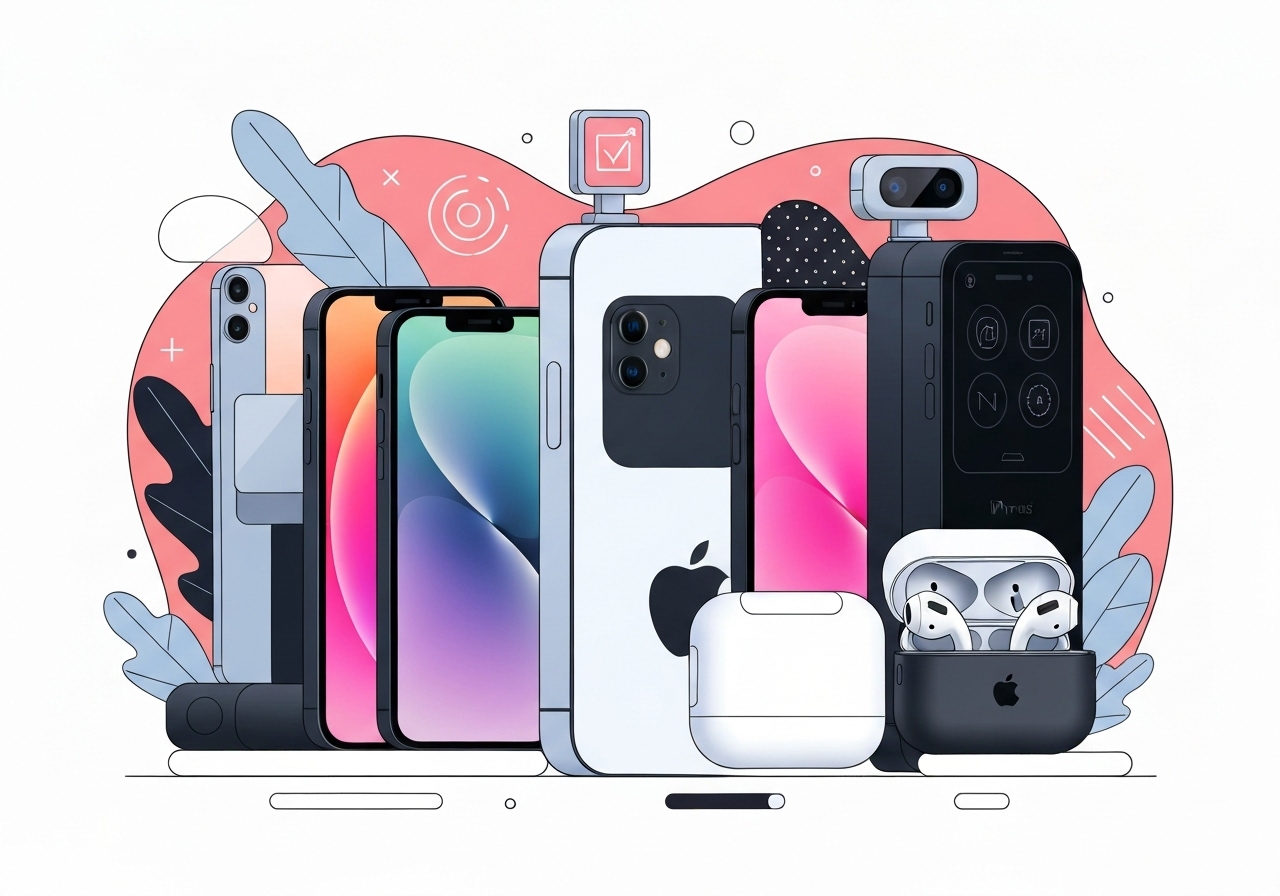
Apple opened its September 9 keynote at Apple Park in Cupertino to unveil its 2025 hardware lineup, introducing the iPhone 17 family, a new ultra-thin iPhone Air, AirPods Pro 3 and three Apple Watch models. The company gave the base iPhone its first 120Hz display, introduced an A19/A19 Pro silicon split across models, and emphasized health and connectivity upgrades on the watch line. Pricing and availability were confirmed: iPhone 17 starts at $799, iPhone Air at $999, and preorders begin Sept. 12 with devices on sale Sept. 19. Apple framed many changes as incremental platform advances rather than a single blockbuster shift.
Key Takeaways
- Apple announced the iPhone 17 lineup on Sept. 9 in Cupertino; starting prices are $799 (iPhone 17), $999 (iPhone Air), $1,099 (iPhone 17 Pro) and $1,199 (iPhone 17 Pro Max).
- The standard iPhone 17 gains a 120Hz ProMotion display and a 48MP main camera; Apple claims up to 8 extra hours of video playback versus the prior model thanks to the A19 chip.
- iPhone Air is Apple’s thinnest phone at 5.6mm with a 6.5″ always-on display, uses the A19 Pro and N1/C1X comms chips, and is eSIM-only globally; Apple lists it at $999.
- Apple Watch Series 11 ($399) is the thinnest watch yet and adds 5G; Watch Ultra 3 ($799) supports satellite emergency messaging and touts up to 42 hours battery life.
- AirPods Pro 3 cost $249, double the active noise cancellation over the immediate predecessor and up to 8 hours of listening with ANC on (10 hours in Transparency mode).
- Apple emphasized real-world safety use cases and battery/thermal engineering (vapor chamber) to sustain higher performance across the lineup.
- Preorders open Sept. 12 at 5:00 a.m. PT and devices reach customers in stores and online beginning Sept. 19.
Background
Apple’s September hardware event follows its pattern of annual system-and-device updates timed to the fall iPhone cycle. Over the last decade Apple has pursued a strategy of alternating cosmetic and internal upgrades across the lineup while expanding health, connectivity and on-device intelligence features tied to iOS releases. This year, iOS 26 and Apple Intelligence set expectations for improved on-device translation, visual intelligence and other AI-adjacent features that rely on tighter hardware-software integration.
The wearables market is increasingly competitive: rivals from Samsung, Google and specialist health-device makers have pressed Apple on battery life, specialized sensors and on-device analysis. Apple’s approach has been incremental—improving sensors and adding software features like sleep scores and hypertension screening—while protecting the user base with a familiar ecosystem. Apple also faces ongoing supply-chain, regulatory and carrier dynamics that shape pricing and regional feature availability, for example in decisions around eSIM-only designs.
Main Event
Apple opened with the AirPods Pro 3, priced at $249. The new earbuds use a multi-port acoustic architecture to improve sound and calls, and Apple said ANC is twice as strong as the previous generation. Battery life was highlighted: up to eight hours with ANC enabled and 10 hours in Transparency mode. Live Translation (powered by Apple Intelligence) and improved ear-tip fit with five sizes were among the software and fit changes announced.
The iPhone 17 family was the centerpiece. The standard iPhone 17 now includes a 120Hz ProMotion display, a 48MP main camera (24MP binned by default), and an upgraded A19 chip with a 16-core Neural Engine. Apple claimed an approximate 8-hour video playback gain for the base model. Pro models start at $1,099 (Pro) and $1,199 (Pro Max) and feature redesigned backs, a larger camera visor, 48MP fusion sensors across three cameras and an improved telephoto approach that Apple describes as 4x optical with up to 8x “optical-quality” reach.
Apple introduced the iPhone Air as a new thin-and-light tier priced at $999. It measures 5.6mm, has a 6.5″ always-on display, uses an A19 Pro chip and integrates N1 and C1X network components for Wi‑Fi 7 and upgraded wireless efficiency. To save space it ships without a physical SIM (eSIM-only globally), and Apple emphasized ceramic surfaces and a sculpted camera module to balance durability and thinness.
The watch lineup arrived as three SKUs: Apple Watch Series 11 at $399, Ultra 3 at $799 and Apple Watch SE 3 at $249. Series 11 is thinner, adds 5G support and a scratch-resistant ceramic surface, and brings sleep scoring and a hypertension detection workflow Apple said is awaiting FDA clearance. The Ultra 3 adds a brighter wide-angle OLED, thinner bezels for a larger usable screen and satellite connectivity for emergency messaging and Find My sync, with Apple marketing up to 42 hours battery life.
Analysis & Implications
Apple’s 2025 hardware refresh emphasizes material, thermal and battery engineering as primary differentiators rather than a single radical feature. The vapor chamber cooling described for Pro models—cited as delivering ~40% thermal improvement versus iPhone 16 Pro—addresses sustained performance for AI workloads and gaming, a response to broader industry demands for longer high-load runtime. For consumers, that can translate to steadier performance during tasks like ProRes RAW capture and on-device model inference.
The iPhone Air positions Apple to capture users who want a large-screen experience in an extremely thin chassis; by making it eSIM-only Apple signals confidence in global eSIM adoption but it also shifts logistical burdens to carriers and consumers who still use physical SIMs. The N1 and C1X chip mentions indicate Apple continues to vertically integrate connectivity to improve power efficiency and future feature support like Wi‑Fi 7 and Thread.
On wearables, Apple is doubling down on health and emergency capabilities. Satellite messaging and longer battery spans on the Ultra 3 are explicit competitive moves against outdoor-focused wearables; meanwhile, Series 11’s thinner form and ceramic finishing target mainstream users seeking comfort and durability. The announced hypertension detection and sleep score analytics, pending regulatory clearances and validation, could broaden Apple’s role in preventive care—but their clinical utility will depend on FDA outcomes and independent verification.
From a market perspective, the pricing largely preserves Apple’s premium structure while introducing product segmentation (Air as a thin premium model). That positioning should help Apple maintain device ASPs (average selling prices) and aftermarket accessory sales, but it also raises questions about cannibalization: the $999 Air sits close to Pro pricing in some markets and could shift upgrade patterns depending on consumer priorities for camera, materials or portability.
Comparison & Data
| Product | Starting price (USD) | Key battery claim |
|---|---|---|
| iPhone 17 | $799 | +8 hours video playback (claimed) |
| iPhone Air | $999 | All-day battery; 40 hours video playback with MagSafe battery pack (Apple claim) |
| iPhone 17 Pro | $1,099 | Largest iPhone battery to date (Apple claim) |
| AirPods Pro 3 | $249 | 8 hours ANC on / 10 hours Transparency |
| Apple Watch Ultra 3 | $799 | Up to 42 hours |
| Apple Watch Series 11 | $399 | Up to 24 hours |
| Apple Watch SE 3 | $249 | 18-hour typical life; 8 hours from 15-minute fast charge |
The table collates Apple’s announced prices and battery claims. These manufacturer-quoted numbers are useful for comparisons but should be validated in real-world testing, where actual runtimes vary with display brightness, connectivity usage (5G, satellite) and app workloads. For example, the A19 Pro’s performance and thermal profile will determine how much of the claimed battery gains persist under sustained heavy use like gaming or video capture.
Reactions & Quotes
The announcements generated a mix of applause and skepticism inside the Steve Jobs Theater and among analysts: Apple highlighted user-safety stories as a framing device, while reviewers flagged trade-offs like reduced optical zoom on some models.
“Good morning,”
Apple CEO Tim Cook (opening remark)
Cook’s customary opening set the tone for a product-first presentation focused on hardware iteration and ecosystem integration rather than a standalone AI reveal. The device demos and hands-on reactions in the room emphasized the Air’s thinness and the Pro models’ camera and thermal updates.
“The most power-efficient iPhone we’ve ever made,”
Apple (product claim)
That claim—referring to the iPhone Air and A19 Pro—signals Apple’s emphasis on power-per-watt improvements, but independent testing will be required to verify real-world efficiency across typical user scenarios.
“I’ll definitely be upgrading to Apple Watch Ultra 3 for the bigger screen and satellite connectivity,”
Industry editor reaction (summarized)
Industry commentators highlighted the Ultra 3’s satellite features and display as strong motivators for existing Ultra owners to consider an upgrade.
Unconfirmed
- Reports that AirPods Pro 3 would include temperature sensing were not realized at launch; any future temperature feature in earbuds remains unconfirmed.
- Reverse wireless charging for iPhones was discussed in pre-event rumors but was not announced; its presence on future models remains uncertain.
- Timing for FDA clearance of hypertension detection on Series 11 is pending; Apple expects clearance “soon,” but an exact date is not provided.
Bottom Line
Apple’s Sept. 9 hardware slate is evolutionary: meaningful refinements to displays, thermal design, battery life and health features rather than a single transformational product. The introduction of the iPhone Air adds a new thin-premium tier that could reshape upgrade decisions, especially for buyers prioritizing portability over multi-camera versatility.
Wearables incrementally increase Apple’s health and safety value proposition, particularly with satellite messaging on the Ultra 3 and sleep/hypertension tools on Series 11—features whose ultimate impact depends on regulatory reviews and third-party validation. For consumers and enterprises, the headline is consistent product polish and tighter hardware-software integration ahead of iOS 26 rollouts and expanded Apple Intelligence features.
Expect independent reviews and battery/thermal tests over the coming weeks to validate Apple’s performance and endurance claims; preorders begin Sept. 12 and the devices reach stores on Sept. 19 for hands-on verification.
Sources
- ZDNET live coverage — (news media, event reporting)
- Apple Newsroom — (official corporate announcements)
- Apple product pages — (official specs and purchase information)