
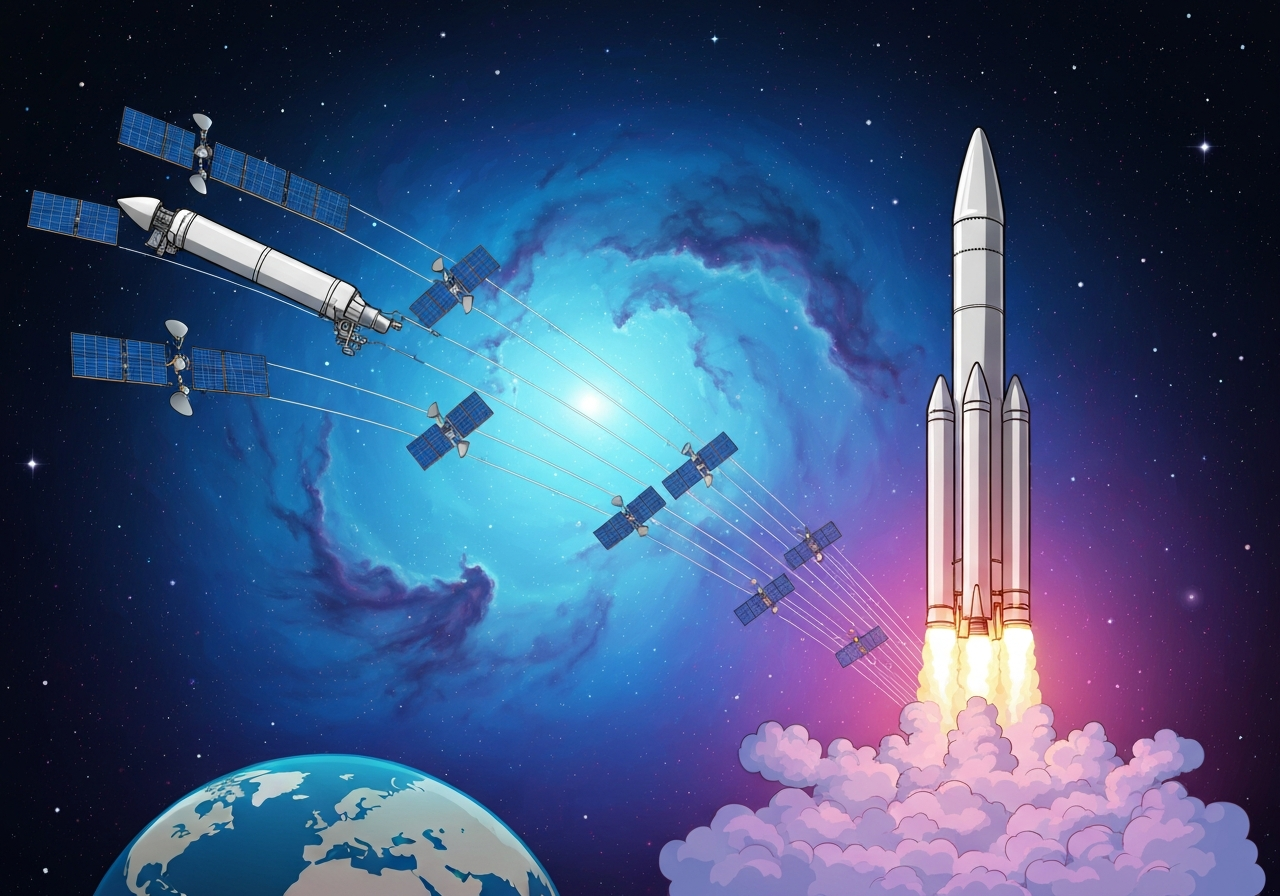
SpaceX is set to launch 25 Starlink internet satellites from Vandenberg Space Force Base on the evening of Monday, Mar. 16, with liftoff scheduled for 10:19:09 p.m. PDT (1:19:09 a.m. EDT / 05:19:09 UTC on Mar. 17). The flight, designated Starlink Group 17-24, will use Falcon 9 booster B1088 on its 14th mission and aims to push the Starlink constellation past 10,000 satellites in low Earth orbit simultaneously for the first time. The launch coincides with the 100th anniversary of Robert Goddard’s first liquid‑propelled rocket flight and will mark Falcon 9’s 615th flight overall. Recovery operations plan for B1088 to attempt a return to the drone ship Of Course I Still Love roughly eight minutes after liftoff.
Key Takeaways
- Launch date and time: liftoff is scheduled for 10:19:09 p.m. PDT on Monday, Mar. 16 (01:19:09 a.m. EDT / 05:19:09 UTC on Mar. 17).
- Payload: 25 Starlink satellites on mission Starlink Group 17-24; the flight would put the constellation above 10,000 satellites in LEO for the first time.
- Vehicle and booster: Falcon 9 booster B1088 will fly for the 14th time; the Falcon 9 family will reach its 615th flight with this mission.
- Landing plan: B1088 is targeting a drone‑ship touchdown on Of Course I Still Love about eight minutes after liftoff, a milestone that would be the drone ship’s 184th landing and SpaceX’s 586th booster recovery.
- Trajectory and site: the rocket will lift from Space Launch Complex 4 East (SLC‑4E) and fly a southerly trajectory; this is the 17th orbital launch from Vandenberg this year.
- Coverage: live reporting is planned to begin about 30 minutes prior to scheduled liftoff.
Background
SpaceX began deploying Starlink satellites in May 2019 and has pursued an aggressive cadence of rides and dedicated launches since then. The company’s objective is a global broadband constellation composed of many thousands of small satellites in low Earth orbit to deliver low‑latency internet service. Over successive flights and hardware reuses, SpaceX has emphasized rapid turnaround and booster reuse as central to lowering launch costs and increasing throughput.
Vandenberg SLC‑4E has been a frequent West Coast departure point for polar and southerly trajectories, supporting military and commercial payloads as well as Starlink missions. The Falcon 9 design, a two‑stage, kerosene‑powered vehicle, has accumulated hundreds of missions and dozens of booster reflights that together underpin SpaceX’s manifest flexibility. Robert Goddard’s 1926 liquid‑propelled test rocket is often cited in aerospace histories as the origin of the liquid‑fuel era that culminates a century later with routine orbital flights like this one.
Main Event
Launch operations will culminate during a nighttime window starting at 10:19:09 p.m. PDT, when the two‑stage Falcon 9 is scheduled to lift off from SLC‑4E and head southward. Ground teams will monitor a standard set of prelaunch checks and a weather window that commonly dictates final go/no‑go calls within minutes of T‑0. The payload fairing will separate during first‑stage ascent, and the second stage will insert the 25 satellites into their target deployment orbit after stage separation and second‑stage engine burns.
First stage booster B1088—making its 14th flight after earlier missions including NASA’s SPHEREx, Transporter‑12, two National Reconnaissance Office launches and nine prior Starlink flights—will attempt a controlled reentry burn and touchdown on the drone ship Of Course I Still Love stationed in the Pacific. If successful, the landing would add to OCISLY’s historical total and to SpaceX’s program‑level recovery tally, numbers the company tracks closely as a measure of reusability.
The mission is logged on SpaceX and independent launch manifests as Starlink Group 17‑24; deployment will occur in a phased sequence to minimize collision risk and permit early commissioning of individual spacecraft. Mission controllers will begin telemetry checkout immediately after separation, followed by tracking and phased activation sequences to certify each satellite for service. Spaceflight Now and company feeds plan to provide live updates starting about half an hour before liftoff.
This flight also contributes to the broader launch tempo observed at Vandenberg, representing the 17th orbital attempt from the site so far this year, and reflecting both commercial demand and national security launch needs that use polar or high‑inclination trajectories. Airspace and maritime notices have been issued for the range of impact and downrange recovery zones associated with the planned southerly ascent corridor.
Analysis & Implications
Pushing the Starlink fleet beyond 10,000 satellites is primarily a network capacity milestone rather than a single‑event technological breakthrough. More satellites typically increase aggregate throughput, redundancy and the ability to serve higher‑latitude and high‑demand regions, but the benefits depend on ground infrastructure, regulatory approvals and spectrum management. Satellite density in low Earth orbit raises operational complexity for collision avoidance and necessitates robust space‑traffic coordination between operators and national agencies.
Economically, continued rapid launches help SpaceX lower per‑user costs by amortizing manufacturing and launch expenses across more subscribers and services. Reuse of boosters like B1088 is central to that economics: each successful recovery translates to fewer new first stages built and lower marginal launch cost. The program‑level landing totals—hundreds of successful recoveries—are a tangible efficiency metric but do not eliminate other costs such as constellation maintenance and ground network expansion.
Strategically, the milestone underscores shifting norms in orbital resource use, prompting renewed attention from regulators and international partners on traffic management and debris mitigation. As constellations grow, national space agencies and industry groups will face increased pressure to adopt common standards for maneuver coordination, end‑of‑life disposal, and transparency about orbital plans. For customers, the immediate implication is potential incremental performance improvements in latency and regional capacity where new satellites bolster local coverage.
Comparison & Data
| Metric | Value |
|---|---|
| Scheduled liftoff | 10:19:09 p.m. PDT, Mar. 16 (01:19:09 a.m. EDT / 05:19:09 UTC, Mar. 17) |
| Starlink payload | 25 satellites (Starlink Group 17‑24) |
| Falcon 9 family flights | 615th flight |
| Booster B1088 flights | 14th flight |
| OCISLY landings (if successful) | 184th on that vessel |
| SpaceX booster recoveries (program) | 586th recovery (if successful) |
The table places this single mission within program‑level tallies: vehicle flight counts, individual booster reuse cycles, and drone‑ship recovery totals. These aggregate figures are useful for tracking operational tempo and the economic case for reusability, but they do not reflect downstream variables like satellite health, commission time, or regional spectrum access that determine on‑orbit service value.
Reactions & Quotes
“Live coverage begins about 30 minutes prior to liftoff,”
Spaceflight Now (news outlet)
“Reusable rocketry and frequent launches are central to expanding constellation capacity,”
SpaceX (official commentary)
Observers from industry groups and independent analysts framed the mission as part of an accelerating cadence of commercial launches that is reshaping access to space. Public interest in the launch is also amplified by the centennial coincidence with Robert Goddard’s early liquid‑propelled test, which space historians note as a symbolic milestone.
Unconfirmed
- Any late adjustments to the launch window due to weather or technical checks are possible and were not confirmed at the time of publication.
- Specific post‑deployment commissioning timelines for the 25 satellites were not published and remain subject to in‑orbit checkouts and potential delays.
Bottom Line
The Starlink Group 17‑24 launch is a routine‑looking mission that nevertheless carries symbolic and practical weight: it would drive the constellation past 10,000 satellites in LEO and further validate SpaceX’s reuse‑centric operational model. The immediate operational elements—Falcon 9 flight, B1088 recovery attempt on OCISLY, and satellite deployment—follow established procedures but will be watched for on‑orbit health and recovery outcomes.
Longer term, milestones like this highlight the growing need for coordinated space traffic management and international norms as commercial constellations scale. For customers and competitors alike, incremental capacity gains from each launch matter, but the broader implications for orbital sustainability and regulatory frameworks will play out over years rather than in a single mission.
Sources
- Spaceflight Now — news outlet live coverage and mission summary.
- SpaceX — official company site (program and vehicle information).