
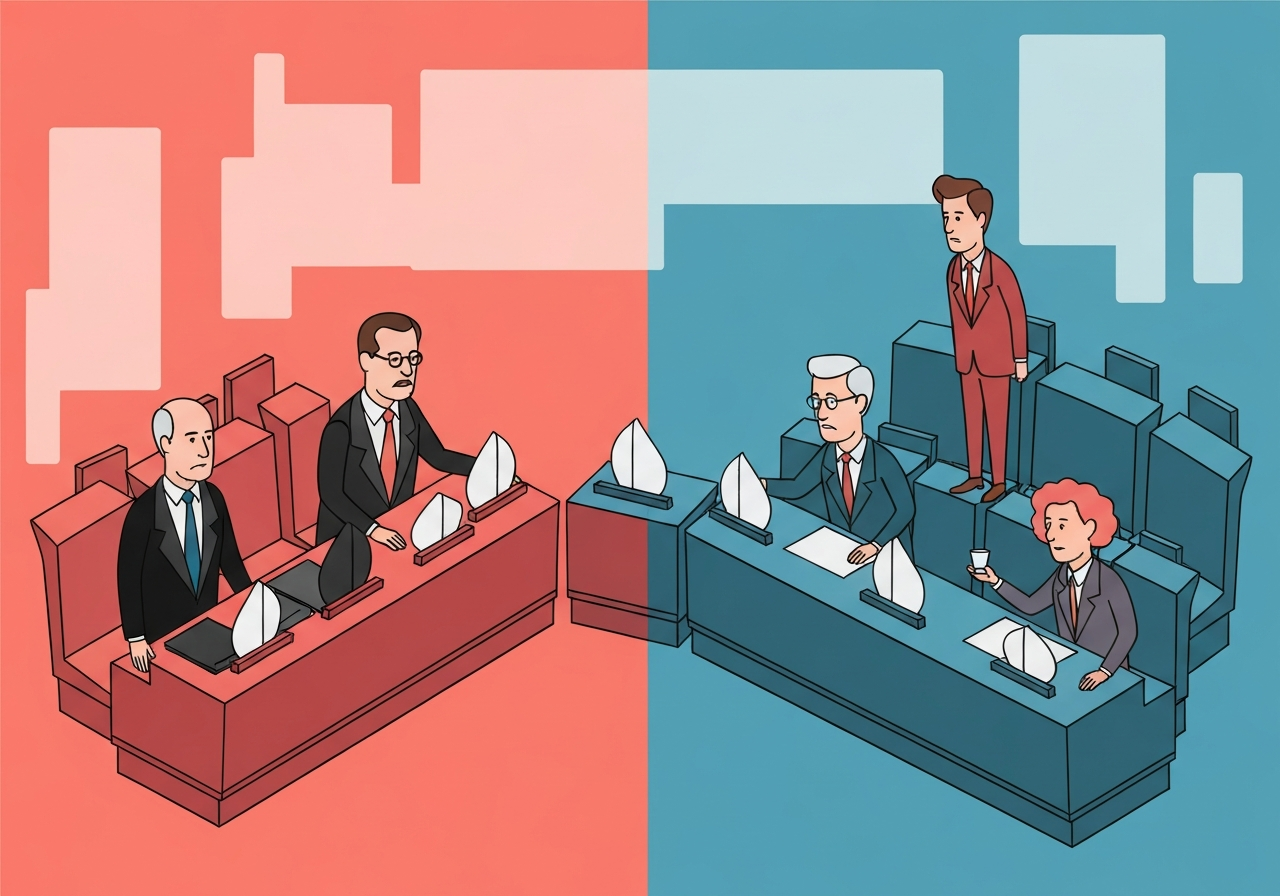
Lead: The Senate is set to hold a pivotal test vote on President Donald Trump’s SAVE America Act on Tuesday, a measure that would require proof of U.S. citizenship to cast a ballot in federal elections. If a simple majority of senators backs the motion, the chamber will open extended debate on the bill. Republican leaders have framed the test as a push for stricter voter ID and election integrity; Democrats and several civil-rights advocates contend it would suppress turnout among minority and low-income voters. The outcome will determine whether the legislation advances to days of floor debate and amendment fights.
Key Takeaways
- Senate Republicans hold a 53-seat majority and need a simple majority (51 votes) to begin further consideration of the SAVE America Act.
- The test vote is scheduled for 2:15 p.m. ET on Tuesday; Vice President J.D. Vance could be asked to break a tie if needed.
- The bill would require proof of U.S. citizenship for federal ballots and imposes photo ID standards that supporters call “strict.”
- Analysis by the National Conference of State Legislatures identifies up to 11 states with strict photo-ID rules: Arkansas, Georgia, Indiana, Kansas, Mississippi, North Carolina, Ohio, Tennessee, Wisconsin, Wyoming and (with narrow exceptions) Alabama.
- Several Republican senators remain undecided or reserved, including Sen. Thom Tillis and Sen. Mitch McConnell, meaning the GOP can only afford three defections.
- Democratic leaders have pledged to oppose the bill and, if necessary, use extended debate tactics; overcoming a filibuster would require 60 votes.
- President Trump has publicly threatened not to endorse lawmakers who vote against the measure, amplifying political stakes for vulnerable members of both parties.
Background
The SAVE America Act—championed by former President Donald Trump—would federalize a requirement that voters present proof of U.S. citizenship before voting in federal elections and set uniform photo ID standards. Supporters argue the law would standardize voter eligibility checks, prevent fraud, and bolster public confidence in election outcomes. Opponents counter that the proposal is unnecessary in most jurisdictions, could create new barriers to voting for elderly, low-income and minority citizens, and duplicate or conflict with existing state systems.
Voter identification has been a recurring flashpoint in U.S. politics since the 2000s, with Republican-led efforts often presented as anti-fraud measures and Democrats warning of disenfranchisement risks. Several states already enforce stringent ID rules at the polls; those state experiences are cited by both sides—Republicans as evidence the rules are workable, Democrats as instances of disparate impact. The bill arrives in a charged pre-election environment, and leadership decisions in both chambers will shape whether it becomes law or remains primarily a campaign issue.
Main Event
On the Senate floor, Majority Leader John Thune said Republicans would force a recorded test vote to put Democrats on the record, arguing the measure represents “common-sense” identification requirements for federal elections. Thune contrasted voting ID rules with everyday ID checks—boarding planes, renting cars, and entering some political events—to argue inconsistency in Democratic opposition. Several other Republican leaders, including House Speaker Mike Johnson, adopted similar framing ahead of the vote.
Not all Senate Republicans are fully behind the plan. Senators including Thom Tillis and Mitch McConnell have signaled reservations or remained publicly silent, complicating GOP calculations. Some Republicans have suggested procedural workarounds or parliamentary maneuvers, but party leaders acknowledge they lack the 60 votes needed to overcome a Democratic filibuster if Democrats choose that path.
Democrats and civil-rights advocates have mounted a sharp counterattack. House Democratic leadership and Senate Minority Leader Chuck Schumer have described the bill as an effort to shrink participation among communities of color; Rep. James Clyburn called it a return to discriminatory practices after Reconstruction. Democrats plan to use extended debate and amendments to highlight perceived flaws and potential harms if the legislation were enacted.
President Trump amplified the pressure on Republican members in public posts, warning of political retribution for lawmakers who oppose the measure and stressing the bill’s priority in his legislative agenda. Conservative allies and some GOP senators have said they will continue to press for passage, even as they acknowledge a difficult path to final enactment.
Analysis & Implications
Short term, the test vote is primarily procedural: a successful simple-majority vote allows hours or days of debate and amendment on the floor, but not final passage. For Republicans, staging the vote can be a political strategy to force Democrats to take public positions ahead of elections. For Democrats, insisting on robust debate can spotlight rights and access concerns and mobilize opposition.
Politically, the bill raises stakes for vulnerable senators in both parties. Republicans who oppose parts of the bill risk angering Trump’s base and conservative activists; Republicans who support it risk attack ads alleging voter suppression. The president’s public commitment to withhold endorsements escalates those intra-party dynamics by tying legislative votes to future campaign backing.
Legally and administratively, nationalizing proof-of-citizenship requirements would interact with a patchwork of state laws and voter-registration systems, creating the potential for litigation and implementation challenges. Courts have previously scrutinized voter-ID measures for disparate racial impact; the SAVE Act’s provisions could prompt a new round of lawsuits alleging violations of the Voting Rights Act or the Constitution, especially if states move quickly to change access rules.
Comparison & Data
| State | Photo ID Standard (per NCSL) |
|---|---|
| Arkansas | Strict photo ID |
| Georgia | Strict photo ID |
| Indiana | Strict photo ID |
| Kansas | Strict photo ID |
| Mississippi | Strict photo ID |
| North Carolina | Strict photo ID |
| Ohio | Strict photo ID |
| Tennessee | Strict photo ID |
| Wisconsin | Strict photo ID |
| Wyoming | Strict photo ID |
| Alabama | Strict rules with narrow exceptions |
Those state-level experiences show that strict photo-ID regimes can be implemented, but they also illustrate variation in administrative approaches, exceptions, and legal challenges. Where states provide free IDs, mobile ID units, or streamlined replacement processes, advocates say barriers can be reduced; where documentation requirements are rigid, critics contend turnout declines among marginalized groups. The federal bill would set a baseline but could produce uneven outcomes across counties and states depending on local resources and rules.
Reactions & Quotes
“They’ll simply continue their mindless, partisan opposition to common sense ID requirements for federal elections,”
Sen. John Thune (R-S.D.)
Thune used the Senate floor to contrast voting ID rules with everyday ID checks and pressed Democrats to explain their opposition in light of other routine identification requirements.
“It is nothing but a throwback to those laws that were passed after Reconstruction,”
Rep. James Clyburn (D-S.C.)
Clyburn, speaking to national media, argued the legislation would disproportionately affect African Americans’ political representation if enacted.
“I WILL NEVER (EVER!) ENDORSE ANYONE WHO VOTES AGAINST ‘SAVE AMERICA!!!'”
Former President Donald Trump (Truth Social)
Trump’s public post sharpened the political consequences for lawmakers weighing support or opposition; aides and strategists say the message increases pressure ahead of the test vote.
Unconfirmed
- Whether the bill, if enacted, would enable federal agencies such as ICE to remove eligible voters from rolls—supporters deny such an effect, while critics say it could be used to purge voters; the claim requires legal parsing and has not been established in court.
- The precise electoral effect on turnout and minority representation is debated; assertions that the SAVE Act would dramatically reduce specific demographic representation are projections, not confirmed outcomes.
- Reports that the bill would immediately be implemented nationwide without transitional or administrative issues are unproven; implementation timing and mechanics would vary by state and likely face legal challenges.
Bottom Line
The Tuesday test vote on the SAVE America Act is a consequential procedural moment rather than a final policy decision: a simple-majority vote would open prolonged floor action, amendments and public scrutiny. For Republicans, the opportunity is both legislative and political—forcing votes that highlight differences with Democrats ahead of fall elections. For Democrats and voting-rights advocates, the debate is a mobilization point to frame the bill as restrictive and potentially discriminatory.
Even with a successful initial vote, the bill faces significant hurdles to becoming law: GOP unity is incomplete, the filibuster remains a structural barrier without 60 votes to cut off debate, and legal challenges could follow any enactment. Observers should watch which senators break with party leadership, how states would implement new citizenship-document rules, and whether courts ultimately shape the law’s fate.
Sources
- Fox News Live Coverage — media live reporting and floor quotes
- National Conference of State Legislatures (NCSL) — nonpartisan policy analysis on state voter ID requirements